ALIEF ISD finance team outlines budget pressures, school-funding shortfalls and pending state bills
Loading...
Summary
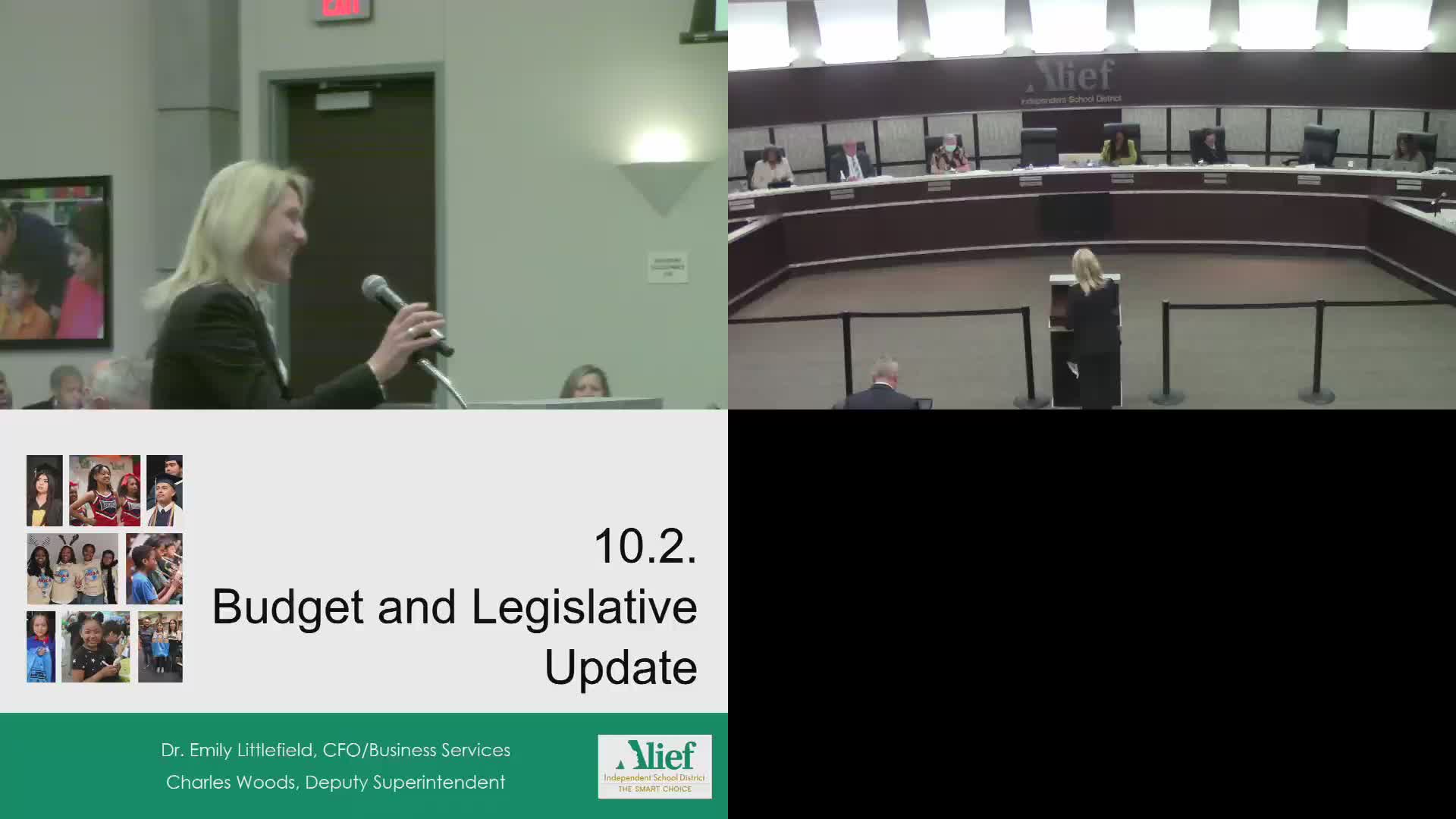
CFO Emily Littlefield and Deputy Charles Woods briefed trustees on district funding gaps — notably transportation and safety allotments — budget drivers for 2025–26 and state legislation (House Bill 2 and House Bill 3) that could affect district revenue and obligations.
ALIEF ISD officials told the board on March 18 that multiple state funding allotments do not cover the district’s actual costs and that pending state legislation could materially affect the district’s fiscal outlook.
Emily Littlefield, chief financial officer, led a presentation on Texas school funding mechanics and district budget development. Littlefield said the district uses 2023–24 final data as the basis for current allotment calculations and reminded trustees that the district must adopt a balanced budget by law in August.
On specific allotments, Littlefield said the district’s transportation allotment for 2023–24 was “almost $2.8 million” while the actual cost of transportation was about $24 million. She summarized that transportation reimbursement largely covers miles traveled for students’ to-and-from-school trips and does not include extracurricular mileage, and she said ALIEF faces a shortfall on transportation “on the order of $21.3 million.”
Littlefield reported the safety allotment at about $1,031,610 and said the district spends roughly $8.1 million on safety and policing, leaving a shortfall she described as approximately $7 million. She noted statutory and programmatic requirements — for example, the presence of school officers at campuses — which drive safety-related spending.
Littlefield also described the early-education allotment (a component that targets K–3 attendance and funding for disadvantaged and limited-English students) and the gifted-and-talented allotment (calculated as basic allotment × 0.07 × ADA but capped at 5% of ADA), both of which must be spent on the programs to which they are targeted and which Littlefield said are not fully resourced by state funding.
Turning to budget priorities and projections for 2025–26, Littlefield said 88% of the district’s budget is for salaries. The draft includes a 3% midpoint adjustment previously adopted by the board that would cost roughly $9 million; the budget also anticipates the second installment of teacher signing bonuses, reductions tied to declining enrollment, and the return of some positions formerly funded by federal grants into the general operating fund. Littlefield noted ongoing adjustments and that these staffing projections are preliminary.
Deputy superintendent Charles Woods gave a legislative update and focused on several bills that could affect funding. He said House Bill 2 (the chamber-level school-finance bill at the time of the briefing) would spend approximately $3.2 billion to increase the basic allotment by $220 per student and include targeted increases such as roughly $1.8 billion for special education and additional compensation allotments. Woods warned, however, that hold-harmless provisions and prior yield changes in law could offset or delay a district’s net gain from any basic-allotment increase. He described proposed changes that would direct a portion of any increase to staff raises and impose reporting and implementation requirements that could carry administrative cost.
Woods also addressed House Bill 3, a proposed Education Savings Account (ESA) voucher bill. He cited the Legislative Budget Board’s fiscal note estimating ESA costs could reach $7 billion by the second biennium — funds that Woods said would be diverted from the state’s overall education budget. He said an ESA of that size would reduce money otherwise available to public schools, and stressed uncertainty around federal funding flows (including changes to Medicaid/SHARS reimbursements) that already complicate revenue projections.
Trustees asked how the district plans to cover the transportation and safety shortfalls. Littlefield and Woods responded that those mandates are met by using available district funds and reallocating among allotments where legally permissible; Woods noted that some proposed allotment changes in the legislature are helpful but will not fully close the gap. Trustees also asked about staffing ratios, calendar and professional-development scheduling, and the possible local impact of federal funding changes.
Littlefield and Woods said they will continue to refine revenue assumptions as the legislative session progresses and as federal funding signals emerge, and that administration plans to return with further budget details during upcoming budget-development meetings. Littlefield reminded the board that the district’s budget process will continue through the spring and that the legally required adoption date is in August.
The board engaged in extended Q&A about special education, staffing, and the mechanics of state allotments; administration said additional staffing detail and updates would be provided at the board retreat and in upcoming presentations.