Get Full Government Meeting Transcripts, Videos, & Alerts Forever!
Get email alerts on the Special Education topic
No spam. Unsubscribe anytime.
ALIEF ISD reports special education enrollment rise, compliance work and dyslexia updates
Summary
District special education leaders reported increased special‑education identification, timeliness concerns on initial evaluations and steps to meet state performance requirements. The district reported 6,597 students receiving special‑education services (17% of enrollment) and a corrective action plan to improve timely evaluations under SPP‑11.
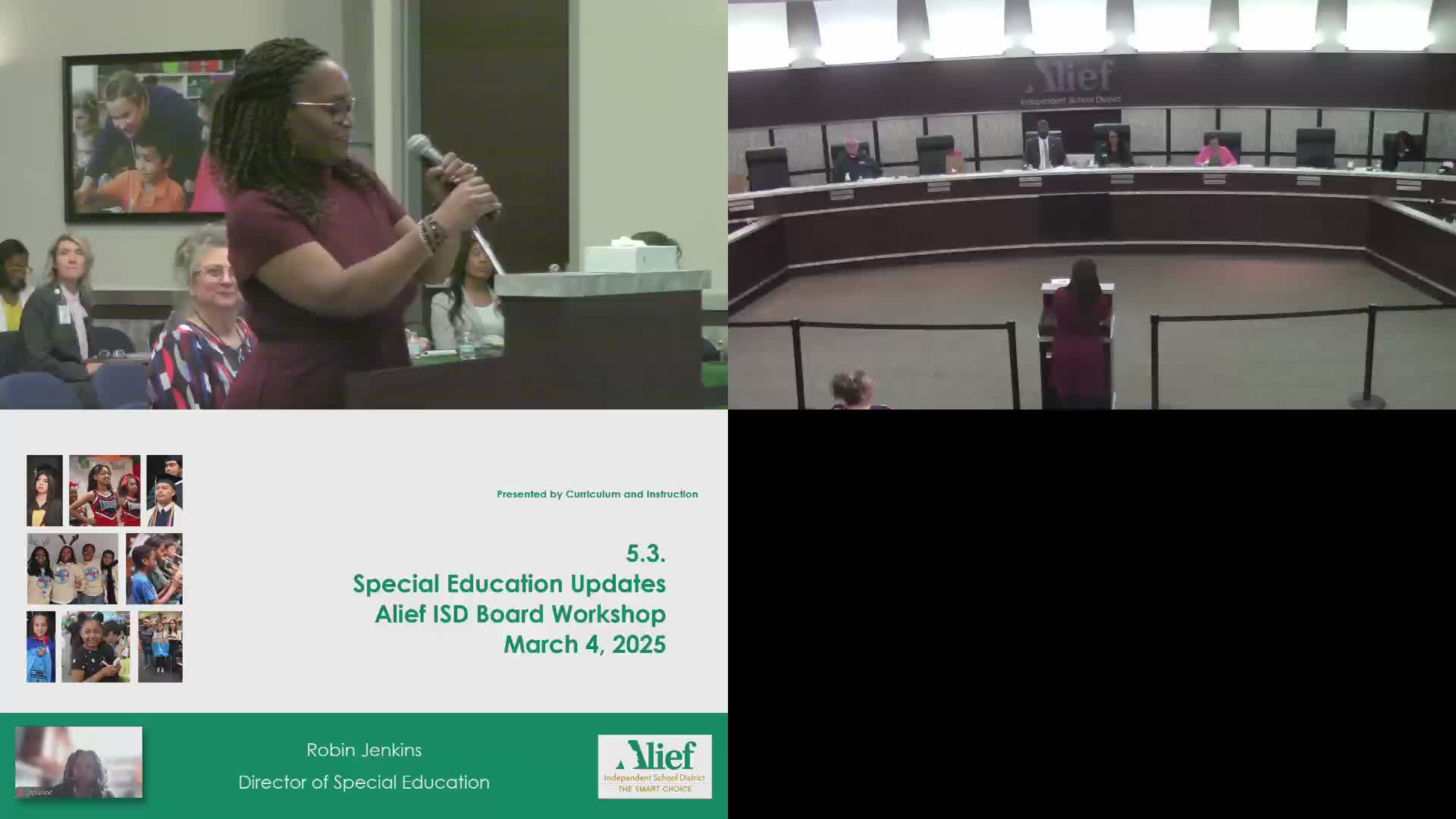
ALIEF ISD special education leaders reported to the board March 4 that the number of students receiving special‑education services has increased and that the department is taking steps to improve compliance with state timelines and program outcomes.
"We have 6,597 students who receive special education services," Robin Jenkins, director of special education, told the board, saying that figure equals about 17% of district students. Jenkins presented child‑find data showing 1,364 initial evaluations completed so far this school year (845 completed, 519 in process) compared with 1,883 completed last year. "We are not attempting to surpass that number. We are doing a very good job with our RTI teams of looking at multiple sources of data," Jenkins said.
Jenkins said the district has been at 98% timely completion on SPP‑11 (the state performance plan indicator for initial evaluation timelines) for the past two years but must reach 100% to meet the indicator. The department has prepared a corrective action plan to reduce missed timelines — from 54 untimely initial evaluations to 10 or fewer — and to lower the number of initial admission, review and dismissal (ARD) meetings held outside the required schedule. Jenkins said principals and evaluation teams are being engaged to improve scheduling and compliance.
The presentation covered state policy changes Jenkins referenced as "House Bill 39 28" (transcribed at the meeting) and the requirement that students receiving dyslexia reading interventions under Section 504 who continue to need intensive, evidence‑based dyslexia instruction be referred for a full individual evaluation under IDEA. Jenkins said the district has trained staff: "We are very proud of the number of special education teachers that we have trained over the last 3 years. We have 19 special education teachers who are trained in providing evidence‑based dyslexia instruction."
Jenkins reviewed the district’s Result‑Driven Accountability (RDA) status, telling trustees the district has remained at Determination Level 2, an improvement from Determination Level 4 in 2021. Jenkins also shared outcome measures: in some exit and end‑of‑course measures (biology, U.S. history) the district’s special‑education cohorts reached performance levels the state defines as stronger; in other areas, notably 3–8 reading and math, the district seeks to improve performance by better ensuring accommodations and instruction are provided.
Board members asked about the structure of dyslexia support across grade bands and transition services for high‑school students. Jenkins and her staff said elementary students needing evidence‑based dyslexia instruction typically receive 30 minutes of targeted pull‑out instruction four days per week, while secondary students may receive fewer pull‑out minutes and more in‑class support; the district will host a March 22 transition fair for ages 3–21 to connect families with colleges, vendors and other supports.
Ending: Jenkins said the department will continue self‑monitoring and campus support to meet corrective targets and to improve outcomes for students receiving special‑education services.