Get Full Government Meeting Transcripts, Videos, & Alerts Forever!
Get email alerts on the Gifted And Advanced Academics topic
No spam. Unsubscribe anytime.
Katy ISD reports roughly 9% of students in GT services; AP and dual-credit enrollment growing
Summary
Director Danielle Sanchez told the board that Katy ISD serves about 8,882 students through gifted-and-talented programming (roughly 9%), highlighted AP and dual-credit growth and described GT facilitator roles and program models.
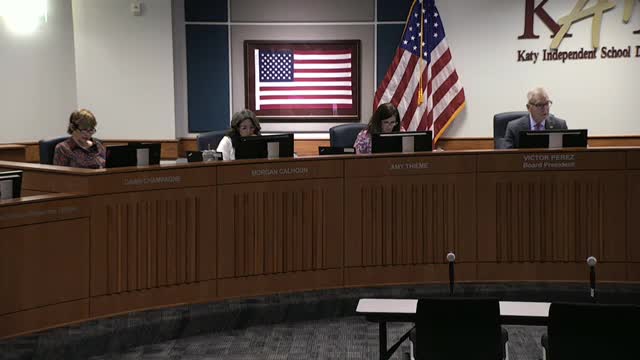
Danielle Sanchez, director of Gifted and Talented and Advanced Academics, presented an overview of Katy ISD’s GT services, AP program and dual-credit partnerships at the April 22 board meeting.
Sanchez said Katy ISD currently serves 8,882 students through GT programming, representing roughly 9% of district enrollment. GT screening and identification follow the Texas State Plan for the Education of Gifted and Talented Students, Sanchez said; elementary students with five or more positive measures and secondary students with three or more positive measures are identified for GT services.
Elementary GT students participate in a full-day “Challenge” pull-out model with a five-year curriculum cycle and a culminating GT Expo. At the secondary level, GT students are clustered in CAP or APGT courses taught by teachers who have the state-required GT training (an initial 30 hours and a 6-hour annual update). Each secondary campus has a GT facilitator responsible for compliance and advocacy; facilitators monitor grades for GT students, coordinate interventions and host workshops such as time-management sessions.
Sanchez reported that more than 12,000 high-school students are enrolled in at least one AP course for the 2024–25 school year and that AP exam participation is sizable (the presentation cited 21,000 AP exams taken in the 2023–24 cycle). Katy ISD had 178 AP Capstone diploma recipients in the class of 2024. The district also partners with Houston Community College (HCC) for dual-credit courses; Katy ISD offers 45 dual-credit courses beginning in ninth grade and, in 2023–24, students completed more than 16,000 college credit hours through dual-credit coursework.
Sanchez said Katy ISD has strategically used ESSER funding to upskill teachers to serve as embedded dual-credit instructors; embedded faculty have at least 18 hours of graduate work and are employed by both HCC and Katy ISD. Currently more than 2,000 students are enrolled in at least one dual-credit course. She said dual-credit pathways also support career and technical education programs that allow students to earn career credentials or an associate degree while in high school.
Trustees asked clarifying questions. Trustee Miss Champagne asked whether students can test for GT beyond fifth grade; Sanchez said the state allows testing through 11th grade. Trustees also asked about numbers of HCC professors versus embedded Katy ISD instructors for dual credit; Sanchez said most dual-credit sections are taught by embedded Katy ISD faculty and that the district has encouraged teachers to pursue the necessary graduate credentials, though ESSER funding that previously supported that upskilling is no longer available.
Sanchez concluded by noting GT participation across demographics (14% of GT students are emerging bilingual, 3% receive special education services, 4% served through Section 504 and 14% are economically disadvantaged) and said she welcomed trustee questions.