Get Full Government Meeting Transcripts, Videos, & Alerts Forever!
Get email alerts on the Water Quality topic
No spam. Unsubscribe anytime.
Hastings official warns nitrate, uranium legacy will cost future generations; urges continued ASR and research
Summary
Retiring water official Marty Stange told the Hastings Utilities Board that long-running nitrate contamination — and a linked rise in mobilized uranium — has already closed wells, driven multi‑million dollar remediation costs, and will require sustained technical, financial and regulatory work to protect public health and water supplies.
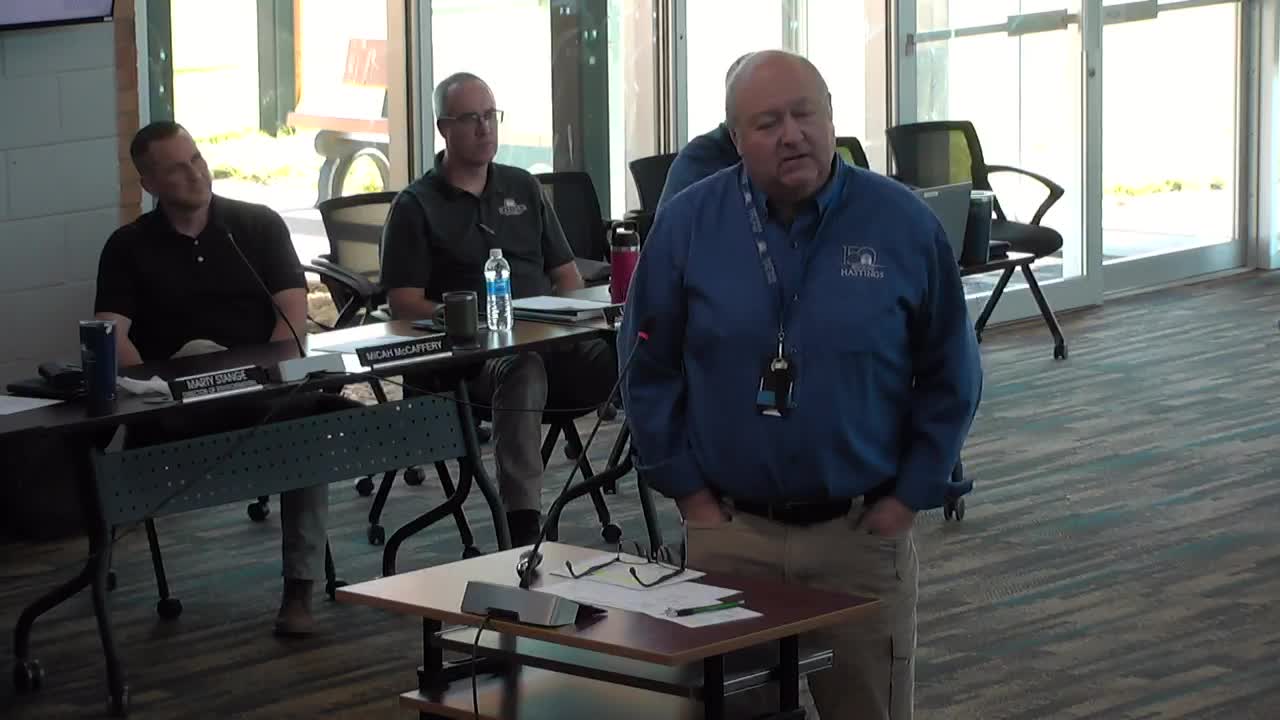
Marty Stange, a long‑time water department official who told the board he will retire after the meeting, gave a wide‑ranging technical and policy briefing May 8 on nitrate contamination, related uranium mobilization and short‑ and long‑term responses.
Stange told the Hastings Utilities Board that nitrates in the area are a multi‑decade legacy tied to fertilizer use, irrigation and other sources, and that half of the city’s groundwater recharge “comes from the Platte River” and can take roughly 30 years to reach local wells. He said the city’s testing program extended beyond the 75‑square‑mile well‑protection area to about 200 square miles and that the utility has shut down eight wells because of contamination.
The presentation laid out why the issue matters locally and for public health: Stange quoted the nitrate regulatory threshold used in the analysis, saying “with an MCL of 10 parts per million, we were 7 and a half times that,” and told the board his team also found elevated uranium, which he described as “10 times the MCL, so it’s at 300” (transcript figures reported by Stange). He warned that nitrates can cause methemoglobinemia in infants (“blue baby syndrome”) and said recent research suggests adults and additional health risks may be associated with long‑term nitrate exposure.
On responses, Stange characterized the city’s aquifer storage and recovery (ASR) effort as the short‑term plan to preserve potable water while longer‑term best management practices are developed. He summarized the program’s costs and alternatives discussed with the board: ASR had been projected at about $46 million, the city had spent roughly $15 million to date, and a conventional water‑treatment plant had been estimated at about $72 million in earlier studies. Stange said the utility received a DNR grant and other low‑interest support but that continued study and funding would be required.
Stange emphasized source control and behavioral change as essential to any long‑term solution: “Who pays for the cleanup, the cleaning up of the nitrate legacy,” he asked, calling it “a debt and it’s a future cost” if left unresolved. He described a five‑pronged short‑term plan (dual pumping, focused treatment, aquifer storage, irrigation management and blending/storage) and urged the board to keep ASR operating and to support staff participation at NRD and university meetings to sustain research and interagency coordination.
Board members and staff pressed him on implementation and near‑term steps. Derek (staff) thanked Stange for the briefing and said it showed the utility is taking steps to provide safe water; one board member asked for the most impactful short‑term actions, to which Stange replied: “Make sure that you keep that ASR operating fully.” Stange also recommended continued staffing to attend NRD, UNL and other interagency meetings and to keep funding for monitoring and mitigation work.
Stange repeatedly framed the problem as regional and slow‑moving: because groundwater travel times are measured in decades, he warned that stopping new inputs today would not quickly eliminate the legacy nitrate load. He described examples of isotope and soil testing done with the University of Nebraska–Lincoln and others to distinguish fertilizer‑derived nitrates from animal‑waste signatures and said some farms and feedlot operators have already changed practices after review of monitoring results.
In concluding remarks Stange urged the board and staff to continue supporting research and education: “Protecting drinking water is everyone’s responsibility,” he said, and pledged to keep working on outreach after he leaves the city role.
The presentation was discussion only; the board did not take a formal vote on new policy at the meeting. Board members thanked Stange for decades of service and asked staff to carry forward his recommended steps to sustain ASR operations, interagency collaboration and public education.