Get Full Government Meeting Transcripts, Videos, & Alerts Forever!
Get email alerts on the Fire Department Ems topic
No spam. Unsubscribe anytime.
Fire department highlights EMS growth, seeks flat FY26 budget while pressing recruitment and technology gains
Summary
Chief Sweat told the City Council budget committee that EMS calls now make up about 86% of the department’s call volume and outlined steps to shorten recruit training, add telematics and monitor overtime. The fire department proposed a mostly flat FY26 budget while warning that recruitment and retention remain the largest risks.
Chief Sweat, the Fire Department’s top official, told the Memphis City Council budget committee on May 12 that emergency medical service demand continues to climb and that the department’s FY26 proposal emphasizes recruiting, training and technology to manage overtime and response capacity.
“Everything we do, that’s our core,” Chief Sweat said, describing the department’s mission to deliver timely emergency response and prevention work.
Why it matters: Fire and EMS operations are largely people‑driven and absorb a high share of the department’s operating budget. The committee’s questions focused on the changing mix of calls (a rising share of EMS), recruit training time and whether shifting deployment toward more ambulances could reduce overtime and better align resources with demand.
Fire officials presented a total complement of 1,860 positions with the bulk of active response personnel (EMS and suppression) comprising roughly 1,668 positions. Chief Sweat said the department had about 24 suppression vacancies that will be filled by a class scheduled to start in August and described administrative, logistics and communications vacancies and their status.
The department’s FY26 personnel budget request increased modestly; overall the requested budget is close to the adopted FY25 total with an approximate net change driven by personnel and material supply line moves. Chief Sweat said revenues are expected to be higher next year — largely from EMS billing and reimbursements from deployments — which will offset some of the pressure on the operating budget.
On EMS trends, fire staff presented that EMS calls now form an outsized share of activity (about 86% of call volume in their slide set). They noted that about 22% of EMS calls in a recent period were coded “non‑emergent” and said the department is exploring ways to reduce non‑emergent transports and to deploy the right resource for the right call.
To reduce training time and speed recruits to the street, the fire department described restructuring its academy and prioritizing recruitment of candidates who already hold EMT certification. Chief Sweat said that by adjusting training and accepting EMT‑certified hires the department shortens time in formal academy instruction and reduces overtime pressure while recruits complete field onboarding.
Technology and productivity measures the department described included telematics on apparatus to monitor vehicle health and driver behavior, an upgraded pre‑incident planning and public‑education system, stronger quality‑assurance review of 911/EMD calls for proper documentation and billing, and pilot programs intended to improve visibility in interior firefighting operations. Chief Sweat pointed to ISO‑1 accreditation and said the department is using data dashboards to monitor overtime every pay period.
Council members asked whether the city should consider more ambulances or different apparatus mixes. Chief Sweat said staffing and national standards factor into the deployment mix — NFPA and ISO guidelines shape minimum staffing levels and first‑alarm feeds — and that many engines and trucks carry paramedics so an engine response often brings medically capable personnel to the scene faster than waiting on an ambulance if an ambulance is farther away.
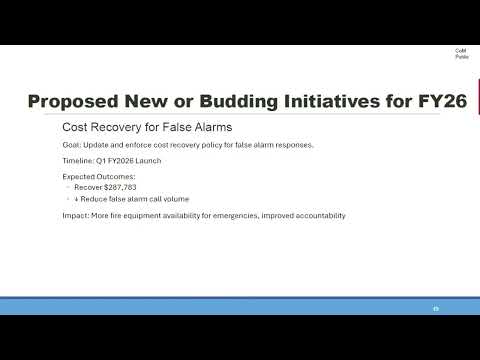
The committee also discussed false‑alarm enforcement and revenue recovery; Chief Sweat said the department is working with Metro Alarm and that revenue recovery and permit enforcement have opportunities for improvement. The committee did not adopt any ordinance changes during this hearing; staff signaled they will return with further proposals if warranted.