Get Full Government Meeting Transcripts, Videos, & Alerts Forever!
Get email alerts on the Transit topic
No spam. Unsubscribe anytime.
Bexley council tables vote on LinkUS bus rapid transit stop after public safety and design concerns
Summary
Councilmember Liz Lamke introduced a resolution supporting a proposed LinkUS median station near Pleasant Ridge; after public comments—particularly from Christ Lutheran Church—and questions about parking, traffic, curb and tree impacts, council voted unanimously to table the measure for further review and outreach.
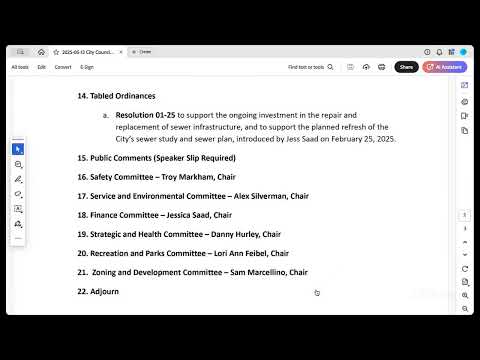
Bexley City Council on Tuesday paused a vote on a resolution supporting the LinkUS bus rapid transit (BRT) stop on Main Street west of Pleasant Ridge Avenue, choosing instead to table the matter and gather more information after public comment and council questions.
Councilmember Liz Lamke, sponsor of Resolution 02‑25, said the council working group asked for a legislative vehicle to solicit public comment and give council time to consider feedback. Lamke said the council received additional survey responses and that COTA (Central Ohio Transit Authority) had provided design and ridership data for review.
During public comment, Kathy Schroer, president of Christ Lutheran Church at 2314 E. Main Street, urged council to postpone approval until full design plans are available. Schroer said the proposed station “would sit directly across the street from our playground, our open yard, and the entrance to the children’s center” and that the location “invites trouble and is an unnecessary risk.” She asked for detailed engineering plans showing curb, sidewalk and tree impacts and asked whether the church and other affected properties would have input.
Residents raised related concerns about congestion, cut‑through traffic and parking on adjacent side streets. Robbie Farquhar, a lifelong resident, asked council to consider riders east of Bexley and whether the stop’s placement could be shifted to better share benefits with neighboring areas.
COTA representatives presented local usage data to the meeting. Kelsey Ellingson, COTA’s local government affairs director, said that at the existing stop near the proposed location, 94 percent of riders walked to the stop and 35 percent were students; she said 23.5 percent used the stop to shop or dine and that only about 6 percent were dropped off by car. Ellingson and city staff said COTA expects the LinkUS premium service to require fewer on‑street buses (moving from four conventional buses per hour to four rapid buses plus a slower route), and that BRT vehicles use signal priority technology to reduce dwell time and congestion.
Mayor Ben Kessler told council the project’s construction and vehicle costs are borne by COTA and the levy that funded LinkUS, with supplemental federal dollars; he said the city might choose to contribute for streetscape enhancements but that transit operating and station costs are not a direct city capital burden. Chief Lewis said Bexley Police would assist with safety audits and that COTA has a dedicated safety and security staff; the chief said he had “no concerns” based on the information he reviewed and offered to work with businesses and institutions to identify risk mitigation steps for stations.
After about an hour of council discussion and public testimony, Lamke moved to table the resolution until the council’s May 27 meeting to give members time to review the latest survey results and to meet with COTA and potentially affected institutions. Councilmember Marcelino seconded the motion; the roll call was unanimous. City staff said additional engineering details and a compiled set of survey responses will be provided to council and posted on the city website.
No final station location or binding right‑of‑way agreement was approved at the meeting; the mayor said the administration will continue negotiating with COTA and will return to council for further approvals if needed.