Get Full Government Meeting Transcripts, Videos, & Alerts Forever!
Get email alerts on the Criminal Justice Defense Contracts topic
No spam. Unsubscribe anytime.
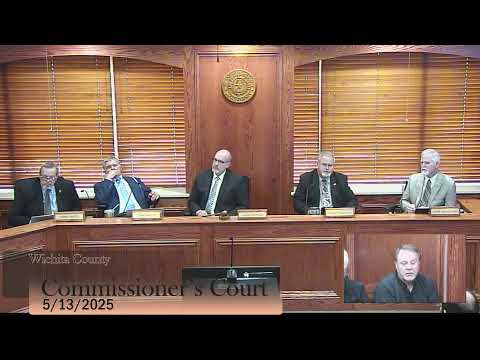
Wichita County Commissioners vote to end contract with Regional Capital Public Defender’s Office
Summary
The Wichita County Commissioner's Court voted 5-0 May 13 to withdraw from its contract with the Regional Capital Public Defender’s Office, after county legal staff said the price rose sharply and the contract now contains an opt‑out provision that undercuts its value.
WICHITA COUNTY, Texas — Wichita County’s Commissioner's Court voted 5-0 Tuesday to withdraw from its contract with the Regional Capital Public Defender’s Office, with county counsel and other officials warning the agreement no longer provides the protections it once did.
The decision came after a lengthy discussion in which a county attorney explained that the annual cost of the contract had climbed from a nominal amount when it began to roughly the mid‑tens of thousands of dollars now, and that new contract language gives the provider broad discretion to refuse coverage in future capital cases.
“This is best thought of as insurance,” the county attorney said during the meeting, adding that “they basically installed a preexisting condition type of term that allows them to essentially opt out of anything that they want.” He said the county currently pays about $73,000 per year for the contract and that the office’s caseload and the contract terms have changed since the county first signed on.
Why it matters: County officials said the contract originally reduced the county’s exposure if the state pursued the death penalty — a rare but very expensive possibility. With the provider’s new opt‑out provision and the steep price increase, county legal staff argued the contract no longer gives reliable protection. The court approved a notice of non‑renewal to take effect at the contract’s conclusion.
County staff described alternatives. The county attorney said that if the state pursues the death penalty in a future case and the contract is not renewed, he would likely return to the court to request funds to hire a second‑chair attorney with capital‑case experience; he estimated that could cost in the range of tens of thousands of dollars for a single case. “I would suspect it would be on the top end about $50,000,” he said when asked to estimate second‑chair costs.
Court members asked about frequency and risk. The attorney said Wichita County currently fields a number of serious felony cases that could, in some circumstances, be treated as capital matters and emphasized the workload that would fall on local lawyers if the county had to mount its own capital defense: “It is likely going to monopolize my personal time for six months to a year and several of my staff’s time,” he said.
Motion and outcome: The court approved a motion to withdraw from the regional capital public defender program at the end of the current contract; the motion passed unanimously, 5‑0. County staff said they have a letter drafted to begin the formal nonrenewal notification and that the contract includes an approximately 180‑day notice window.
What comes next: Officials said they will not immediately set aside a dedicated escrow for capital defense but will rely on existing budgetary contingencies and, if necessary, return to the court for case‑specific funding requests. The county attorney said he is exploring options to share experienced capital counsel with neighboring jurisdictions rather than paying the full cost of a private second chair.
The court’s vote closed the item; no immediate budget adjustment was approved as part of this action.