Get Full Government Meeting Transcripts, Videos, & Alerts Forever!
Get email alerts on the Arts And Culture topic
No spam. Unsubscribe anytime.
Odessa Arts tells council cultural tourism supports $33.5 million in annual economic activity; urges renewed percent‑for‑art discussion
Summary
Odessa Arts briefed the City Council on its hotel‑occupancy-tax subgrant program, saying arts and culture contribute $33,500,000 a year to the local economy, and urged the council to reopen discussion about a revised 1% capital‑project percent‑for‑art ordinance that was adopted in 2020 and later rescinded.
Odessa Arts told the City Council that its cultural tourism grant program and public‑art work produce $33,500,000 in annual economic activity for Odessa and Ector County and asked the council to reopen discussion about a revised percent‑for‑art funding mechanism.
The figure came from an economic impact survey Odessa Arts completed this year, which the presenter said surveyed about 800 audience members and 19 of 20 local cultural organizations. "We found out that arts and culture contribute $33,500,000 to the local economy every single year," the presenter said.
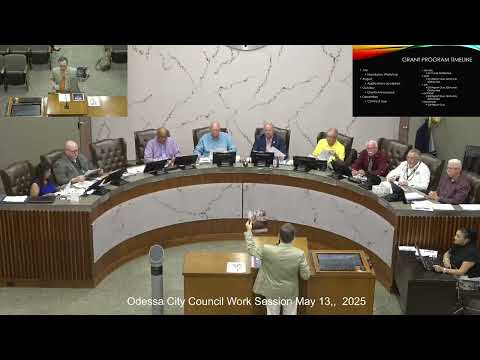
Odessa Arts staff emphasized the city’s hotel‑occupancy‑tax (HOT) role in funding cultural tourism and described the agency’s grant timeline and oversight. The grants program, the presenter said, awards roughly 10–15 organizations about $200,000 total a year; applications open in August for the following calendar year, awards are announced in October, contracts are due in December, and the first quarterly payment is cut on Jan. 1. Grantees submit quarterly hotel‑impact and cultural‑impact reports; Odessa Arts follows up every 90 days to monitor attendance and hotel impact.
"We give out about $200,000 in grants each year," the presenter said, adding that Odessa Arts provides marketing and logistical assistance to grantees and seeks to maximize hotel impact by means such as a free quarterly arts magazine distributed to every hotel in Odessa.
Council members asked for context about the $33.5 million number. The presenter said Odessa Arts conducted a previous, smaller survey in February 2019 that showed just under $10 million in economic activity and that the organization aims to repeat the survey every five years.
The presenter also reviewed the city’s public art work and a past percent‑for‑art mechanism. "One of the recommendations from this public art plan in terms of funding mechanism is called a percent for art ordinance... That 1% was adopted back in 2020," the presenter said, and described how the 1% was applied to capital projects and earmarked to the specific building or project. He said the ordinance was later rescinded and that shortcomings in the prior ordinance included lack of mandatory spending clarity and no maintenance mechanism for interactive artworks.
Speakers and council members discussed fiscal concerns tied to very large capital projects and said a rewritten ordinance could include flexibility and maintenance provisions. The presenter said he and city staff have reviewed ordinances in other Texas cities and are willing to draft alternatives to address those concerns.
The presenter described Odessa Arts as the city’s local arts agency since the late 1970s and said the organization also curates the city public art program and produces events such as the Odessa Shakespeare Festival. He said Odessa Arts staff currently includes himself, an office manager and an intern, and that the agency works with hotels, museums and performance groups across Odessa and Ector County.
The presenter invited council questions and said Odessa Arts views the city’s funding as an investment rather than a handout. Council members asked for follow‑up conversations about a revised percent‑for‑art ordinance and for more detail on the grant evaluation process.