Get Full Government Meeting Transcripts, Videos, & Alerts Forever!
Get email alerts on the Signs topic
No spam. Unsubscribe anytime.
Commissioners favor 100‑nit nighttime cap for electronic message signs in commercial and industrial districts
Summary
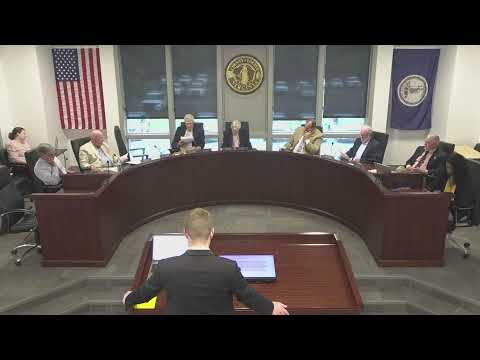
After a lengthy discussion of measurement methods and enforcement, Louisa County planning commissioners indicated a preference for an electronic message‑sign standard that would cap nighttime brightness at 100 nits in specified nonresidential districts and require administrative review or special exceptions for uses in other zones.
Louisa County planning commissioners discussed several measurement and enforcement options for electronic message signs during the May work session and signaled support for a modest nighttime brightness cap and selected zoning coverage.
Planning staff told commissioners they investigated measurement methods and recommended using luminance measured in nits (candelas per square meter), a method used by Fairfax County and recommended by the International Sign Association, because it can be measured at any time of day and simplifies field enforcement. "Nits can be measured daytime or nighttime," staff said, noting that a handheld meter can take readings close to a sign without requiring enforcement officers to wait until after sunset.
Commissioners debated numeric limits and enforcement details. Several commissioners favored a lower nighttime cap appropriate for a rural county; Commissioner Dickerson and others said a 100‑nit limit at night would be reasonable for Louisa, while Fairfax had adopted a 300‑nit standard for some contexts. Commissioners also discussed whether to include a cutoff time (a period when signs must be turned off) or allow signs to remain on at a reduced level; opinions varied. Staff said the draft options include either a cutoff time (for example, 10 p.m. to sunrise) or a single cap that would apply after sunset.
On zoning, commissioners agreed the administrative option should apply to commercial and industrial districts but not to agricultural or residential districts. Under the preferred approach, electronic message signs would be allowed administratively in C‑1, C‑2, IND, I‑1, I‑2, RD and PUD zones; agricultural (A) and residential (R) districts would be excluded and could seek a special exception from the Board of Supervisors.
Commissioners also discussed exemptions for churches and schools, with staff explaining that if a district (A or R) excludes electronic message signs, an applicant could still seek a special exception. Commissioners noted enforcement dynamics — for example, many businesses would likely switch signs off overnight to save costs — and suggested allowing exceptions for businesses that can show a commercial need (such as 24‑hour operations).
No ordinance text was adopted at the work session; staff asked the commission to select preferred options for a draft ordinance. The commission generally favored a 100‑nit nighttime cap for Louisa County and administrative review in the named nonresidential districts, and asked staff to incorporate that preference into the next draft for formal review and public hearing.