Get Full Government Meeting Transcripts, Videos, & Alerts Forever!
Get email alerts on the Land Development Regulations topic
No spam. Unsubscribe anytime.
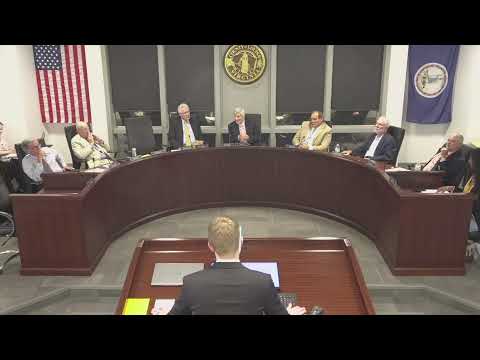
Planning commission recommends approval of phase‑3 land development amendments, tightens nighttime digital‑sign rules
Summary
The Louisa County Planning Commission voted to recommend approval of Phase 3 amendments to Chapter 86, the county's land development regulations, and adopted tighter restrictions on electronic message signs including a 20‑second minimum static display time and a prohibition on animation.
The Louisa County Planning Commission voted to recommend approval of proposed Phase 3 amendments to Chapter 86, the county Land Development Regulations, with changes discussed at the public hearing. The commission—s vote moves the package to the Board of Supervisors for consideration.
Staff presented multiple text changes that span definitions, subdivision standards, private lanes, utilities and signs. Miss Buckler, staff member, summarized the package and the principal edits, including adding surveyor as an acceptable third‑party reviewer and requiring a performance agreement in addition to interim road‑maintenance agreements for subdivisions.
On signage, the commission focused on electronic message signs. Staff presented three options and a handout; commissioners discussed brightness, message change frequency, animation and exemptions. Commissioners agreed to tighten the nighttime brightness and message‑change rules. The planning commission directed language that messages be static for a minimum of 20 seconds and “with no animation, videos, flashing, or scrolling text.” As Commissioner Dickerson phrased the intent during final wording, staff later recorded the text as: “Messages must be static for 20 seconds or longer, with no animation, videos, flashing, or scrolling text.”
The package also includes: a new sentence requiring vegetative buffers that meet criteria to be shown on a plan prepared by a certified landscape architect, surveyor, engineer, or other qualified licensed professional; striking the word “only” where private lanes serve fewer than three lots; a limit to private lanes within subdivisions to a maximum of two; a requirement that private road disclosure language be included on subdivision plats; and a provision that hydrants and restroom facilities in common areas will be required only if mandated by the Department of Fire and EMS or the Virginia Department of Health and coordinated with Dominion Energy when necessary.
Telecommunications provisions were revised to allow on-site backup generators operated only during outages or testing, and to require additional structural reports and analysis for co‑location applications as recommended by the county—s telecommunications consultant. For electronic signs, staff noted a proposed nighttime maximum of 100 nits between sunset and sunrise as set by the National Oceanic and Atmospheric Administration; the commission discussed implementation and legacy‑sign nonconformities and allowed limited grandfathering for older signs unable to meet new technical requirements.
After discussion and minor language clarifications (including an explicit carve‑out that a sign solely displaying time, date or temperature is exempt from the animation prohibition), Commissioner Gutter moved to recommend approval by the Board of Supervisors of the proposed Phase 3 amendments “with the changes that have been discussed agreed upon tonight.” The motion passed on roll call.
The commission also asked staff to clarify remaining drafting points and to reconcile handout tables with ordinance text prior to Board review. No members of the public testified at the public hearing.
Ending: The commission—s recommendation will be transmitted to the Board of Supervisors; staff will finalize ordinance text, confirm the numeric brightness and timing language, and note conforming/nonconforming sign implementation details for the board packet.