
Seal Beach council opens Prop 218 proceedings to consider major water and sewer rate hikes
Get AI-powered insights, summaries, and transcripts
Sign Up Free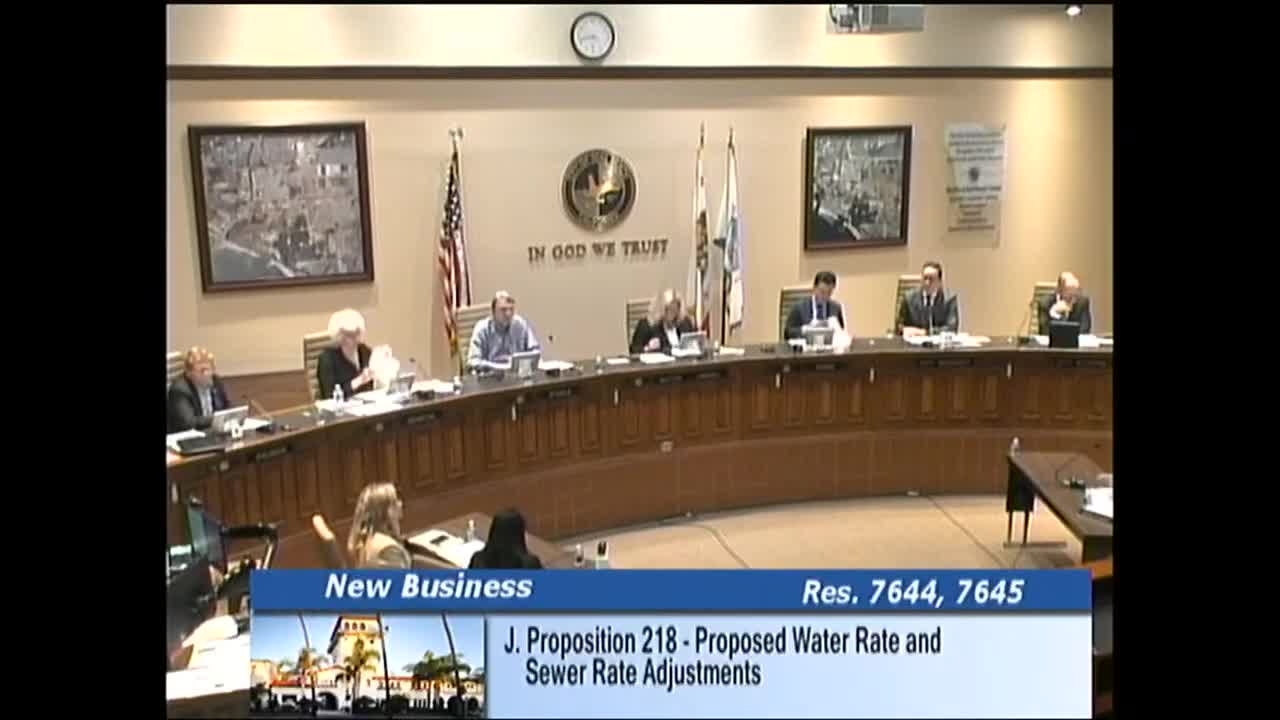
Summary
The council voted to begin formal Proposition 218 hearings and mail notices about proposed water and sewer rate increases that would fund $34–$44 million in water projects and $15–$19 million in sewer work; staff set a July 14 public hearing and two community outreach sessions in June.
Seal Beach — The City Council voted to initiate Proposition 218 proceedings on Tuesday to notify property owners and set a public hearing on proposed water and sewer rate increases that would pay for a multi‑million‑dollar program of capital improvements and loan repayments.
The action starts a statutorily required public process under Proposition 218 and sets a tentative public hearing for July 14, 2025, while also scheduling two community information sessions on June 4 and June 14 at Fire Station 48, staff said.
The move matters because city staff and the consultant, Raftelis, told the council the utilities are running short of revenues to meet operating costs, debt coverage requirements and needed capital repairs. Director of Public Works Iris Lee said the city is “out of time” for some projects and that delays are “putting our public health and safety at risk.” The council adopted resolutions to begin the Prop 218 notice and to use the revised public‑hearing and majority‑protest procedures staff presented.
Consultant Steve Gagnon of Raftelis presented two scenarios the council may consider. Under the more aggressive scenario (scenario 1), the study projects roughly a 96.5% increase in water revenues over five years and a 170‑dollar bimonthly increase for the average residential account by year five; scenario 2 is slightly smaller (about 82% water revenue growth and roughly $145 bimonthly by year five for the average household). Gagnon said the scenarios finance differing capital packages: about $44 million in water projects under scenario 1 versus $34 million under scenario 2, and about $19 million (scenario 1) versus $15.5 million (scenario 2) in sewer projects.
Raftelis and staff described specific projects that the rates would fund, including the Lampson well treatment system (a $4.5 million Orange County Water District loan is listed as a funding source), water main lining in the southern portion of the city, and replacement of an aging pump station at Sunset Aquatic Park so sewage does not overflow into Anaheim Bay. Gagnon also showed the utilities’ current cash‑flow shortfalls: without new revenue, the water enterprise is forecast to be in the red in the current year and the wastewater enterprise is failing to meet bond covenants.
City Attorney Garelli reviewed the Prop 218 and related legal process. He said the council must mail notice at least 45 days before the hearing and that written protests will be counted one per parcel; if written protests from owners of a majority of parcels subject to the charges are filed and not withdrawn, the council cannot adopt the proposed increases. Garelli also explained AB 2257’s exhaustion‑of‑administrative‑remedies requirements and set a deadline of 5 p.m. July 7 for legal objections (distinct from written parcel protests) so staff can respond in writing before the public hearing.
Leisure World, the city’s large multifamily development, will see a change in how fixed charges are calculated after an engineering review showed it requires two 12‑inch meters instead of the earlier assumed single 1½‑inch meter. Raftelis estimated that change will increase Leisure World’s fixed charges substantially — the firm showed it would raise the community’s bimonthly charge by roughly $125 (about $753,000 per year) under scenario 1 and about $100 (about $602,000 per year) under scenario 2. Raftelis said the meter sizing affects cost allocation across customer classes but that the study followed standard cost‑of‑service methodology.
Council members asked about outreach, timing and project delivery. Director Lee said notices will be distributed through the city newsletter, social channels and press releases; staff also will coordinate with Leisure World. Several council members requested regular reporting on project progress if the rates are adopted. Interim City Manager Gallegos and the public‑works director said staff will return regularly with updates on schedules and expenditures, and Gagnon said the council may adopt rates lower than the notice if it so chooses at the public hearing but may not adopt rates higher than the mailed proposal.
The council’s motion to proceed with the Prop 218 mailings, public hearing and adoption of the hearing procedures passed. The city clerk will mail the formal Prop 218 notice and accept written parcel protests by mail or email until the close of the July 14 public hearing; legal objections must be filed by 5 p.m. July 7 to be included in staff’s written response prior to the hearing.
If the council ultimately adopts rate increases, staff said the revenue will be used to repay planned state revolving fund and OCWD loans and to fund the listed capital projects and routine operations.
A public FAQ and copies of the Raftelis study and the draft notices are available on the city website and at the city clerk’s office, staff said. The council also directed staff to include the Prop 218 items in the upcoming budget cycle and to return with project and budget updates as construction and engineering estimates are developed.