Get Full Government Meeting Transcripts, Videos, & Alerts Forever!
Get email alerts on the Saltwater Canal Dredging topic
No spam. Unsubscribe anytime.
Council backs next design step for Saltwater Canal dredging; funding still open question
Summary
City staff and consultants summarized a multi‑phase study of Palm Coast’s saltwater canal system and, by consensus, directed staff to pursue design and permitting for a compromise dredging option; the council asked staff to return with funding options before committing construction dollars.
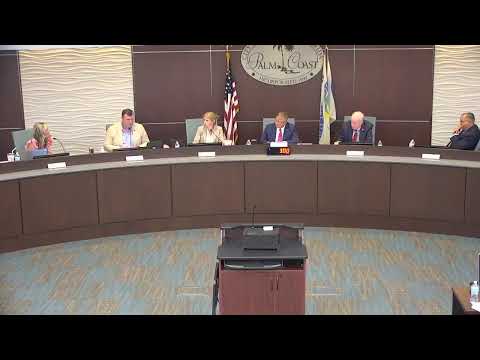
Palm Coast — The City Council on May 13 supported moving into design and permitting for a phased saltwater canal dredging program after consultants reviewed bathymetric, permitting and sampling work completed to date, but council members said funding and a long‑term maintenance plan must be resolved before construction.
Taylor Engineering and city staff summarized phase‑two work including historical permit research, a bathymetric survey, limited sediment sampling and regulatory pre‑application meetings. Terry Cake, representing Taylor Engineering, said the team located original design depths for many canals and reported typical canal‑bottom material as organic silty sediment; chemical tests showed generally low contaminants with naturally occurring arsenic detected in small amounts. Cake said regulatory staff at the Florida Department of Environmental Protection and the U.S. Army Corps of Engineers indicated the project could be treated as maintenance dredging if original constructed depths are used.
Consultants presented multiple scenarios for dredging and placement. Staff described three principal options: restore all canals to their originally constructed depths (deeper dredging); a compromise (deeper at entrance canals and shallower elsewhere); or dredge only the main collector canals. The city presented a mass‑balance price estimate using current assumptions (about $50 per cubic yard of material), and showed a substantial cost range depending on depth and which canals are included. Staff estimated a roughly $3.6 million to $4.0 million cost for a compromise scenario (dredge most canals to minus‑9 NAVD, smaller dead‑end canals to minus‑7 NAVD) and noted a higher‑depth, full restoration option could be an order of magnitude larger.
Staff recommended the compromise option (dredge entrance/major canals to minus‑9 and other canals to minus‑7) and asked council to authorize design and permitting work. The city manager and consultant advised the council that design and permitting fees were estimated during earlier work at roughly $310,000, while a later staff note placed the remaining design/permitting work at about $460,000. Taylor Engineering listed remaining tasks: final bathymetry review, final dredge prism and construction drawings, environmental permitting, funding applications, final specifications and bid support.
Discussion addressed boat access, long‑term maintenance and possible outside funding. The Florida Inland Navigation District (FIND) was identified as a potential partner; FIND’s typical assistance model for entrance waterways is a 75/20/5 split (FIND/sponsor/other) for eligible projects, but staff said FIND’s current rules do not automatically cover interior private marina canals. Council members asked staff to pursue FIND and other funding discussions and to return with a funding strategy for council consideration during the next budget cycle. City staff also noted the earliest practical start for the next design phase is after the FY‑26 budget process.
Several residents who live on or near canal lots spoke in favor of dredging now, saying low tides prevent routine boat use and reduce property‑value utility. Others urged care on seawall foundations and raised concerns about who bears the cost of maintenance in front of private docks. A resident noted earlier municipal work and taxes had promised canal maintenance years ago and asked that the city account for previously collected funds.
Council consensus was to proceed with design and permitting for the compromise option and to return with a clear funding plan, including pursuit of FIND coordination and potential assessment or grant strategies, before committing construction funds.