Get Full Government Meeting Transcripts, Videos, & Alerts Forever!
Get email alerts on the Traffic Calming topic
No spam. Unsubscribe anytime.
Palm Coast council agrees to formalize traffic‑calming policy after mixed pilot results
Summary
After a months‑long pilot on residential collectors, the Palm Coast City Council directed staff to draft a citywide traffic‑calming manual and application process, keep speed cushions as a proven tool but refine the toolbox and public‑vote threshold, and remove experimental cushions on one Cimarron segment pending further review.
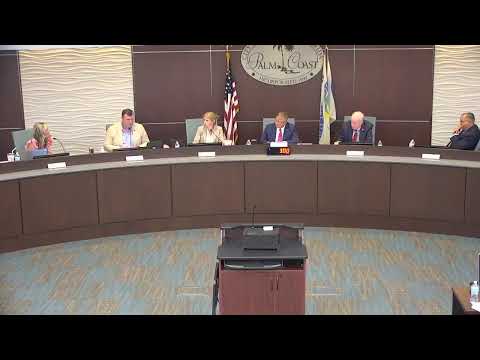
Palm Coast — The City Council directed staff on May 13 to develop a formal traffic‑calming manual and an application process after a pilot program showed speed cushions reduced speeds in some locations but other measures were less effective or raised concerns.
The direction came after staff and consultant presentations on a pilot study that tested speed cushions, chicanes and lane‑narrowing striping on several residential collector streets. Vaneesh Crawford, project manager for the city’s stormwater and engineering department, summarized the study’s origin: “In June 2024, the city completed … the speed limit study throughout the city of Palm Coast and presented our recommendation to the council,” and the council subsequently asked staff to develop a traffic‑calming plan.
The consultant, Emmanuel Rodriguez of Kimley‑Horn, presented the pilot data. He said the speed cushions were the most effective treatment tested, noting the measured reduction in the 85th‑percentile speed and the upper end of the 10‑mph pace at the cushion locations: “Speed cushions, very effective.” Chicanes produced smaller speed reductions, and lane narrowing by striping produced no reduction and in some spots showed a small increase in speed.
Public comments and some council members raised practical and equity concerns. Several residents reported improved safety on Florida Park Drive after cushions were installed. Paulette Hatfield, who lives near Florida Park Drive, told the council: “The traffic calming speed humps on Florida Park Drive have brought a welcome change to our neighborhood these past few months. They need to remain in place.” Other residents, especially on Cimarron Drive, said cushions made ambulance and fire response more difficult, increased noise and caused vehicles to circumvent the devices into yards. A resident said ambulances sometimes “have gone around these devices.”
Fire and rescue staff said they are tracking response data and evaluating vehicle compatibility. The fire chief told the council the dual‑rear wheels on some engines make traveling over the cushions problematic and that the department cannot yet quantify any effect on response times.
Council discussion focused on balancing effectiveness, resident support and unintended consequences. Council members and staff discussed alternatives including speed tables and “inverted” trough‑style devices that may produce less noise, and lowering neighborhood speed limits as a separate policy option. Staff and the consultant warned that lane striping could worsen speeds in some places and that speed tables can affect roadway drainage.
Council gave staff the following direction by consensus: develop and return with a traffic‑calming manual and formal application process (including how affected households are defined), finalize the public‑engagement and ballot method (the consultant recommended a 70 percent approval threshold for the impacted residents), explore other device types (speed tables and inverted designs) and evaluate emergency‑vehicle compatibility, and remove the experimental cushions on Cimarron Drive and consider relocating them as test devices elsewhere. Staff was also asked to provide the full survey breakdown and the vendor/cost details for the pilot installations.
The presentation included pilot costs and participation numbers: the city purchased a system of speed cushions for the pilot for about $20,000 (roughly $2,500 per cushion location), chicanes for about $5,000 per set (with the pilot spaced across multiple sites), and the public survey collected about 1,200 responses. Staff noted the survey was open (not unique per email) and that more granular address‑level results would be provided.
Next steps include producing the traffic‑calming manual and application process for council review, refining public‑engagement methods (an app‑based single‑vote option was discussed), testing additional device types where feasible, and returning with costs and an implementation plan as part of the next budget cycle.