East Point council hears that solid-waste service is running a multi-year deficit; staff, residents push for solutions
Loading...
Summary
Public-works staff and the solid-waste director told the council that the department’s long-standing practice of holding residential collection rates flat has produced an ongoing deficit driven by disposal (tipping) fees, illegal-dumping cleanups and aging equipment; council discussed franchise consolidation, user-fees and general-fund subsidies.
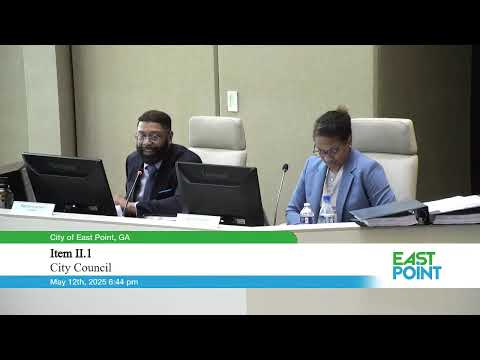
East Point’s solid-waste fund is operating in the red and will need policy choices from the city council, Solid Waste Director Mr. Moore told the council during the May 12 work session.
Why it matters: The city has historically held residential garbage rates steady while absorbing increasing hard costs (disposal fees, equipment replacement, labor). Staff said that approach has produced an ongoing deficit in the solid-waste enterprise fund; council members and staff discussed rate adjustments, commercial-hauler consolidation, targeted collections for illegal dumping and internal chargebacks as possible remedies.
What staff said: Director Moore described frequent, costly responses to illegal dumping and special pickups. He told the council that one bulk pickup could cost the city hundreds of dollars to collect and dispose, and cited examples including $7,000 and $15,000 single cleanups at sites with tires, chemicals and other material. Moore said illegal dumping can impose spillover costs on stormwater systems and require specialized disposal fees that the solid-waste fund must absorb.
Moore also explained that the city’s residential collection rate has not been changed in roughly 17 years while disposal and operational costs have increased. He described recycling as a separate pressure point—staff are projecting about a $400,000 annual gap in the recycling program—and said the department currently subsidizes services requested or used by other city departments.
Council concerns and staff options: Council members asked why the city did not simply budget to cover predictable costs such as bulk-amnesty pickups and illegal-dump removal. City Manager Jones and staff explained the budget choices are partly political: past councils have prioritized keeping the residential rate low and using general-fund transfers or fund balance to cover shortfalls. Jones advised three programmatic approaches for council consideration: (1) consolidate the city’s commercial haulers under a single franchise contract to improve revenue capture and eliminate “pirate” haulers; (2) increase residential fees to better reflect costs; and (3) explicitly budget a general-fund transfer to the solid-waste enterprise to cover programs the council wants to continue (bulk amnesty, free pickups for seniors at risk, department disposals).
Commercial-hauler franchise discussion: Council members and staff described a longtime effort to consolidate commercial hauling and require franchise fees. Staff said the city currently has multiple commercial haulers (four franchise haulers plus other operators) and a 20% commercial franchise fee; previous attempts to consolidate to a single hauler were delayed by legal challenges. Several council members indicated support for pursuing exclusive commercial franchising and stricter enforcement of existing franchise rules to widen the revenue base.
Illegal dumping enforcement and revenue: Police and public-works staff told council that cameras and enforcement have reduced the volume of illegal dumping from historic highs but that prosecution and fines rarely cover cleanup costs; council asked for a tally of citation actions, fines and recoveries so it can assess potential enforcement policy changes (for example, higher fines tied to cleanup costs).
Quotes: “To service that 1 home there, it cost us about $500 to collect and dispose of that stuff,” Director Moore said, describing a bulk pickup, and later, “There’s a lot of revenue that’s not being identified.” City Manager Wayne Jones said the city has historically chosen to subsidize rates to protect residents, “and that decision has been made.”
Next steps: Council asked staff to return for the final budget decision with a multi-year accounting of solid-waste costs (illegal dumping, bulk amnesty, departmental disposals), estimates of revenue from franchise consolidation, and options that show the fiscal impact of keeping rates level versus raising them. Council members also asked the police department for a summary of enforcement activity and collections against illegal dumping so council can evaluate enforcement-and-collection effectiveness.
Ending: The solid-waste deficit was one of the most pointed operational items discussed during the budget presentation. Council members signaled willingness to consider policy changes—consolidating commercial hauling, charging internal departments for disposal and a targeted general-fund transfer—but asked for concrete dollar estimates before authorizing any changes.