Get Full Government Meeting Transcripts, Videos, & Alerts Forever!
Get email alerts on the Probate topic
No spam. Unsubscribe anytime.
Fort Bend County judge admits wills, appoints executors and administrators, releases estate funds
Summary
Fort Bend County Court at Law No. 1 admitted several wills as presented, appointed independent executors and administrators to serve without bond in multiple estates, declared heirs in an intestate matter and ordered $100,000 released from the court registry to a dependent administrator.
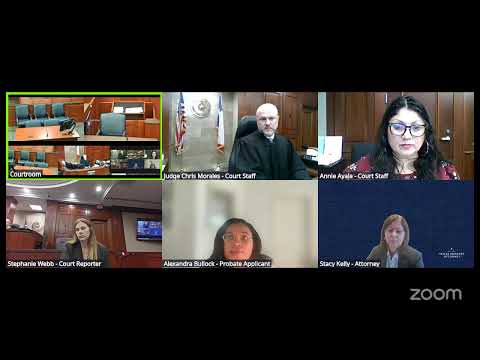
Fort Bend County Court at Law No. 1 on a Wednesday heard a slate of probate matters, admitting multiple wills, appointing independent executors and administrators to serve without bond, determining heirs in an intestate matter and ordering the release of funds held in the court registry.
The court’s actions cleared estate administration steps that will allow executors or administrators to settle debts, sell property and administer distributions. Several filings also waived appraisals and bonds, and the court awarded attorney fees in two matters.
In the matter of the estate of Don Victor Benskin (case no. '24 CPR 041936), the court admitted a will dated Oct. 16, 1998, and appointed John Floyd Nichols Jr. as independent executor to serve without bond; appraisers were waived. The judge recorded that Nichols had testified to proof of death, identified the will and recognized the signature. The judge stated that the court “will admit the will and the probate and appoint Mr. Nichols as independent executor to serve without bond, and appraisers will also be waived.”
In the estate of Claudia Ann Betting (case no. '24 CPR 041921), James Brian Medding testified as to proof of death and the self-proved will dated Nov. 6, 2009; the court admitted the will and appointed Medding as independent executor to serve without bond, with appraisers waived.
The court admitted the will presented in the estate of Walter T. Haney (case no. '25 CPR 042468). Attorney Carol Bartlett testified that she prepared and witnessed the decedent’s will and that no children or subsequent marriages affected the document; the court admitted the will and appointed the person named in the judgment as independent executor to serve without bond and waived appraisers.
In the estate of Christopher Robert Ayers (case no. '25 CPR 042395), Lauren Brown Ayers testified and the court admitted the will, appointed her as independent executrix to serve without bond and waived appraisers.
The court resolved an intestate/heirship matter arising from the estate of Abdul Hamid Merchant (case no. '24 CPR 041846). After testimony from four witnesses and the applicant, Sean Merchant, the court found the decedent’s heirs as listed in the judgment, discharged the attorney who had appeared for unknown heirs and awarded that attorney a fee of $1,025. The court then granted administration: it found the decedent died intestate, that a necessity for administration existed, and appointed Sean Merchant as independent administrator to serve without bond.
In the estate of Kelly Renee Duat (case no. '24 CPR 040579), witnesses and the applicant testified that the decedent left a will dated Nov. 6, 2023 that named a primary executor—who disclaimed the appointment and any inheritance—and that no alternate executor was named. All heirs consented to the applicant, Ryan Mark Duarte, serving as independent administrator without bond. The court approved appointment and awarded the attorney a fee of $650 for the heirship portion of the case.
In a delayed muniment-of-title filing for the estate of Maddie Nel Carrillo (case no. '24 CPR 041751), Laurie Frudensprung testified about her mother’s death on Oct. 9, 2016, identified a will dated March 30, 1989, and explained she and her stepfather had assumed the matter was in progress after earlier consultations with counsel. After hearing that some earlier probate efforts had not been completed, the court found the explanation sufficient to avoid default for failing to present the will within four years, admitted the will as a muniment of title and said an affidavit of fulfillment of terms would be required.
Separately, in the estate of Benjamin Okeny Okebo (case no. 21 CPR 035829), the court granted a motion to release $100,000 that had been deposited in the registry of the court while the recipient was not yet appointed. The court ordered the funds moved from the registry to the estate and directed counsel to file an order memorializing that release.
Several other routine admissions and appointments were handled in the same session. Where applicable the court took judicial notice of original wills filed with the clerk, confirmed that no state agency or charitable organization was named as a beneficiary in the presented wills, and recorded that Medicaid estate-recovery inquiries returned no pending claim in at least one case.
Clerk’s filings and final orders are expected to reflect the day’s rulings and to enable the newly appointed executors and administrators to begin estate administration tasks (paying debts, selling property, distributing assets) and, in the Carrillo matter, to permit a pending sale to proceed once the required affidavit is filed.