Get Full Government Meeting Transcripts, Videos, & Alerts Forever!
Get email alerts on the Water Infrastructure topic
No spam. Unsubscribe anytime.
Livingston engineering outlines $27M SRF bid and well-treatment plan to address TCP and arsenic
Summary
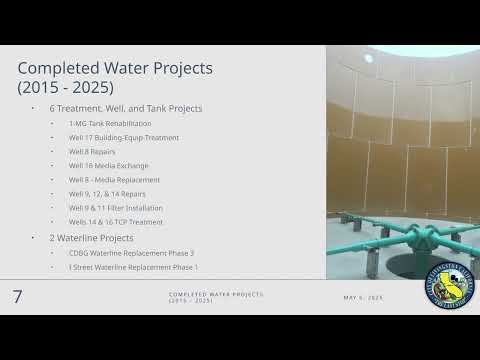
City engineering presented an overview of water capital projects May 6, including centralized TCP treatment sites, arsenic treatment at Well 8A, test-well results at Lucero Park (Well 18), a $27 million SRF funding application, and remaining ARPA funds that must be used by December 2025.
City of Livingston engineering staff on May 6 presented a multi-year plan to expand centralized treatment for 1,2,3-trichloropropane (TCP) and arsenic removal, including ongoing construction at Well 8A, test-well results at Lucero Park (Well 18) that showed TCP presence, and an SRF funding application for $27 million that would cover two centralized TCP treatment projects.
The presentation mattered because the projects are intended to bring treated water into compliance with state drinking-water rules and because some federal ARPA funds earmarked for treatment equipment must be spent by December 2025. Engineering staff said those deadlines and grant windows affect procurement and construction sequencing.
Engineering staff said Well 8A is under construction with an estimated cost of “around $4,000,000.” Nick, an engineering department staff presenter, said the city is proceeding with multiple centralized treatment projects: a Killian-Park centralized TCP plant that would treat wells 12, 13 and 17 and another expanded centralized site paired with an arsenic treatment plant that would treat wells serving the same site. The city has applied for State Revolving Fund (SRF) support and is pursuing a $27,000,000 package the presenters said now appears to be a 100% grant in the current application rather than a mix of grant and loan.
Engineering staff reported that a test well drilled at Lucero Park (Well 18) in April showed TCP and minimal arsenic at deeper depths; staff said shallower intervals above about 400 feet showed much lower arsenic. Nate, another engineering department staff presenter, described that Well 18’s water will be piped to a centralized treatment site for TCP removal if the site is developed. Well 19 — a site on or adjacent to Foster Farms property that previously underwent appraisal and negotiation — remains on hold pending land negotiation and additional funding.
City staff emphasized the treatment strategy will centralize wells with similar contaminants to reduce equipment duplication. “The idea of centralization is the closest wells that are viable and feasible will be basically converged together and have one location for a multiple treatment process,” an engineering presenter said. Staff said some centralized plants already operate (Well 14/16 centralized TCP plant completed in 2021) and that future plants are being sized to serve multiple wells (for example, one planned site is sized to treat wells 12, 13 and 17; another for wells 9, 18 and 8A).
Project timing and funding: staff listed several water capital projects with different phases (preliminary engineering, bidding, construction). Well 8A’s construction began in September 2023 and staff said construction is expected to finish in early 2026. Projects labeled 2 through 4 (two centralized treatment sites and Well 18) were presented as anticipated to be completed by 2028 if funding proceeds as planned. Engineering staff also presented a combined project total figure used in planning (previously discussed at roughly $42,000,000 for a suite of projects), while noting specific projects had been removed from earlier grant submissions when deemed ineligible.
ARPA and procurement constraints: council members asked about American Rescue Plan Act (ARPA) amounts shown in the work plan. Happy, identified in the presentation as finance staff, said the ARPA allocations were reported to the state and that the remaining ARPA funds must be spent by December 2025. “The ARPA funds have already been allocated for the project… but we do have to spend them by December of ’25,” Happy said. Staff noted one strategy is to pre-purchase treatment vessels and specialty equipment to lock in prices and avoid losing ARPA-eligible expenditures because long lead times and contractor markups can increase final costs. Engineering staff said fabrication of some specialty vessels takes about nine months after materials arrive and that most vessels referenced are U.S.-manufactured (outside California, in the Midwest).
Regulatory context and compliance goals: presenters underscored the goal of meeting Title 22 drinking-water standards and the applicable maximum contaminant levels (MCLs). “Yes. That’s the goal,” an engineering presenter responded when asked whether the planned treatment plants were expected to bring arsenic and TCP into compliance. Staff discussed that regulatory thresholds have tightened over time (for example, arsenic MCLs previously were higher and have lowered) and that TCP is now stringently regulated (presenters said detection is treated as noncompliance under current MCLs). Staff also noted the city issues an annual consumer confidence report describing constituent levels and regulatory limits.
Permitting and schedule risks: presenters told the council the permitting environment for wells has tightened in recent years. One staff member said a state executive order requires more extensive state-level review of well permits and that basin conditions (the Merced basin was described as “severely impacted” in the presentation) create added documentation and reporting requirements similar to environmental review. Staff also flagged long lead times for controls and specialty equipment and described those procurement and manufacturing timelines as a significant schedule risk.
Surface water option: engineering staff presented a long-range, phased surface-water alternative that would use riverbed takeouts and a surface-water treatment plant blended with groundwater. Staff estimated a regional surface-water treatment project could cost in the hundreds of millions; a planning slide showed a $660,000,000 planning-level estimate and noted that a regional approach would require multiple stakeholders, extensive permitting, and many years to complete.
What’s next: staff recommended continuing design and funding applications (SRF and other state/grant programs), pursuing procurement strategies to use ARPA funds before the December 2025 obligation deadline, and maintaining public outreach (staff noted an upcoming town hall where water quality is expected to be a central topic). Council members asked about operations and maintenance, north–south distribution constraints under Highway 99, and whether private–public partnerships (for example, a developer or Foster Farms contribution) could accelerate delivery. Staff said those relationships are valuable when the private work meets municipal standards.
Ending: presenters closed by inviting questions and reminding council and the public they can email city engineering for details. The presentation moved next to closed session items after the public portion ended.