
Livingston planning commissioners recommend expanded sphere of influence, pick hybrid land-use alternative
Get AI-powered insights, summaries, and transcripts
Sign Up Free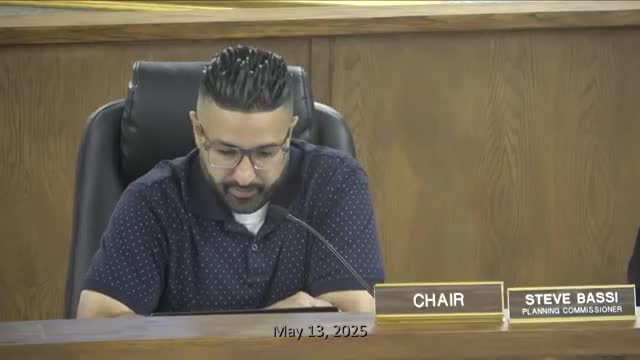
Summary
The Livingston City Planning Commission recommended a modified version of the consultants' expansion alternative — combining elements of infill and outward expansion, adding a potential specific‑plan area and preserving some agricultural land — and voted 5-0 to forward the recommendation to the City Council.
The Livingston City Planning Commission on May 20 recommended that the City Council consider a preferred 2040 General Plan land-use alternative that expands the city’s sphere of influence and blends features of the consultants’ infill and expansion scenarios.
The commission voted 5-0 to forward the modified Alternative 3 — with specific additions requested by commissioners, including a potential specific-plan designation for a commercial/industrial node near the Sultana/Liberty area and preservation of selected agricultural areas — to the City Council for further review and environmental analysis.
The vote advances a stage in the city’s multi-year general plan update in which consultants modeled three land-use scenarios: a baseline “no change” option, an infill-focused option that emphasizes higher downtown density and mixed use, and an expansion option that converts some agricultural land on the urban fringe to urban uses. Michael Gibbons, project manager for Mintier Harnish, the consultant team assisting Livingston, described the alternative analysis as “what if scenarios” that forecast outcomes to a 2040 horizon year. “Essentially, what if the city were to designate that portion of the city a certain designation?” Gibbons said during the presentation.
Why it matters: the commission’s recommendation sets the map and assumptions the city will use to prepare required environmental review under the California Environmental Quality Act (CEQA) and to refine municipal planning documents. Expanding the sphere of influence would begin a separate jurisdictional process with the county and the Local Agency Formation Commission (LAFCO) and would require additional steps — a municipal services review (MSR), tax‑sharing agreement with Merced County, and master infrastructure plans for water, sewer and storm drainage — before parcels could be annexed and developed.
What the commission recommended and why
Commissioners combined elements of Alternative 2 (infill and downtown mixed‑use) with Alternative 3 (outward expansion) rather than endorsing any single consultant scenario unchanged. The commission asked staff and consultants to: forward a preferred alternative that (1) expands the sphere of influence roughly to the orange planning boundary shown in the presentation; (2) designates a focused area near the Sultana/Liberty interchange as eligible for a specific plan to guide mixed‑use, commercial and light‑industrial development; and (3) preserve defined agricultural areas identified during the meeting as urban reserve or agricultural land rather than converting all fringe ag to urban uses.
Commissioners and staff repeatedly emphasized that environmental review will assume a worst‑case build‑out: Miguel Galvez, contract city planner for Livingston, reminded the body that the consultant models “assume[] that all the properties will be developed at the highest maximum density,” and that the environmental impact report (EIR) will analyze those worst‑case impacts and potential mitigation measures.
Key figures from the consultant analysis presented to the commission include: the baseline Alternative 1 capacity of roughly 17,000 people in the planning horizon; Alternative 2 (infill) a capacity in the low‑to‑mid 20,000s; and Alternative 3 (expansion) the highest analyzed capacity, roughly 30,000. The consultants also reported large percentage increases in multifamily capacity under the infill alternative (about +94%) and in single‑family and multifamily designations under the expansion alternative (+108% and +75%, respectively).
Public comment and local concerns
Property owners and local residents spoke during the public comment period and during the hearing on land‑use alternatives. Noor Sahota, a property owner whose parcels touch the city limits, asked that her family’s parcels be considered for inclusion in the sphere of influence and asked whether the city has water and tax‑sharing arrangements to support expansion. “I see my properties there. I’d like them incorporated into at least the sphere of influence later on. But best case into the city,” Sahota said.
Artist and long‑time resident Patricia Zamora urged the commission to prioritize community wellness and cultural infrastructure alongside physical development, citing local health data: “33.6% of people in this, in our city, feel down, depressed, and hopeless,” she said, and asked the city to include arts, culture and mental‑health considerations in planning.
Staff clarifications and next steps
Staff and the consultant team clarified key procedural constraints. Galvez and the consultants noted that most of the 22 privately requested parcels submitted for analysis are not currently connected to city utilities; five are inside the existing sphere of influence and the remainder are outside both the city limits and the sphere of influence. Any annexation would require: (1) a tax‑sharing agreement with Merced County, (2) an updated municipal services review to demonstrate the city can provide utilities and services, and (3) master infrastructure plans for sewer, water and storm drainage. LAFCO makes the final decision on annexation applications.
The commission’s recommendation directs staff to prepare a preferred‑alternative package for City Council consideration and to include the commission’s requested modifications. The consultants said they will prepare updated build‑out estimates and noted that the planning commission and council will each have further opportunities to refine the map and the policy language before the EIR and final general plan are produced.
Action taken
At the end of the hearing a commissioner moved to adopt a resolution recommending the modified Alternative 3 (with the additions discussed during the meeting) and expanded sphere of influence; another commissioner seconded the motion. The motion passed on a roll‑call vote of 5‑0 (Commissioners Jose Flores, Jasneel Singh, Diogo/Diego Castillo, Vice Chair Renee Mendonca and Chair Steve Bassi voted yes).
What remains unresolved
Speakers and commissioners flagged several open items that city council and staff must address before annexations or major new development: whether a county tax‑sharing agreement can be negotiated and with what split; how and when an MSR and the master infrastructure plans would be prepared and funded; precise utility availability (staff said none of the 22 requested parcels are currently served by city utilities); and how the city would manage the pace of growth (for example, by tying extensions of sewer/water to completion of infill or to specific plan approvals).
The planning commission asked staff to present the recommended alternative and revised maps to the City Council and noted the council could return the draft to planning commission for further edits. The commission did not adopt any zoning changes or entitlements; the action forwarded only a recommendation on a preferred land‑use alternative and sphere‑of‑influence expansion for the next stage of analysis.
Ending
Staff will prepare a draft resolution and revised maps reflecting the commission’s direction and transmit those materials to the City Council. The selection of a preferred alternative will be used to scope the EIR and to shape follow‑up actions such as municipal services reviews, specific plans and any annexation applications that the city elects to pursue.