Get Full Government Meeting Transcripts, Videos, & Alerts Forever!
Get email alerts on the Zoning Code Updates topic
No spam. Unsubscribe anytime.
Commission recommends broad city code updates including sign, CUP and annexation rules
Summary
The commission voted to forward a package of Nampa city code amendments — covering chapters on signage, conditional use permits, annexation notification, parking, industrial uses, and other zoning matters — with a direction for staff and legal counsel to refine conditional‑use language discussed at the meeting.
The Nampa Planning and Zoning Commission on May 13 recommended approval of a set of ordinance text amendments to multiple parts of the Nampa municipal code, including chapters addressing signage, conditional use permit criteria, annexation notice procedures, parking/site permits, industrial zones, and other zoning code clarifications.
Christie Watkins, the city’s principal planner, presented the package and said the changes are intended to clean up inconsistencies, consolidate definitions (for example, moving kennel definitions into a single animals section), clarify public‑notice procedures and property posting requirements, add a data‑center definition (allowing data centers only in light and heavy industrial zones with conditional use review), and simplify development‑agreement modification criteria.
Watkins said staff will move to a process requiring applicants to provide their own 4×4 posted notices beginning Aug. 1, with limited exceptions where staff will continue to post notices on behalf of applicants. The proposal also harmonizes sign standards and creates clearer guidance for higher‑profile signs along I‑84, which the sign subcommittee recommended.
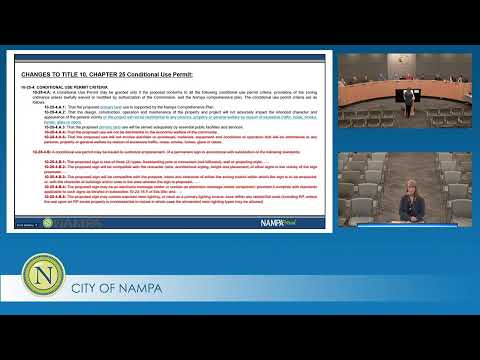
Commission discussion focused on the conditional use permit language; commissioners and legal counsel debated phrasing to ensure the criteria are applicable to different types of uses without unintentionally creating an impossible standard. The commission requested staff work with the city attorney to adjust the conditional use criteria wording to reflect the meeting discussion before the package goes to city council. Commissioner Garner moved to recommend approval with that additional condition; Commissioner Miller seconded and the motion carried.
Watkins told the commission the proposed changes remove redundant or now‑irrelevant provisions (for instance, hazardous‑use lists addressed by building and fire codes) and reorganize sign provisions to reduce variance requests that must go to council. The commission recommended approval and asked staff to coordinate the conditional‑use language edits with legal counsel prior to council consideration.