Get Full Government Meeting Transcripts, Videos, & Alerts Forever!
Get email alerts on the Land Use Rezoning topic
No spam. Unsubscribe anytime.
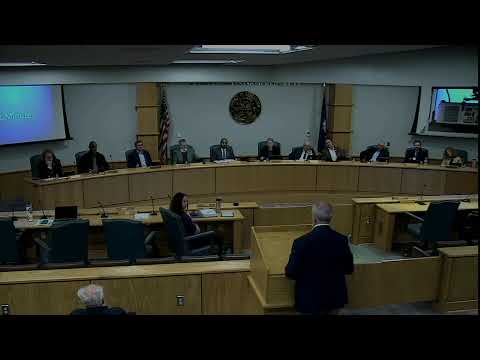
Charleston County planning panel backs Orange Hill plan development, adds condition on tree mitigation and community involvement
Summary
The Charleston County Planning Commission voted to recommend approval of a rezoning and plan-development request for the Orange Hill property on Johns Island, reducing permitted dwelling units from 181 to 120 and attaching a condition requiring tree-mitigation funds or plantings remain on Johns Island with community participation.
The Charleston County Planning Commission voted to recommend approval of a rezoning and plan-development request for the 933.097-acre Orange Hill property on Johns Island, including a development agreement that would vest project rules for 10 years and require a mix of habitat protections, affordable-housing contributions and public-safety payments.
The recommendation, made after a staff presentation and public comment and adopted with a condition tying any off-site tree mitigation or tree-fund expenditures to Johns Island with community participation, moves the request to county council for two public hearings and potential ordinance readings.
Staff told the commission the project parcels (TMS 215000030, 215000163 and 2560000120) total 933.097 acres, roughly 628 acres of high ground and 304 acres of freshwater wetlands. The current entitlement (PD 83A) allowed 181 single-family lots; the proposed Orange Hill plan development (PD 191) would reduce that to 120 dwelling units. The developer also proposes a conservancy tract where, under the recorded restricted covenants, only a single dwelling would be allowed.
Under the draft development agreement described to the commission, the property owner (identified in the record as Kiowa Resort Associates) would have a 10-year vested-rights term unless extended by mutual consent. The agreement requires annual review by the zoning administrator and may be amended or canceled by mutual consent or successors in interest. Staff said state law requires two public hearings for a development agreement.
The agreement and PD would permit certain utility uses for the development, including a wastewater treatment facility and a reverse-osmosis plant; the applicant indicated it proposes tertiary treatment with water recycling for irrigation of the golf course. The PD also proposes to allow up to 68 short-term rental units, limited to club members and their guests and managed by the club rather than through open public advertising.
The development agreement contains several community-benefit payments and public‑safety contributions. The owner would deliver $1,000,000 to Charleston County Community Development and Revitalization over five years (at $200,000 per year) to support preservation of existing dwelling units and development of workforce and affordable units. The owner would also pay a flat fee of $4,166.67 per first‑generation closing to Sea Island Habitat for Humanity Inc., up to a cap of $500,000 tied to 120 first‑generation lot sales. The agreement also calls for roughly half the cost of an ambulance ($215,000) once 50% of dwelling units have certificates of occupancy, and roughly half the cost of a fire apparatus ($450,000) when 50% of occupancies are completed, to support St. Johns Fire District services.
Tree protection and mitigation were focal points of staff, applicant and public discussion. The development agreement would modify local tree-protection standards for this property and seek pre-approval to remove or encroach on grand and protected trees shown in the applicant’s exhibit (14.1) for construction of the golf course and primary roads without separate Board of Zoning Appeals approval, while requiring mitigation. Staff summarized the mitigation rules in the agreement: Grade A and B trees require inch‑for‑inch mitigation with minimum 2.5‑inch‑caliper replacement trees; Grade C mitigation is determined by the zoning and planning director based on condition; mitigation may be planting on-site, planting off-site on Johns Island, or payment into a Johns Island tree fund. Trees encroached upon by more than 25% must be monitored by a certified arborist for at least five years and mitigated if they do not survive.
Applicant representatives said the revised plan reduces road miles and tree removals compared with the prior entitlement and concentrates short-term rentals near the clubhouse so they are walkable. “We are community developers,” Jordan Phillips, a partner for the applicant, told the commission. Ray Pamplin, the applicant’s development director, said the team has experience working with eagle-nesting restrictions and monitoring protocols and that an identified eagle nest lies within the conservancy tract outside planned disturbances: “we're very familiar with nesting pairs … that season of monitoring begins on October 1 and it runs all the way through May 16.”
County housing staff explained how the housing payment amounts were reached. “It was just a good-faith negotiation with the applicant,” Eric Davis said, adding staff reviewed comparable agreements and council priorities from Charleston County’s Housing Our Future plan.
Public comment included concerns about wildlife and tree loss. Martin Myers, a River Road resident, said eagles nest in the area and urged protection. Mike McShane, representing the Johns Island Task Force, said the applicant had been collaborative and urged that any off-site mitigation dollars be spent on Johns Island with community involvement. The commission’s motion incorporates that condition: if mitigation is off-site or funds are used instead of plantings, they must be applied on Johns Island and the Johns Island Task Force or similar local representatives will participate in siting decisions.
Commissioners voted to recommend approval for the PD and related requests; the roll call recorded all members present voting yes. The commission noted the development agreement itself is not part of the commission’s formal zoning recommendation but will be considered by county council as a contract matter. County council will hold two public hearings on the development agreement and PD request on June 10, 2025, and July 22, 2025, both at 6:30 p.m. in council chambers; the council’s planning and public works committee will consider the request on June 17, 2025, at 5 p.m. If council approves, the ordinance would still require council readings at the council’s discretion.