Get Full Government Meeting Transcripts, Videos, & Alerts Forever!
Get email alerts on the Public Venues Accessibility topic
No spam. Unsubscribe anytime.
Salem committee recommends pausing weddings in City Council chambers during business hours over ADA concerns
Summary
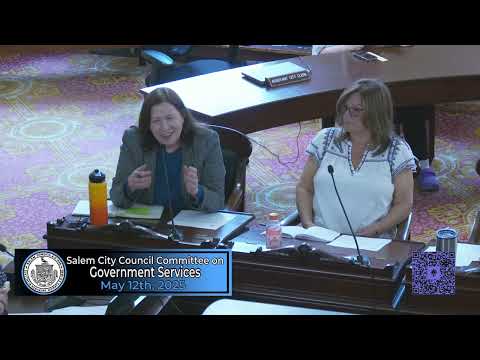
The Committee on Government Services of the Salem City Council voted May 12, 2025, to recommend the full council pause newly scheduled wedding and marriage ceremonies in City Council chambers during City Hall business hours, including a 45-minute buffer, citing repeated accessibility and crowding problems.
The Committee on Government Services of the Salem City Council voted May 12, 2025, to recommend that the full council pause newly scheduled wedding and marriage ceremonies in City Council chambers during City Hall business hours, including a 45-minute buffer before opening and after closing, while the city studies accessibility and use-policy changes.
The measure (Order 206) was presented by Councilor Stott and, as amended by the committee, would bar new bookings in the chambers during business hours; the committee voted to send the recommendation to full council. Councilors cited repeated instances in which furniture, tripods and wedding party members blocked an access path and raised concerns about compliance with the Americans with Disabilities Act (ADA).
Why it matters: City staff and councilors said the chambers’ current layout and frequent daytime ceremonies have created situations that can block required access routes and make members of the public and staff uncomfortable. Committee members said a temporary pause will allow time to draft a formal policy for use of the chambers and anteroom, review occupancy and furniture placement, and identify low-cost, permanent accessibility fixes.
Most of the debate centered on whether the chambers can safely host ceremonies during business hours without extra staffing or physical changes. Councilor Merkel said, “A wedding is a very private event as opposed to a swearing in ceremony or a flag raising or a scout ceremony,” and added that photos and larger-than-expected parties have frequently blocked circulation in the hallway. Lisa Cammarata, the city’s ADA coordinator, told the committee, “We want a 36-inch width path at least,” and urged permanent measures — ropes, stanchions or other design solutions — to keep a clear route to the elevator and restrooms.
Councilors described practical problems they said recur during daytime ceremonies: doors and hallways blocked by photo shoots or equipment, wedding parties that arrive with more people than scheduled, and furniture moved during meetings that can reduce required clearances. One councilor said clerks’ office bookings have produced more than 100 weddings during a seven-month window, a figure cited to illustrate how often the chambers are used for ceremonies in normal business hours.
The committee discussed three possible approaches the clerk’s office had outlined: (1) take no immediate action but ask the clerk to propose clearer measures to maintain circulation; (2) amend the clerk’s delegated authority by adding time-and-manner restrictions and a requirement for a designated, roped ADA pathway when ceremonies occur during business hours; or (3) rescind the clerk’s delegated authority and require city council approval for use of the chambers and anteroom. Members favored keeping options open and developing a written policy; several said they will involve the fire department and building official on occupancy limits.
Public commenters and councilors who are liaisons to disability groups urged the city to move quickly. A local resident, Alphonse Wright of 23 Nursery Street, told the committee the central problem is ADA compliance: “The fact that it has not been, for as long as I’ve been coming into the chambers for 5 years now, is a failing.”
The committee amended the order to strike language that would have allowed the clerk to approve previously scheduled weddings without council action, then voted to recommend the amended order to full council. Committee members said the change was intended to create a clear pause on new bookings while staff and council draft a permanent policy and implement physical changes to preserve access. The motion to refer the amended order carried on a voice/hand vote recorded by the chair; the committee chair reported the result as “four hands plus my own.”
The committee also voted to keep separate work on the data about the number of marriages performed in City Hall in committee for further review, and to continue drafting a policy on use of the chambers and anteroom, referencing Salem Code Chapter 2, Section 10.
Next steps: Committee members asked the clerk’s office and ADA staff to return with a written inventory of scheduled events, any bookings that might be affected, options for furniture reconfiguration or permanent stanchions, and input from the fire and building departments on occupancy limits. The committee also discussed consulting the state disability office and the Salem Commission on Disabilities about standards and potential funding sources for accessibility improvements.
What the action does not do: The committee’s recommendation does not cancel ceremonies already scheduled by other parts of City Hall (the city clerk’s office may continue to perform marriages in other rooms or in the clerk’s office itself), and it does not permanently prohibit weddings outside business hours. The referral asks the full council to adopt the temporary restriction while staff and councilors develop a permanent policy and physical accessibility fixes.