Get Full Government Meeting Transcripts, Videos, & Alerts Forever!
Get email alerts on the Municipal Court topic
No spam. Unsubscribe anytime.
Bellingham municipal court reports surge in cases, asks council to consider third judicial officer
Summary
Bellingham Municipal Court officials told City Council the court handled nearly 24,000 cases in 2024, saw large increases in DUIs and parking infractions, and asked the city to consider adding a judicial officer and courtroom to handle a growing criminal docket.
BELLINGHAM, Wash. — Bellingham Municipal Court officials told the City Council on April 14 that caseloads have jumped sharply and the court needs more capacity to meet demand.
Judge Deborah Lev said the court handled “just under 24,000” total case filings in 2024, including roughly 2,490 gross misdemeanors and 392 DUI or physical control cases; parking citations alone totaled 19,778. She said those filings represent an overall increase of about 33 percent from 2023 and that the court is prioritizing criminal hearings because criminal cases involve potential loss of liberty.
The numbers matter because the court must meet speedy-trial timelines for people not held in custody. Commissioner Nicholas Henry told council that out-of-custody cases are being set about 75 days out for trial hearings — longer than the typical 40–60 days the court used to set — and that backlog pressures are forcing staff to set jury trials at the earliest available dates, sometimes within weeks.
“We have 15 criminal calendars per week,” Lev said, “and both courtrooms are in session simultaneously six times a week. We need basically four to five additional criminal calendars per week to accommodate the increased caseload.” She asked the council to consider adding “a third judicial officer” — either a full-time commissioner and two elected judges — and a third courtroom as the city’s population approaches 100,000.
Why it matters: Court staff described operational consequences of the caseload surge. Tamara Bennett, court director, and Commissioner Henry said most of the court’s time is spent on criminal hearings; online parking appeals and other infractions are handled afterward or by temporary pro tem review because in-court time is scarce. Henry said the court had about 500 outstanding online parking appeals at the end of 2024.
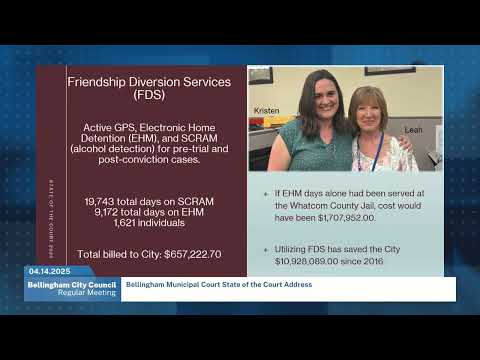
The court also described programs it uses to avoid incarceration and reduce jail days. The court partners with Friendship Diversion Services (FDS) to provide active GPS, electronic home monitoring (EHM), and SCRAM alcohol monitoring. Judge Lev said about 19,172 days were served on SCRAM and related monitoring in 2024; the total billed to the city for monitoring services in 2024 was $657,222.70. She said using monitoring since 2016 has saved the city “almost $11,000,000” compared with incarcerating those days in the county jail, per the court’s accounting.
Lev and court staff outlined specialty and diversion programs they said reduce recidivism and provide treatment rather than jail. The court’s domestic-violence specialty docket had 355 cases in 2024, a 20 percent increase from 2023. The wellness (mental health) court, a joint city–county program established in 2015, admits participants to an 18–24 month program; Lev said five members were active with three pending admissions and a 10‑year anniversary graduation planned. The court launched a “community court” pretrial diversion program in January 2025 and reported five enrolled participants and six pending entrants.
Rising DUIs: Lev warned of a marked increase in DUI and drug-impaired driving cases, saying the court is on pace in early 2025 for roughly 470 DUI/physical-control filings through March — “at least a 25% increase” from 2024. She said about 35 percent of 2024 DUI offenders had at least one prior DUI conviction in Washington, and that out-of-state DUI histories are not fully captured in local statistics.
“People are passed out in their cars in the middle of the roadway,” Lev said. The court proposed exploring a dedicated DUI court to pair substance-use treatment with monitoring (ignition interlocks, SCRAM, GPS) and other conditions intended to protect public safety while honoring least-restrictive-release principles.
Other operations and outreach: Staff described a variety of internal improvements and community programs: an annual all‑staff training day; a “protein for all” program offering high‑protein snacks at arraignments to reduce stress and trauma responses; and Law Day events that bring hundreds of eighth-graders to observe court. Security screening at the courthouse prevented more than 2,100 prohibited items from entering in the past year, but staff raised concerns about people who are unhoused having no secure place to store belongings when they must come to court and suggested installing lockers.
Council questions and next steps: Council members asked about the composition of cases eligible for public defenders, the makeup of parking infractions (expired meters versus vehicle‑residence situations), and the proportion of hearings conducted online versus in person. Court staff said arrears and parking appeals are handled largely online — “at least probably three quarters” of infractions are processed online — and that Zoom remains widely used for hearings unless in-person appearance is specifically ordered.
The court did not receive an immediate vote on new judicial staffing on April 14. Lev said the court is coordinating with executive and legislative leaders on space and staffing and is seeking council consideration of an additional judicial officer and courtroom to address the backlog.
Lev closed by reiterating the court’s dual goals of protecting public safety and using the least-restrictive tools available to keep people out of custody when appropriate.
Ending: Council did not take action on staffing or facility requests at this meeting; Judge Lev and staff asked council members to consider the court’s staffing and physical-space needs as part of upcoming budget and capital planning discussions.