Get Full Government Meeting Transcripts, Videos, & Alerts Forever!
Get email alerts on the Light Rail Permitting topic
No spam. Unsubscribe anytime.
Committee reviews code amendments to speed permitting, add construction and tree plans for light-rail stations
Summary
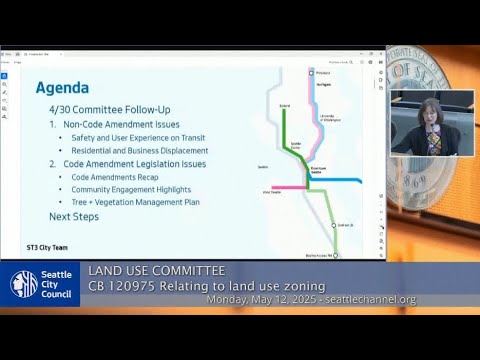
Seattle’s Special Land Use Committee on May 12 heard presentations on Council Bill 120975, a proposed amendment to the Seattle Municipal Code that would create light-rail–specific development standards and require a preliminary construction management plan and a project-level tree and vegetation management plan for Sound Transit 3 stations.
Seattle’s Special Land Use Committee on May 12 heard presentations on Council Bill 120975, a proposed amendment to the Seattle Municipal Code that would create light-rail–specific development standards and require a preliminary construction management plan and a project-level tree and vegetation management plan for Sound Transit 3 (ST3) stations. The presentation and subsequent committee discussion focused on permitting efficiency, community engagement, tree preservation and replacement, and relocation assistance for people and businesses affected by property acquisition.
The proposal would bundle several process and design changes intended to reduce redundant permit steps while adding public-facing engagement earlier in the permitting sequence. “It is the largest infrastructure project in the city's history,” said Sarah Maxana, Sound Transit program director at the Office of Waterfront Civic Projects and Sound Transit, describing the West Seattle and Ballard Link extensions and why the city is pursuing tailored code language. Maxana also said the code package “will put in place new community engagement requirements that do not exist today.”
Presenters said the amendments split into three process improvements—streamlining master use permits and appeals, requiring a preliminary construction management plan, and establishing a project-level tree and vegetation management plan (TVMP)—and several design improvements, including station-specific development standards, bicycle-parking typologies and use of the Seattle Design Commission as an advisory reviewer. Lindsay King, SDCI Sound Transit 3 project manager, said, “Every station we intend to have a public meeting associated with it,” and she and Maxana stressed that the public meetings and preliminary construction management plan are intended to give neighborhoods an earlier, geographic view of cumulative construction impacts rather than treating each permit in isolation.
Committee members pressed presenters for details about outreach and tree preservation. The presenters described multi-year public engagement tied to Sound Transit’s environmental review, surveys that drew about 2,100 responses, open houses in 2023–24, briefings with commissions and the business improvement area, and targeted meetings with tribes and neighborhood organizations. Committee member Teresa Rivera said she wanted broader outreach beyond stakeholder groups and farmers markets to reach “the average person.” Presenters answered that the TVMP and preliminary construction management plan would be drafted and available for public review in advance of permitting and that the city plans targeted public meetings for each station and for sensitive areas.
Tree management and transplanting drew detailed technical discussion. City presenters said transplanting is constrained by tree size, species, health, seasonality, access at sending and receiving sites (for example overhead power lines and heavy-equipment access), and geotechnical conditions such as steep slopes. They noted that transplanting large, well-rooted trees is logistically difficult and can delay tightly sequenced construction schedules. King said recent local transplant attempts had low survival rates and that transplanting often requires contracting specialized crews. Presenters cited an outside example in Boise in which moving a single large tree cost about $300,000 and required a year of root preparation plus multi‑year maintenance; they also summarized an internal estimate that transplanting can be roughly 10 to 100 times more expensive than routine tree replacement in some cases. The presenters added that many transplanting costs could be considered a Sound Transit “betterment” and therefore potentially funded by the city or partners rather than by Sound Transit under its current policies.
On displacement, presenters said the council’s 2022 resolution (Resolution 32055) had influenced selection of station locations with attention to safety, user experience and minimizing residential displacement. They also said the state legislature recently raised the statutory cap on business reestablishment payments tied to displacement and that the new cap will be periodically adjusted for inflation; presenters offered to follow up with Sound Transit for property‑specific relocation details because Sound Transit’s real property staff negotiate compensation and relocation assistance with affected owners and tenants.
Public comment included two speakers. Mark Weed, who identified himself as representing property owners on Sixth Avenue near SODO, told the committee he supports the ordinance and recommended considering a citywide approach rather than limiting the code changes to Sound Transit projects. A second commenter, David Haines, used profanity and accused council members of corruption and racial bias; his remarks were heard during the hybrid public-comment period and were not repeated verbatim in committee discussion.
The committee did not vote on Council Bill 120975 on May 12. Members asked for a clearer, time‑bound outreach plan and stronger coordination with Sound Transit and SDOT on construction mitigation (traffic routing, bus access and pedestrian circulation) and urged frequent consultation with the Urban Forestry Commission about the TVMP. Committee chair Mark Solomon and staff noted the next step: a public hearing is scheduled for May 29 and the committee anticipates voting at that meeting. Permitting for West Seattle is expected to begin in earnest in the third and fourth quarters of 2025, according to presenters.
Ending: Committee members generally expressed support for the intent of the code package—streamlined permitting, station-specific design guidance and earlier, public-facing planning for construction impacts—while reserving judgment pending additional detail on outreach timelines, transplant feasibility and the funding and legal treatment of any transplanting betterments. Presenters committed to follow-up briefings and to providing more specific relocation and cost information from Sound Transit and the city’s arborist teams before the May 29 public hearing.