Get Full Government Meeting Transcripts, Videos, & Alerts Forever!
Get email alerts on the Education Levy topic
No spam. Unsubscribe anytime.
Seattle council committee holds public hearing on proposed $1.3 billion FEPP levy renewal
Summary
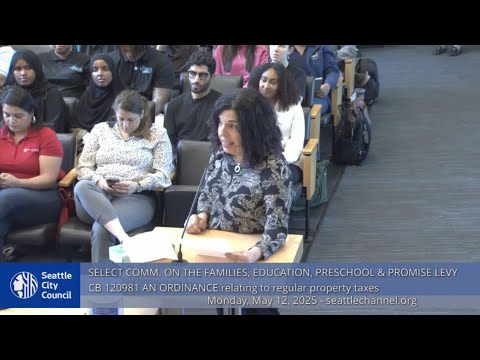
Seattle’s Select Committee on Families, Education, Preschool, and Promise opened a public hearing May 12 on council bill 120981, a proposed six‑year, $1.3 billion levy renewal intended to fund early learning, K‑12 academic and health supports, and the Seattle Promise college and career pathways program.
Seattle’s Select Committee on Families, Education, Preschool, and Promise opened a public hearing May 12 on council bill 120981, a proposed six‑year, $1.3 billion levy renewal intended to fund early learning, K‑12 academic and health supports, and the Seattle Promise college and career pathways program.
Director Dwayne Chapelle of the Department of Education and Early Learning (DEEL) gave a brief overview of the mayor’s “Every Child Ready” proposal, saying the levy would expand early learning slots, bolster services for K‑12 students and sustain Seattle Promise. “This vision focuses on upstream investments and harnesses evidence, research, and what we've observed here…,” Chapelle said.
The hearing matters because FEPP funds operate as a major local source of support for preschool classrooms, after‑school providers, school‑based mental health and safety services, and post‑secondary access programs. The city’s proposal would maintain and expand those investments through a levy lid lift placed before voters in November, with a forthcoming implementation and evaluation plan to set program rules and partner eligibility.
Most public commenters urged the committee to place the levy on the ballot and to preserve or expand specific programs. Seattle Promise staff and students described the program’s role in college access and transfer pathways; University of Washington representatives and Promise advisers highlighted Path to UW transfer advising and outcomes. “Path to UW programming is unique … it removes barriers and support students in making informed decisions,” Lily Peterson said. A Seattle Promise official noted the program’s high FAFSA/WASFA completion rates and the number of students it has supported since 2019.
Speakers representing community‑based violence interruption organizations, including Community Passageways and Choose 180, called for levy funding for community‑based safety and prevention rather than renewed funding for school resource officers. Michael McIntyre of the Alliance for Gun Responsibility urged investment in school counselors, nurses and threat‑assessment teams and suggested levy support for firearm injury research programs at the University of Washington. Several speakers sought explicit protections in levy implementation to ensure funds for community violence intervention groups.
Multiple witnesses, including restorative‑justice practitioners and Seattle Public Schools staff, urged dedicated funding for restorative practices in schools. Lianne Caspi, restorative practices program manager at Seattle Public Schools, said city funding has allowed placement of restorative‑practices coordinators in schools and that coordinators “are the trusted adults in their buildings.” Practitioners and principals described reduced disciplinary incidents and improvements in school climate where those staff work.
Environmental education advocates urged the committee to restore and protect Seattle Parks’ environmental education programming. Speakers from Seattle Parks and volunteer guide programs said the mayor’s proposal would rescue some positions but not the administrative and infrastructure support that schedules and manages field trips. Maggie Johnson and volunteers described the scale of field trips and asked the council to fund at least one additional administrative specialist to make school field trip programs viable.
Early learning providers and advocates — including Parent Child Plus managers, preschool teachers, and family child‑care network representatives — asked the committee to retain and expand preschool slots, home visiting and child care subsidy supports. Testimony noted proposed increases in early learning capacity in the mayor’s plan, including the transcripted goal of 600 new Seattle Preschool Program seats, 800 additional childcare subsidy slots and supports for childcare workers.
Workforce and pathway speakers asked that levy implementation explicitly include pre‑apprenticeship and registered apprenticeship pathways. Representatives from labor training programs and South Seattle College urged that the levy’s Ready to Launch investments support trades pathways and that partnerships between Seattle Public Schools and registered apprenticeship programs be continued and expanded.
Several school principals, educators and nonprofit providers urged continued school‑based levy investments that fund interventionists, family advocates, tutors and counselors. Cleveland STEM and Chief Sealth school leaders described how levy‑funded staff provide counseling, restorative justice coordination, family support and case management. Nonprofits that supply tutors and AmeriCorps members described measurable reading and attendance gains tied to levy funding.
Concerns raised during public comment included requests for a transparent, community‑engaged implementation process; specific questions about whether any FEPP funds would pay Seattle Police Department salaries for school resource officers; and requests for clearer, dedicated line items for restorative practices, environmental education and violence‑interruption organizations.
Procedural notes: the committee adopted the meeting agenda by unanimous consent and the clerk read council bill 120981 into the record as the item for the hearing. Clerk counts showed 69 in‑person and 29 remote speakers signed up; the hearing allowed two minutes per speaker. Chair Maritza Rivera closed the hearing at 7:42 p.m. and directed staff to return with implementation details in early 2026 as described by DEEL.
The committee did not take a final vote on the levy during the hearing. The legislation before the committee establishes the levy amount and investment priorities; DEEL officials said they will return with an implementation and evaluation plan that will define eligible partners, program policies and competitive grant timelines.
What’s next: the committee’s next meeting was scheduled for May 15, when further briefing and a public hearing on related matters were expected. DEEL representatives told the committee they plan to develop the levy’s implementation plan in partnership with community stakeholders and return to council in early 2026 with the detailed program and reporting rules.
Ending: the hearing assembled a broad set of providers, school staff, students and community advocates who overwhelmingly urged that the FEPP renewal be placed on the November ballot and that the city protect and clarify funding streams for early learning, school mental‑health supports, restorative practices, environmental education, apprenticeships and community violence intervention.