Get Full Government Meeting Transcripts, Videos, & Alerts Forever!
Get email alerts on the Starchase Pursuit Mitigation topic
No spam. Unsubscribe anytime.
Committee hears StarChase pursuit-mitigation tracker briefing; city next to pilot a 2-year, $250,000 grant-funded deployment
Summary
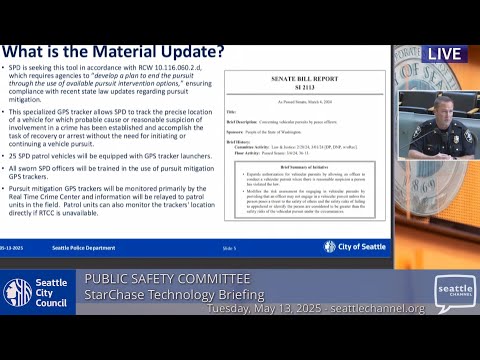
Seattle Police Department presented a material update request to use StarChase pursuit-mitigation trackers as part of its GPS tracking surveillance approval. SPD said a State Department of Commerce grant will fund a two-year pilot equipping 25 patrol vehicles; public commenters urged a standalone surveillance impact report and more public review.
The Seattle City Council Public Safety Committee on May 13, 2025 received a briefing from Captain James "Jim" Britt of the Seattle Police Department on a proposal to deploy StarChase pursuit-mitigation trackers under a material update to the department—s existing GPS-tracking surveillance impact report (SIR).
"Our goal is to pursue technology that makes it so we don't have to pursue," Captain James Britt told the committee, summarizing SPD—s stated aim to reduce dangerous vehicle pursuits while preserving investigative leads. Britt said the department has received a $250,000 grant from the Washington State Department of Commerce to equip 25 patrol vehicles with launcher devices and a two-year subscription to StarChase tracking software.
How it works: Officer-operated launchers project a small tag onto a target vehicle; the device reports latitude/longitude and device status to investigators, enabling tracking without a high-speed pursuit. Britt told the committee the StarChase tags SPD proposes to use have about an eight-hour battery life, are not intended to provide persistent long-term surveillance and are distinct from the existing warrant-authorized covert GPS trackers described in the department—s originating SIR (approved February 2023). He said monitoring would be handled primarily by the Real Time Crime Center (RTCC) when it is operating, and by officers during other hours.
Costs and scope: The $250,000 grant would cover purchase and two years of service for 25 launchers; Britt said continuing the deployment at that level after the pilot would cost about $37,500 per year. He said SPD would train all patrol officers to operate the equipment and that the pilot is intended to test whether the technology reduces pursuits, aids investigations and lowers pursuit-related liability and vehicle damage.
Public commenters pressed for a fuller review. A remote speaker identified as DJ/BJ Last argued that StarChase is a "brand new technology" and "should be going for the full, surveillance impact report process," saying the material-update route "locks the public out" of deeper review and noting the public comment window on the material update was less than two weeks. Cynthia Spieth (recorded in the transcript as Cynthia Spieth/Spies) told the committee that the pursuit trackers are from a different vendor, are not interoperable with existing covert trackers, would require a new contract and recurring expense, and "warrants a new standalone SIR." Those commenters also said the department—s track-changes document replaced answers throughout the original SIR, which they argued indicates a new technology rather than an update.
Captain Britt said the department and the Office of Technology and Privacy determined StarChase qualifies as a material update to the existing GPS SIR rather than a full new SIR. He distinguished the pursuit-mitigation tags from covert trackers by intent and duration: StarChase is designed to enable short-term tracking after a traffic stop or flight to avoid dangerous pursuits and the proposed tags have limited battery life. He said the vendor is widely used nationally and that nearby jurisdictions and counties have been evaluating or deploying similar technology.
Uncertainties and evaluation: Committee members asked about vendor track record, attachment reliability (the devices use adhesive and magnets), weather impacts and success rates; Captain Britt said those factors vary and that SPD will collect deployment metrics and work with its analytics unit to define success criteria such as number of deployments, apprehensions and cases where tracking produced investigative leads without a pursuit.
Next steps and oversight concerns: Captain Britt and the chair agreed to follow up with additional information, including deployment data from other jurisdictions, vendor history and a possible demonstration. Public commenters and some committee members requested clarity on whether the material-update path provides adequate public notice and oversight. The department said the grant covers the pilot so the initial deployment would not require general fund money.