Get Full Government Meeting Transcripts, Videos, & Alerts Forever!
Get email alerts on the Environment Solar Decommissioning topic
No spam. Unsubscribe anytime.
House approves 90-day recycling rule for decommissioned solar panels; sponsors say measure prevents stockpiles
Summary
The Maine House voted to advance a bill that requires solar developers to begin recycling or disposing of decommissioned solar panel materials within 90 days, citing environmental risks from long-term storage; supporters and critics clashed over enforcement and market readiness.
The Maine House voted to send a bill addressing decommissioning and waste handling for utility-scale solar projects to the Senate after a floor debate that focused on environmental protection and regulatory enforceability.
Supporters said the bill fills an enforcement gap and prevents Maine from becoming a repository for decommissioned panels. Representative Lemlin said she inspected a new solar farm and was told, "We're just gonna store the panels up in the county," and argued the bill requires developers to recycle or dispose of materials within 90 days.
The bill's sponsor and other proponents said existing statutes require recycling and proper disposal but that the Department of Environmental Protection has limited enforcement capacity unless a complaint is filed. "They do have provisions for this," Representative Lemlin said of the department, "and I asked the commissioner about this, and I said, how will this be enforced... She says, 'Unless I have a complaint, we're not gonna remove these solar panels.'" Supporters framed the 90-day clock as a practical enforcement tool, not a ban on solar development.
Opponents warned the bill locks future legislatures and regulators into a fixed timetable that may clash with evolving recycling markets. Representative Reilly said the measure "does not provide flexibility necessary for recycling and disposal" and noted that market conditions for recycling in 20 to 40 years are uncertain.
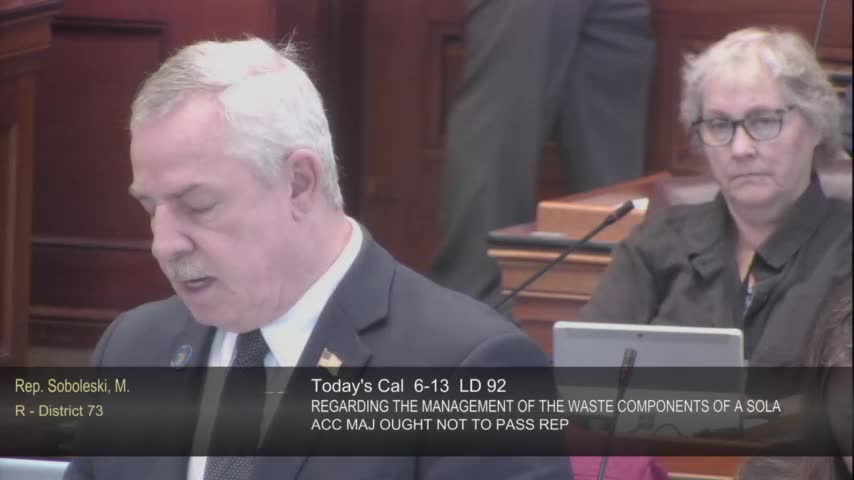
Other floor speakers highlighted the pace of technological change: Representative Sobolewski said newer, smaller panels will accelerate turnover, arguing Maine needs a clear policy for end-of-life management now as older arrays are replaced.
On the vote, the House recorded a roll-call result reported as 73 in the affirmative and 68 in the negative; the motion "prevails" and the bill was sent to the Senate for further consideration.
The measure also includes an emergency clause in sponsorship remarks and assigns oversight roles to the Department of Environmental Protection, which sponsors said would enforce the new timetable and reclamation responsibilities.
Supporters and critics urged the Senate to reconcile two central tensions as the bill moves forward: ensuring timely disposal and recycling to protect the environment, and preserving flexibility so compliance tracks future recycling technology and markets.