Get Full Government Meeting Transcripts, Videos, & Alerts Forever!
Get email alerts on the Traffic Safety Cameras topic
No spam. Unsubscribe anytime.
Council approves expanded automated traffic-safety camera authority after debate over how revenue will be used
Summary
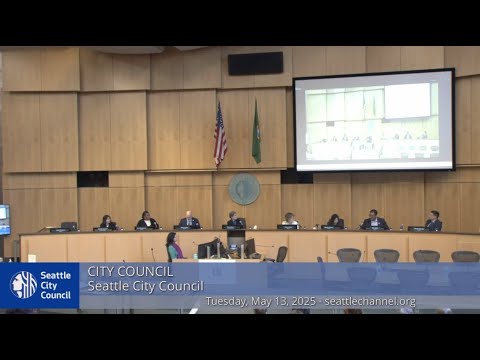
The Seattle City Council on May 13 passed ordinances expanding automated traffic-safety camera authority, adopting amendments that set guidelines on how revenue will be allocated and directing a portion toward pedestrian infrastructure including sidewalks.
The Seattle City Council passed ordinances on May 13 to expand the city's authority for automated traffic-safety cameras and to lift a budget proviso that restricted funds for camera implementation.
The legislation (Council Bill 120971, as amended, and Council Bill 120972) aligns city code with recent state law, authorizes additional camera types and locations beyond school zones and rescinds certain prior designations. The council adopted two amendments that affect how revenue from camera citations will be allocated and how the program will be phased.
Key outcomes - Amendment A (sponsored by Councilmember Sara Hollingsworth) removed a requirement that revenue from a specific camera remain tied to that camera's immediate location; the council adopted Amendment A 7-1. - Amendment B (sponsored by Councilmember Rob Saka) reduced the executive's proposed general-fund share from 80% to 70% of net program revenue and directed 15% of the designated safety fund toward construction or repair of sidewalks; the council adopted Amendment B 5-3. The final ordinance passed on a roll call of 8-0.
Why it matters: The changes expand the city's tools to slow speeding and enforce restricted lanes or school-zone speeds. Council members and remote commenters debated whether camera revenues should be returned to the neighborhoods where cameras are deployed, used for a broad set of Vision Zero safety investments, or designated for sidewalks.
What councilmembers and speakers said - Councilmember Rob Saka, chair of the Transportation Committee, said the bill "aligns current city law with current state law" and would authorize "non-school speed zone cameras, among other things." He described the bill as a step toward scaling camera deployment to reduce dangerous speeding. - Councilmember Sara Hollingsworth, sponsor of the location-based revenue language, said she wanted camera-derived funds to be directed back to impacted communities, while others argued for operational flexibility for the Seattle Department of Transportation (SDOT). - Remote and in-person commenters were split. Charlotte Stark told the council she supported funding and amendments to address high-speed, dangerous roads; Clara Kanter of Whose Streets Are Streets urged that automated-enforcement revenue be returned to slowing speeds and cautioned against using the program primarily as a revenue source.
Budget and implementation details Council discussion referenced varying revenue estimates. Council staff and members noted the program's anticipated revenue at this early stage was modest (staff estimates discussed in the meeting ranged from roughly $300,000 to $500,000 annually depending on deployment). The amendments aim to prioritize safety spending: Amendment B sets a 70/30 split (executive general fund/safety fund) of net revenues and earmarks a portion of the safety fund for sidewalks and related pedestrian improvements.
Next steps SDOT told the council it planned an initial roll-out to scale up school-zone cameras and begin pilot deployments of non-school speed-zone cameras. The bill to lift a proviso in the 2025 budget (Council Bill 120972) clears a path for SDOT to use the allocated funds for implementation. Councilmembers noted the exact timing and number of cameras depends on executive deployment capacity.
Ending: The council and staff said they expect camera deployments to begin this calendar year and continue into the next year as SDOT implements the program and identifies priority locations.