Get Full Government Meeting Transcripts, Videos, & Alerts Forever!
Get email alerts on the Budget Capital Improvement Plan topic
No spam. Unsubscribe anytime.
St. Pete Beach begins FY2026 budget workshops, prioritizes storm repairs and resiliency amid FEMA uncertainty
Summary
City staff asked the commission for policy direction on a draft five‑year capital improvement plan that emphasizes storm repairs and resiliency projects while flagging large unfunded needs, uncertain FEMA reimbursements and enterprise‑fund subsidies.
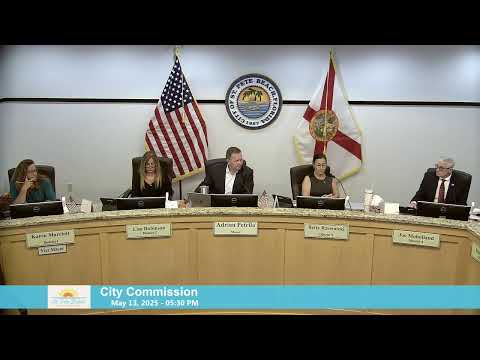
City staff opened the first of five budget workshops asking the St. Pete Beach Commission for policy direction on a draft fiscal‑year 2026 capital improvement plan that prioritizes storm repairs and resiliency projects and highlights substantial unfunded needs.
The workshop presented a consolidated capital program compiled from past studies and asked the commission to endorse staff’s category ranking so staff can pare the long list of projects into a balanced recommended budget. Finance Director Devin Schmidt said the presentation was intended to start a policy conversation rather than to adopt specific spending levels.
The request matters because the city faces large near‑term costs from recent hurricanes, uncertainty over the timing and amount of FEMA reimbursements and a pattern of capital budgets that have outpaced project completions. Schmidt told commissioners that “forecasting the 2026 [budget] presents several challenges” including the hurricane impacts on property‑tax and parking revenues and “uncertainties regarding the FEMA reimbursements and the time frame of those.”
Staff presented fund‑level analyses showing recurring issues: the general fund has subsidized enterprise funds (wastewater, reclaimed water, stormwater), the building fund lost about $3,000,000 in waived permit fees in the past two years, and capital budgeted but not completed has left a large backlog. For 2023 staff said the city budgeted about $22,000,000 in capital projects and completed roughly $4,800,000; in a subsequent year staff reported about $25,000,000 budgeted versus $7,100,000 completed.
The presentation listed many proposed projects across funds, with staff grouping them under categories such as “restore,” “resiliency” and “amenity enhancement.” Examples included seawall replacements (30th Street, Boca Ciega neighborhood, Pass‑a‑Grille living shoreline work), major street and drainage work including Boca Ciega Drive reconstruction with a $7,000,000 stormwater component, rehabilitation of fishing piers and docks, Fire Station 22 demolition and reconstruction, and force‑main and pump‑station replacements in the wastewater system.
Schmidt and staff stressed that the published dollar figures are preliminary engineering estimates that will be refined: “once we get a good revenue picture, we’ll know what to do,” a staff member responding to a commissioner’s concern about seawall per‑foot costs. Staff also noted tariffs and material‑price volatility as drivers that could raise estimates.
Staff outlined hurricane costs and reimbursements: contracts for Hurricane Helene totaled $7,300,000 with $6,200,000 in expenditures to date; Milton emergency contracts were $2.7 million with $761,000 spent so far. Staff said some wastewater pump‑station repairs were initially paid from the general fund and may be eligible for FEMA reimbursement, but timing is unknown and could be several years.
The Finance Budget Review Committee recommended completing fee studies quickly, approaching capital programming so failures and restorations are addressed first, and returning to the commission with staff recommendations and a balanced budget. Schmidt asked the commission for “policy direction for staff to proceed with utilizing the presented capital category prioritization in preparation for the recommended capital budget for fiscal year 2026.” No formal motion or roll‑call vote was recorded during the workshop.
Commissioners asked for realism in annual budgets and pushed staff to prioritize projects that can be executed within a year rather than re‑creating a backlog of unfunded items. Commissioner Marriott cautioned against “overpromising what we’re gonna do when we clearly can’t execute.” Commissioner Mulholland asked staff to report back on the city’s existing leases and whether revenues from leases are being fully captured; he said some leases historically have been “way too cheap.” Another commissioner raised short‑term rental compliance as a potential revenue/administration item but staff cautioned state limits on locally imposed taxes and that some registration fees must be cost‑based and could create administrative burdens.
Staff identified near‑term next steps: finish fee and impact studies, refine engineering estimates and revenue projections, and return with an updated capital improvement plan and the general‑fund operating budget and position listing at the next workshop. Schmidt said the team will present an updated CIP and benefits/position overview at the June 10 meeting. The city manager closed the session by saying staff will return with “more detail” and the workshop was adjourned.
The workshop combined a long list of required rehabilitation projects with staff recommendations to prioritize repairs and resiliency measures first and defer amenity enhancements where funding is limited. The commission provided directional feedback but did not take a formal vote; staff will refine estimates and pursue fee‑study results before presenting a recommended, balanced FY2026 budget.