Get Full Government Meeting Transcripts, Videos, & Alerts Forever!
Get email alerts on the Invasive Species Management topic
No spam. Unsubscribe anytime.
Adams County supervisors approve resolution to seek state grant for Japanese knotweed control at Peppermill Lake
Summary
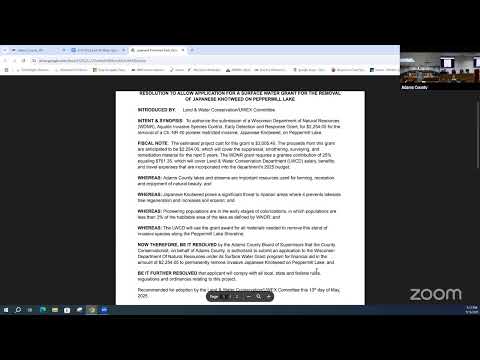
The Adams County Board of Supervisors voted to forward a resolution asking county administrators to apply for a state surface water grant to control an infestation of Japanese knotweed at Peppermill Lake.
The Adams County Board of Supervisors voted to forward a resolution asking county administrators to apply for a state surface water grant to control an infestation of Japanese knotweed at Peppermill Lake.
County staff member Colton told the board that volunteers with the Citizen Lake Monitoring Network located the stand, and that the department found “about a 1,400 square foot population within the riparian area of the Southwest side of the lake.” Colton said the plant is listed as a restricted species under NR 40 and that the county is seeking an Early Detection and Response grant from the Department of Natural Resources’ Surface Water Grant Program to begin control this June.
The measure matters because Colton described the species as aggressive and difficult to control, and because the proposed treatment is conservative and site‑specific: cut back shoots in early June, place about 3 inches of wood chips over the cut material, and cover the area with tarps for a planned five‑year suppression period, followed by remediation with native plants. Colton told the board the county is proposing tarping instead of chemical herbicide “because of the sensitive location and the proximity to some large and healthier native species in the area.” He also said the tarping method was approved by federal and state regulators when the species was listed in 2009.
Board discussion and public questions focused on scale, timing and documentation. Supervisor Jerry Posdowski asked operational questions about staffing and coverage, saying, “What kind of how many people are gonna be doing this?” A resident raised procedural concerns about advance materials, asking why the resolution packet did not include attachments or a plan file for public review prior to the meeting; Colton and the chair replied that only the resolution is required to be on the agenda and that staff could provide additional details by appointment.
The board’s resolution directs county staff to apply for the DNR Surface Water Grant (Early Detection and Response) for the Peppermill Lake site and to bring the grant request and associated plans to the county board. During the vote, Supervisor Jerry Posdowski recorded a “nay.” The chair declared the motion approved and said the item will appear on the county board agenda next week.
The action is contingent on grant approval and any additional permitting or approvals required by state regulators. County staff said shoreline assessments are performed on a rotational basis and that Kiefer and Tyler, the resource conservationists, conduct field assessments; Colton said he could provide a list of lakes that are on this year’s assessment rotation on request.
The board had previously canceled a meeting when there was no business; staff said the Peppermill Lake knotweed discovery occurred after that cancellation during routine chemistry sampling, which prompted the off‑cycle meeting to consider the emergency timing of a treatment window.
The resolution and grant application will now proceed to the county board for final consideration. If the grant is awarded, staff said they plan to implement a multi‑year tarping and replanting regimen at the identified site on the southwest shoreline of Peppermill Lake.