Get Full Government Meeting Transcripts, Videos, & Alerts Forever!
Get email alerts on the Infrastructure Wastewater topic
No spam. Unsubscribe anytime.
Southborough committee seeks MassWorks grants for Route 9 sewer study, debates downtown ask
Summary
Town committee met with engineers from Weston & Sampson to refine two MassWorks grant proposals — a $400,000 geotechnical study for the Route 9 corridor and a previously submitted $2,000,000 downtown request — and to identify likely sites, match funding and next steps.
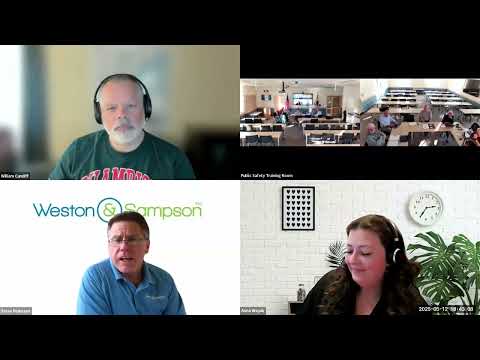
The Town of Southborough’s wastewater committee met May 12 to coordinate MassWorks grant applications aimed at bringing municipal sewer service to the Route 9 corridor and to consider a separate, larger downtown project.
Committee members and engineers from Weston & Sampson reviewed two expressions of interest the town submitted: a plan centered on Route 9 that the group described to engineers as seeking roughly $400,000 for geotechnical work and initial design, and an earlier $2,000,000 request focused on a downtown wastewater facility. The committee discussed likely project scope, potential disposal or recharge sites, schedule constraints tied to the MassWorks one-stop application, and the town’s ability to provide matching funds.
The discussion matters because town leaders say sewer infrastructure along Route 9 is intended to support commercial and industrial development there — a stated goal of increasing the nonresidential tax base and easing residential tax pressure. The advisory group asked Weston & Sampson to help shape the narrative required by the MassWorks project impacts table, including estimated housing units, jobs and commercial square footage that inadequate infrastructure now prevents.
Engineers advised the committee that state environmental guidance and recent technical reviews make groundwater (subsurface) discharge the likely disposal approach rather than open-water discharge. Committee members described a target capacity range in preliminary planning of roughly 0.5 million to 0.75 million gallons per day for a plant that could serve the corridor in future build-out.
Potential sites discussed for recharge or siting included: an area of town-owned land near the DPW that committee members said might hold roughly 1.5 acres; the town golf course as a possible recharge field (which would raise questions about conservation restriction language and requires coordination with the conservation commission and CR grantees such as the Sudbury Valley Trustees); a parcel within the I‑495 median north of Route 9 that was described as MassDOT-controlled land that could be viable only with MassDOT real-estate concurrence and potential legislative support; and the EMC property on the west end of Route 9, which committee members said is about 50 acres of underdeveloped or developable land and could serve as a focal site for the Route 9 effort.
Committee members also discussed a possible regional approach — building larger capacity that could serve neighboring towns — but emphasized there are no commitments from adjacent communities and that regional cooperation would be a much larger undertaking.
On application logistics, Weston & Sampson staff walked the committee through the one-stop portal sections, noting character limits on narrative boxes (some at about 1,000 characters and others around 2,000) and the portal’s expectation of concrete numbers in the project impacts table (housing units, jobs, and square footage tied to infrastructure constraints). The consultants recommended assembling attachments and letters of support (including from private developers and state legislators) but cautioned attachments are typically not scored and that reviewers spend limited time on each application.
The committee discussed funding and match requirements. Town members reported an expectation that the town would plan for approximately a 25% local match if awarded design money and identified a likely funding mechanism as free cash certified before a special town meeting — the select board was said to be generally supportive but the budget remains tight. Committee members also raised District Improvement Financing (DIF) as a possible longer-term financing tool to capture tax increment for infrastructure payback.
Next steps agreed by participants included: Claire Reynolds (committee volunteer who has led previous grant work) sending the draft application material she has compiled to Weston & Sampson; Weston & Sampson producing an annotated application outline and helping populate technical sections; Sam Stivers and Bob Moss drafting an economic-impact narrative and numbers for the project-impacts table; Al Hamilton and staff sending the master plan and parcel/spreadsheet data to the consultants; and the town planning to brief the select board about an anticipated local match requirement. Weston & Sampson said they can fill parts of the IGX/one-stop portal as primary contact if the town prefers.
Committee members debated whether to pursue both grant asks at once. Some participants said Route 9 is the higher-priority, higher-impact target for long-term tax-base growth. Others advocated keeping a scaled-back downtown predevelopment request that demonstrates steps taken along the MassWorks “development continuum” (early studies and commitments that would justify later construction funding). No new construction funding was approved at the meeting; members emphasized that the $2,000,000 downtown request (previously filed as an expression of interest) seemed premature without developer commitments or clearer build-out plans.
The group set short internal deadlines to assemble the application package and to meet again within a week, and scheduled follow-up outreach to potential private developers and state legislators. The committee also agreed to ask the select board to designate the town administrator as the organization CEO for the portal and to plan a fall special town meeting to consider a potential match appropriation if a grant award is likely.
Implementation uncertainties flagged during the meeting included: the technical challenge of identifying and permitting a suitable recharge/disposal site; conservation-restriction encumbrances on the golf-course option; MassDOT control and leasing rules for potential land in the I‑495 median; the need for clear developer commitments to make a downtown construction ask competitive; and the timing pressure from the MassWorks application schedule.
Members closed the meeting by assigning responsibilities, confirming that Weston & Sampson would draft and refine the application language with town contacts, and agreeing to reconvene for additional work sessions as the one-stop deadline approaches.