Get Full Government Meeting Transcripts, Videos, & Alerts Forever!
Get email alerts on the Education Budget topic
No spam. Unsubscribe anytime.
Fall River school committee holds public hearing on FY2025 budget as unions raise ratification and program-cut concerns
Summary
At a May 12 public hearing on the proposed fiscal 2025 budget, teachers and union representatives urged clearer public disclosure of cuts and timely ratification of negotiated agreements; district staff said some summer programs may require fees after ESSER funding ends.
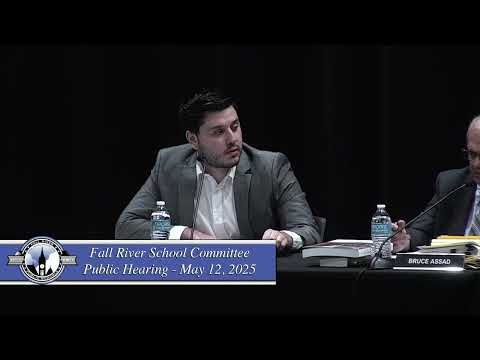
FALL RIVER, Mass. — The Fall River School Committee held a public hearing May 12 on the proposed fiscal year 2025 budget, where educators and union representatives urged the committee to clarify planned staffing and program changes and to ratify negotiated memorandum of agreements (MOAs).
Keith Mishan, president of the Fall River Educators Association, said the budget "is a moral document," and urged the district and committee to make clearer which positions and programs will continue. "Elementary students deserve access to working school libraries," Mishan said, citing the planned elimination of the technology/library media specialist position at Sylvia as a specific concern.
The hearing also included remarks from Sheila Kearns, social coordinator for AFSCME Council 93, who pressed the committee to ratify four MOAs ratified by the union membership and criticized individual committee members for seeking internal union meeting minutes and for acting outside their roles. "The negotiated MOAs that are before this committee are not complicated," Kearns said, adding that "the union is not going to tolerate the stalling tactics that are being used."
A district administrator identified as Merrick described how the end of federal ESSER funding affects summer offerings. "There is a summer enrichment program at Durfee High School, which historically has been for pay, and that will continue," Merrick said. He said some summer-credit recovery offerings have historically been free during the school year, creating a policy question about whether summer versions should carry a fee; district staff are reviewing proposed fees and “are trying to lower the cost, to be as low as possible and still cover all of our costs.” He said other summer enrichment that had been free under ESSER funding may not continue without new funding.
School Committee members asked procedural and disclosure questions during the hearing. Member Mr. Dias asked who receives notice of the public hearing; the committee recorded that notice was published in The Herald News, which a member said meets the legal requirement but suggested expanding outreach beyond a single paper so more residents can participate. Another committee member mentioned the committee’s remaining unallocated funds and asked staff to provide a cost estimate for continuing summer programming in the operating budget.
The chair read the statutory public-hearing language required by Mass. Gen. Laws, ch. 71, § 38N; the committee did not vote on adoption of the budget during the hearing. The public hearing concluded after the required reading and the committee then moved to adjourn. A motion to adjourn was seconded and carried on a roll-call vote.
The hearing combined statutory procedure with public comment and raises several follow-up items for the committee: clarifying which positions and programs will be eliminated or converted, providing cost figures for summer programming previously funded by ESSER, and completing timely action on the four MOAs ratified by union members.