Get Full Government Meeting Transcripts, Videos, & Alerts Forever!
Get email alerts on the Coastal Resilience topic
No spam. Unsubscribe anytime.
Boston and Revere plan road and park elevations, marsh restoration for Bennington Street flood risk
Summary
Catherine McCandless, senior climate resilience project manager for the City of Boston Office of Climate Resilience, told the Nantucket Coastal Resilience Advisory Committee on May 13 that Boston is designing a multi‑jurisdictional project to raise Bennington Street and elevate Fredericks Park to reduce coastal flood risk in East Boston and adjacent Revere.
Catherine McCandless, senior climate resilience project manager for the City of Boston Office of Climate Resilience, told the Nantucket Coastal Resilience Advisory Committee on May 13 that Boston is designing a multi‑jurisdictional project to raise Bennington Street and elevate Fredericks Park to reduce coastal flood risk in East Boston and adjacent Revere.
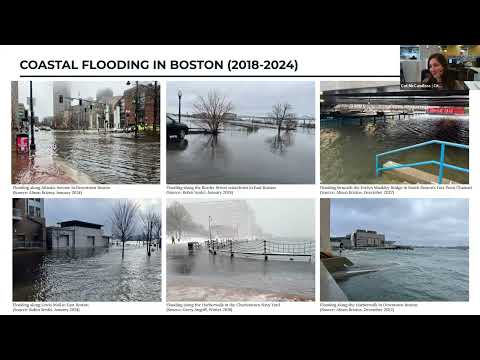
McCandless said the Bennington Street and Fredericks Park project will "move down Bennington Street and wrap around the perimeter of the park," addressing flooding that currently overtops the roadway from the neighboring Belle Isle Marsh and disrupts the MBTA Blue Line access and a K–8 school in Revere.
The project is one example of Boston's larger Climate Ready Boston program. McCandless summarized that planning has prioritized near‑term 2030 flood pathways and longer‑term protections through technical studies and partnerships, including a six‑year U.S. Army Corps of Engineers coastal storm risk management study that the city said could enable a 65/35 federal cost share for major construction.
Why this matters: Bennington Street is an evacuation corridor serving East Boston, Winthrop and Revere; the marsh adjacent to the roadway is ecologically significant and regulated as an Area of Critical Environmental Concern. McCandless said the roadway and Fredericks Park currently flood in frequent storm events and that protecting both transportation access and recreational open space is central to the project goals.
Key project choices and rationale
McCandless described an alternatives analysis released in June 2024 and said the team is now advancing a recommended approach in schematic design after two Municipal Vulnerability Preparedness (MVP) grant cycles. For Bennington Street the preferred approach is to elevate the roadway rather than rely on a marsh‑side berm or vertical flood wall because elevation reduces the need for pumping and limits wetland impacts. For the privately owned Veterans of Foreign Wars (VFW) property adjacent to the marsh, project designers proposed a land swap and removal of some parking to make room for a nature‑based berm instead of an 8‑foot retaining wall.
On Fredericks Park the team’s preferred option is to elevate the park to increase usable recreational space while reducing storm and sea‑level risk. McCandless said the alternatives analysis considered roughly 20 options and that wetlands permitting near the salt marsh has been a major constraint.
Costs, funding and schedule
McCandless told the committee the current preliminary construction estimate for the overall project is about $55,000,000, which includes the road elevation and diet, park elevation, buried seawalls recommended by the Army Corps and public‑realm improvements. She said Boston has relied on a mix of city capital, state grants and federal programs for implementation but noted federal funding uncertainty: "With the recent federal changes, specifically the elimination of the FEMA BRIC program ... the city has lost $36,000,000 in awarded funding for 2 major projects," she said, adding that Boston had also submitted a $50,000,000 BRIC grant application that would support other resilience work.
McCandless said the project team includes consultant VHB (lead engineers) and Terra (landscape architects), and project stakeholders include the Massachusetts Department of Conservation and Recreation (which owns Belle Isle Marsh), MassDOT, the MBTA and private property owners. She said the project began after an MVP grant award in September 2023, that a second MVP grant funded schematic design work, and that the team is aiming toward 50% schematic design and then permitting; she cautioned that wetlands permitting and multi‑agency approvals could extend the timeline.
Questions from the committee
Committee members asked about zoning, private property coordination, groundwater and funding alternatives. McCandless described Boston’s coastal flood resilience overlay in municipal zoning and an internal city standard the team “strives for” of designing to a 20/70 flood elevation for city‑led projects and encouraging partners to match that level. On private properties she said the city has used partnerships and cost‑sharing with multiple property owners to build district‑scale defenses and cited district projects in East Boston that span seven property owners.
On groundwater and subsidence McCandless said consultants are accounting for groundwater impacts and subsidence in the park design and that parts of Fredericks Park will be raised by an extra margin to allow for future settling. On federal funding she said the city is evaluating phased construction and multiple grant sources and considering alternative financing such as revolving funds, climate banks or business improvement districts to cover project costs or maintenance.
Next steps
McCandless said the project will move into continued schematic design, coordination with permit authorities and outreach to affected property owners; she recommended expect permitting and funding work to extend the timeline and encouraged stakeholders to contact the project team for details.
Ending
McCandless closed by offering to connect committee members with project staff and the consultant team and by pointing interested parties to Climate Ready Boston materials online for further project tracking.