Get Full Government Meeting Transcripts, Videos, & Alerts Forever!
Get email alerts on the Council Chambers Access Weddings topic
No spam. Unsubscribe anytime.
Salem committee pauses weddings in council chambers during business hours, cites ADA access concerns
Summary
The Salem City Council Committee on Government Services voted to recommend a temporary ban on newly scheduled wedding ceremonies in City Council Chambers during business hours, citing repeated accessibility problems and the need for a formal policy and room reconfiguration to ensure Americans with Disabilities Act compliance.
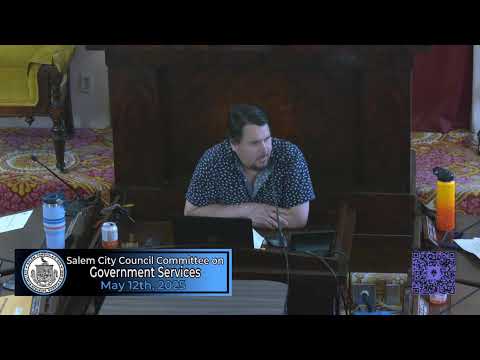
The Salem City Council Committee on Government Services voted May 12 to recommend that the full council bar newly scheduled wedding or marriage ceremonies in City Council Chambers during regular city hall business hours, including a 45-minute buffer before opening and after closing, while the city develops a formal use policy and addresses accessibility concerns.
Committee Chair Varela said the committee would refer Councilor Stott’s order to full council “as amended,” after Councilor Stott moved the recommendation and Councilor Merkel seconded. Chair Varela recorded that she saw four hands plus her own in favor and declared the matter carried.
The vote followed extended discussion focused on whether the chamber’s current layout and event practices keep the space compliant with the Americans with Disabilities Act. Councilor Stott, who introduced the order, framed it as a temporary pause on scheduling new ceremonies in the chambers during business hours while the city confirms scheduled bookings and works on longer-term solutions. “No newly scheduled wedding or marriage ceremonies may be performed in council chambers during city hall business hours,” Stott said when introducing the order.
Human Resources Director and ADA facilitator Lisa Cammarata told the committee the room can meet a minimum 36-inch accessible path when furniture is arranged properly but warned that the configuration often changes and that enforcement and permanent measures are needed. “That was why I got here a little early. We want a 36-inch width path at least,” Cammarata said, and later added that the city could pursue more permanent stanchions or other fixtures to keep a clear path.
Councilors described repeated incidents in which event setups blocked doorways and passageways. Councilor Merkel said staff reported a recent photo shoot that obstructed access near a water cooler, and mentioned an active discrimination complaint filed on disability grounds. “We still have many incidences of blocked doors, complaints, and comments being made to people walking through,” Merkel said.
Several councilors argued the practical issue is not banning ceremonies generally but ensuring public access and staff safety during business hours. Councilor Marcello urged a broader review of room use rules, furniture placement and occupancy limits; Councilor Cohen, a committee nonmember who participated in debate, said he supported Stott’s order and noted repeated examples of difficulty moving through the chamber when events occur.
The committee also discussed three policy options presented by the clerk for next steps: (1) take no immediate action and ask the clerk to propose access solutions; (2) amend the clerk’s delegated authority with specific time-and-manner restrictions and a required designated ADA pathway; or (3) rescind delegation to the clerk and require city council approval for chamber use. The committee voted to keep the separate item about compiling data on weddings in committee and to keep the chamber-use policy item in committee for further work, adding the anteroom to the policy discussion.
Public commenters supported the committee’s focus on accessibility. Alfon Trike, a resident, told the committee that ADA compliance in the chamber has been a longstanding problem and called the proposed pause appropriate. A caller on Zoom echoed those remarks.
The committee instructed staff and members to prepare for a follow-up meeting: gather a list of scheduled events, consult the city’s flag-raising policy and Salem Code Chapter 2 Section 10 on use of the council chambers, consult the Disabilities Commission and fire/building officials about occupancy and access, and draft specific options for furniture, stanchions or other permanent measures. Members said the city clerk will be asked to participate in the next discussion. The committee did not adopt any rule changing weddings in other city spaces; several members noted weddings remain available in the city clerk’s office and other city meeting rooms outside of the council chambers.
The committee’s recommendation to the full council was procedural — to refer Councilor Stott’s order for a positive recommendation as amended — and does not itself alter city code. Further council action will be required to make any permanent change to chamber use or to the clerk’s delegation of authority.