Mecklenburg supervisors reject 7 Bridges Solar siting agreement and deny 80‑MW permit after months of hearings
Loading...
Summary
After an extended public hearing with dozens of speakers for and against, the Mecklenburg County Board of Supervisors voted to reject a developer’s siting agreement and then denied a special‑exception permit for the 80‑megawatt 7 Bridges Solar project, citing farmland, forest conservation and river‑corridor concerns.
The Mecklenburg County Board of Supervisors voted May 12 to reject a siting agreement with 7 Bridges Solar LLC and, after a separate hearing, to deny a special‑exception permit to build an 80‑megawatt solar facility near Chase City.
The board first voted to reject the siting agreement offered by the developer; a later roll‑call vote approved a motion to deny the special‑exception permit. The denial cites staff findings that the proposed project would place panels on roughly 435 acres inside a larger 1,249‑acre property that includes areas mapped as prime farmland and forest with high ecological value and that the site lies near the South Meherrin River, a tributary to the Maherrin River.
Why it matters: The votes stop a project Long Road Energy has been developing since 2017 that the company and supporters described as a local source of renewable electricity, a multi‑million‑dollar revenue stream for Chase City and the county, and a construction‑period jobs generator. Opponents argued the site threatened water quality, historical resources and farmland, and that prior solar projects in the region had caused erosion and other lasting impacts.
Long Road Energy and backers outlined changes they said addressed community concerns. Cliff Sher, development director for Long Road Energy, told the board the project had been reduced from about 942 acres to roughly 435 acres of panel footprint and that the company had offered a series of mitigations, including a 250‑acre conservation easement adjacent to the South Meherrin River, a western construction access road to reduce traffic at Scott’s Crossroads, expanded capital payments to Chase City and a commitment to use First Solar modules. "We are not utilizing good neighbor agreements on this project," Sher said, presenting a sworn affidavit he said had been handed to the county.
Supporters — including landowners, local nonprofit representatives and several residents — spoke in favor of the project, calling it a source of local revenue and long‑term investment. John Mullen, a landowner who negotiated the option with Long Road, told the board the company had "listened to the community and addressed concerns" and that the site was well‑sited for transmission access. Karen Drozdiak of First Solar described her company’s panels and recycling program and said the technology was proven in other jurisdictions.
Opponents urged the board to protect river water quality, farmland and scenic and historic resources. Deborah DeSantis, who lives where the project’s main construction entrance would be located, described receiving a "good neighbor" document and said she would not sign it, adding, "There was no way that I would ever sign that agreement." Judy Brothers of Friends of the Meherrin River cited erosion, siltation and historical sites along the river corridor and recommended rejecting the project. Other speakers cited concerns about panel disposal, wildfire risk, and the adequacy of erosion control during construction.
Staff and the board cited several technical concerns in the decision denying the permit. The board’s motion to deny referenced findings in the staff report and state planning models noting agricultural and forestry conservation values on the site, the property’s identified ecological significance, and the site’s proximity to the South Meherrin River and the Maherrin River scenic corridor as designated by the General Assembly (cited at hearing as Va. Code §10.1‑418.3). The staff statement also said the developer had not provided an overall vehicle count for proposed construction routes and that potential off‑site impacts to waterways merited denial.
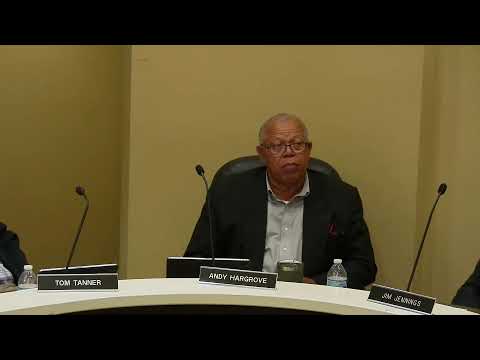
Roll‑call outcomes: On the siting agreement rejection vote, supervisors registered these recorded positions ("Yes" votes rejected the siting agreement): David Brinkley (Yes), Craig Gravatt (Yes), Dennis Spence (Yes), Andy Hargrove (Yes), Sterling Wilkinson (Yes), Brenda Blackwell (No), Claudia Lundy (Yes), Tom Tanner (No), Jim Jennings (Yes). On the later special‑exception permit denial, the board’s roll call was similar and the motion to deny passed.
Board members also debated the county’s long‑term approach to solar development. Several supervisors emphasized property‑owner rights and the need to follow ordinances and the comprehensive plan; others stressed the county’s responsibility to protect water and environmental resources. The board noted that planning commission hearings had previously recommended approval in some cases but concluded the staff report and site‑specific impacts supported denial.
The project’s next steps: With both the siting agreement and permit denied, the developer could seek further administrative remedies, revise and resubmit plans, or pursue other legal options. County staff and several speakers noted that change in energy sourcing is likely to continue across Virginia and that future proposals will probably return to the board.
The decision concluded a daylong public hearing that drew roughly 20 speakers for each of the project’s two hearings and extensive written materials submitted to the county.