Get AI Briefings, Transcripts & Alerts on Local & National Government Meetings — Forever.
Senate committee adopts substitute to require filtration in small systems after repeated complaints
Loading...
Summary
A Senate committee advanced a substitute to Senate Bill 2,497 that would require small public water systems to install filtration for underground wells when TCEQ has recommended treatment and the system received multiple complaints in the prior year; witnesses warned the measure is prescriptive and costly for small utilities.
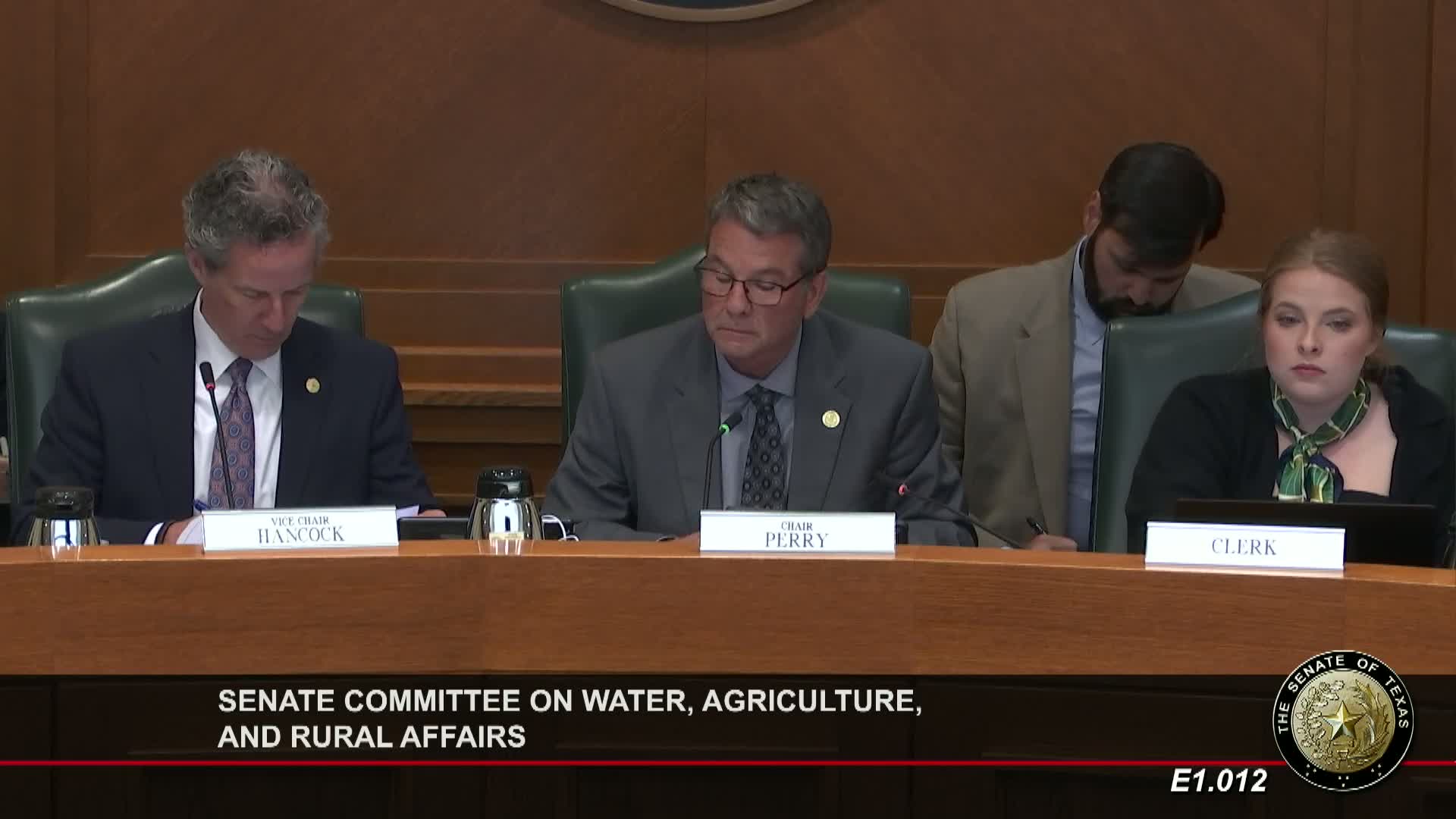
A committee of the Texas Senate on Wednesday advanced a substitute to Senate Bill 2,497 that would require certain public water suppliers relying on underground sources to install filtration systems when the Texas Commission on Environmental Quality (TCEQ) has recommended filtration and the supplier received more than one TCEQ complaint about that source in the previous year.
The substitute, which the committee adopted and sent to the full Senate, applies only to systems serving fewer than 100 connections and to parameters where TCEQ and the U.S. Environmental Protection Agency identify secondary contaminant exceedances, and only when filtration can be installed at a reasonable cost, the bill author said. Senator Zaffirini, the bill’s sponsor, told the panel the measure is intended to address ongoing water quality complaints such as discoloration, odor and cloudiness in small systems.
Supporters and resource witnesses told the committee they want reliable, aesthetically acceptable water for customers. Michelle Risco, a resource witness with the Texas Commission on Environmental Quality, said secondary contaminants are ‘‘non health based’’ and ‘‘aesthetic in nature’’ but confirmed TCEQ’s role in recommending treatment: "For the record, my name is Michelle Risco. I'm with the Texas Commission on Environmental Quality as a resource witness on the bill, and that is correct." The committee substitute restricts requirements to systems for which TCEQ previously recommended filtration and that have had multiple complaints.
But the Texas Rural Water Association, represented by Mary Alice McCahon, said the bill as drafted is overly prescriptive and will not resolve the majority of water-quality problems. McCahon told the committee that installing a single filtration system for a small system with fewer than 100 connections could cost ‘‘between $200,000 and $300,000’’ and warned that a filtration unit alone may not fix issues driven by distribution systems, source water chemistry, or treatment selection. "As the bill is written, as the committee substitute is written, we have to testify against the bill," McCahon said, adding the association wants flexibility so TCEQ and water-system experts can determine the appropriate treatment.
A consumer witness from Floresville, Carrie Wilcox, told the committee her community experienced brown water after a filtration system was removed and said residents had received multiple rate increases without seeing promised improvements. "We are willing to pay for good water," Wilcox said, recounting notices of rate increases and noting that residents learned the filtration system had been removed when water became brown overnight.
Committee members discussed the trade-off between requiring treatment and shifting costs to customers. Senator Hancock said many constituents want problems fixed but ‘‘nobody wants to pay to fix it,’’ while other senators urged flexibility so TCEQ and rural water experts can recommend the most effective treatment rather than a single mandated approach. The sponsor and members expressed an expectation to accept an amendment on the floor to give regulators and water experts more flexibility.
The committee adopted the committee substitute and reported the bill favorably to the full Senate; the chair said the bill would go to the floor with the expectation of an amendment to address implementation concerns. For the record, the committee recorded a final committee vote of 5 ayes and 2 nays on the substitute. The bill will return to the Senate floor for additional consideration and amendments.
The committee hearing included technical discussion of treatment options (chemical treatment, ozone for iron, tannin removal) and a repeated emphasis that small water systems and rate payers bear the cost of capital improvements. Several members asked staff and stakeholders to continue negotiations on substitute language that would permit TCEQ to choose an appropriate treatment approach when filtration is not the optimal solution.
If enacted as substituted, the measure would create a regulatory trigger for installation of filtration in narrowly defined small systems with documented complaints and prior agency recommendation; the committee directed continued work to refine cost, treatment choice, and funding/affordability concerns.