Get email alerts on the Municipal Governance topic
No spam. Unsubscribe anytime.
Committee advances bill allowing very small Texas cities to convert to Type C governance
Summary
House Bill 303 would remove a 501-resident floor so Type A and B general-law municipalities with populations under 501 can incorporate as Type C cities; the committee left the bill pending and later reported it favorably.
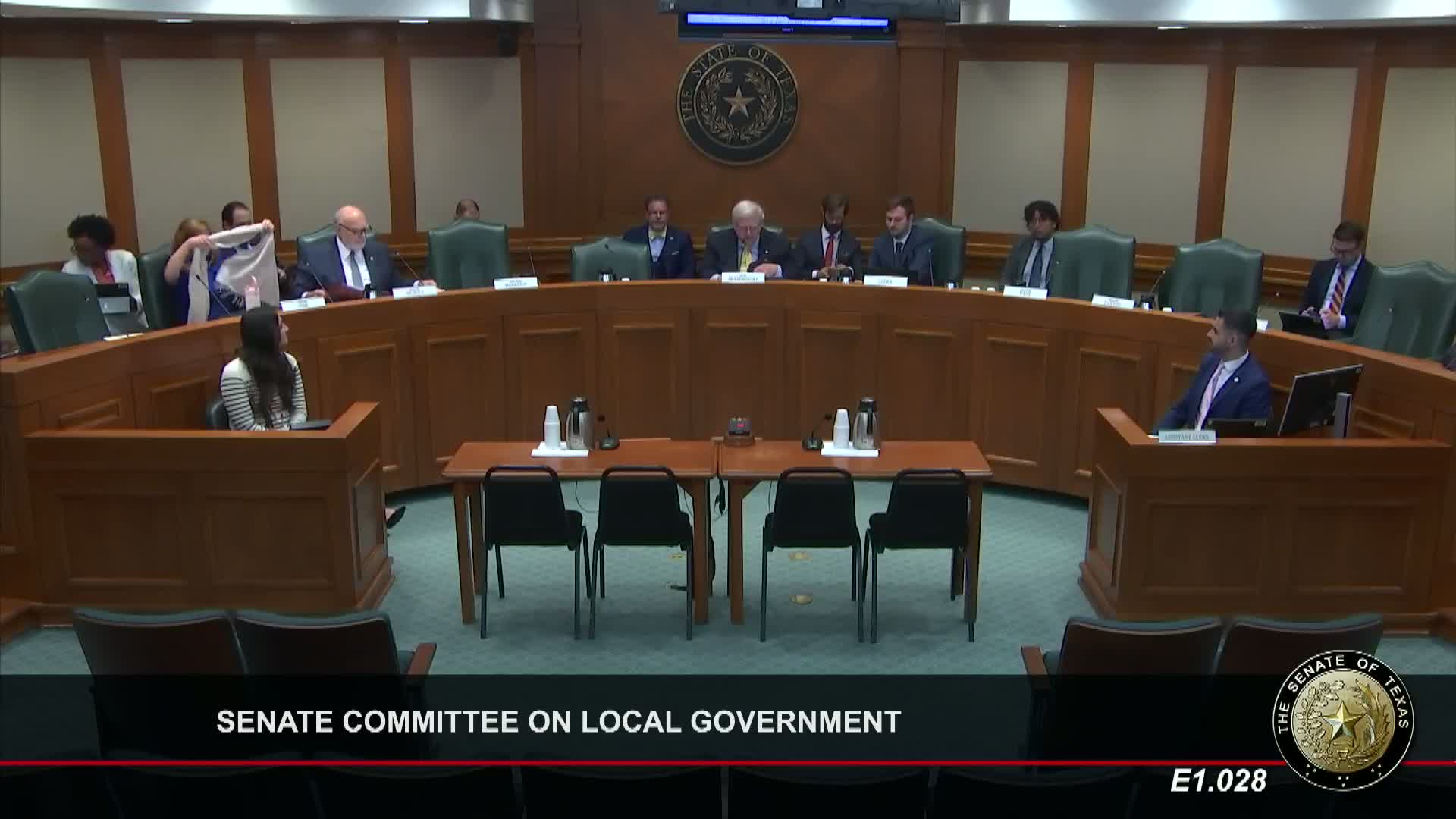
The Senate Committee on Local Government left pending House Bill 303, a bill that removes a population-floor requirement and would allow small Texas general-law municipalities to convert to Type C status.
Senate sponsor Sen. Hagan presented the bill and cited Quintana in Brazoria County as an example: ‘‘The village’s population has declined from close to 500 in 1890 to less than 30 residents today,’’ he said, adding that Quintana has difficulty meeting Type A governance obligations, which require a mayor and five aldermen.
Under current law, conversion from Type A or B to Type C is limited by population brackets that effectively prevent communities with fewer than 501 residents from becoming Type C cities. The bill would amend section 8.0288021 of the Local Government Code to remove the 501‑resident floor for Type A and B cities to incorporate as Type C municipalities.
Committee members opened public testimony and received no speakers; the chair left the bill pending. Later in the meeting the committee reported HB 303 to the full Senate and recommended it for the local and uncontested calendar with a recorded favorable vote.
Supporters said the change would let very small communities adjust government form to match current population and administrative capacity; no public opposition or legal impediments were raised in committee testimony.
AI generated
The text on this page is AI generated. Summaries, highlights, analysis, and video transcripts are all produced from the original source material.
AI can make mistakes, so if you spot one, and we will fix it for everyone.
Note: the source content is unaltered by us. Any content source we link to, be it a video, an audio recording, or a document, is presented exactly as its publisher released it. That publisher is usually a government body, sometimes an individual official or another organisation.