Get Full Government Meeting Transcripts, Videos, & Alerts Forever!
Get email alerts on the Consumer Protection Identity Theft topic
No spam. Unsubscribe anytime.
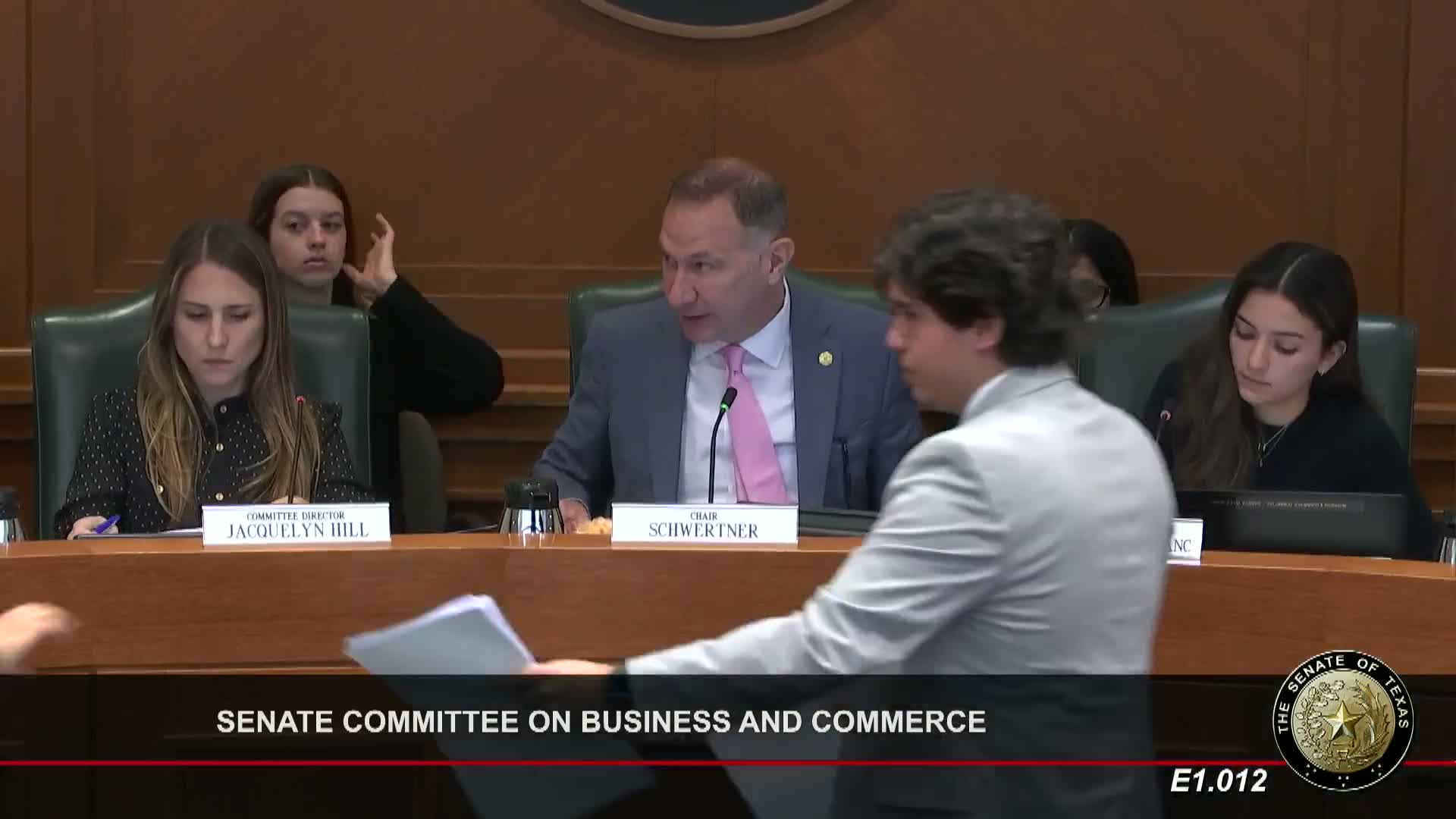
Senate panel hears support for HB 4238 to protect victims of coerced debt and identity theft
Summary
The Senate Committee on Business & Commerce heard testimony supporting HB 4238, which would limit debt collection when consumers present a court order showing debts were incurred through identity theft or coercion, including in domestic-violence cases.
The Senate Committee on Business & Commerce heard testimony in favor of House Bill 4238, a bill intended to protect consumers from collection attempts on debts incurred through identity theft, including coerced debts arising from domestic violence.
Senators were told the measure aligns with prior work on coerced debt and would give victims a clear mechanism to stop collection activity. Senator Dean Zaffirini described the committee substitute as narrowing proof of identity-theft victim status to a court order issued under state law, a substantially similar federal law, or comparable law in another state, and giving creditors and collectors seven business days to cease collection after receiving the order.
Angela Litman, professor of law at the University of Texas, testified in her individual capacity that her research shows coerced debt can ruin victims’ credit and prevent access to housing, employment and utilities. “HB 42 38 provides crucial relief for victims of domestic violence and it also applies to victims of elder abuse and of course to all victims of identity theft,” Litman said, adding that the committee substitute requires a court order as proof.
Molly Voyles Wallace, director of public policy for the Texas Council on Family Violence and a member of the Texas Coalition on Coerced Debt, described coerced debt as a documented form of identity theft in Texas since 2019 and said the bill is narrowly tailored. “If you go to the trouble to get a court order to declare you a victim of identity theft … then you should not be able to collect that debt from a victim who may have been physically assaulted to accrue it,” she said.
Committee members asked procedural questions; senators noted they received the committee substitute the morning of the hearing and that no floor vote was planned that day. The committee closed public testimony and left the bill pending.