Get Full Government Meeting Transcripts, Videos, & Alerts Forever!
Get email alerts on the Rent Control Economic Analysis topic
No spam. Unsubscribe anytime.
Senate panel considers dash-1 that directs economic analysis of rent-control effects and contemplates tax-credit pilot for new construction
Summary
A dash-1 amendment to Senate Bill 500 would require the Oregon Office of Economic Analysis to prepare a report by Dec. 1, 2026, assessing whether income-tax credits would be an effective supplement to Oregon’s rent-control law in preserving and producing affordable housing.
A dash-1 amendment to Senate Bill 500 would task the Oregon Office of Economic Analysis with an independent study of how income-tax credits and other policy tools interact with Oregon’s rent-control law, and would require a report to legislative committees on revenue by Dec. 1, 2026.
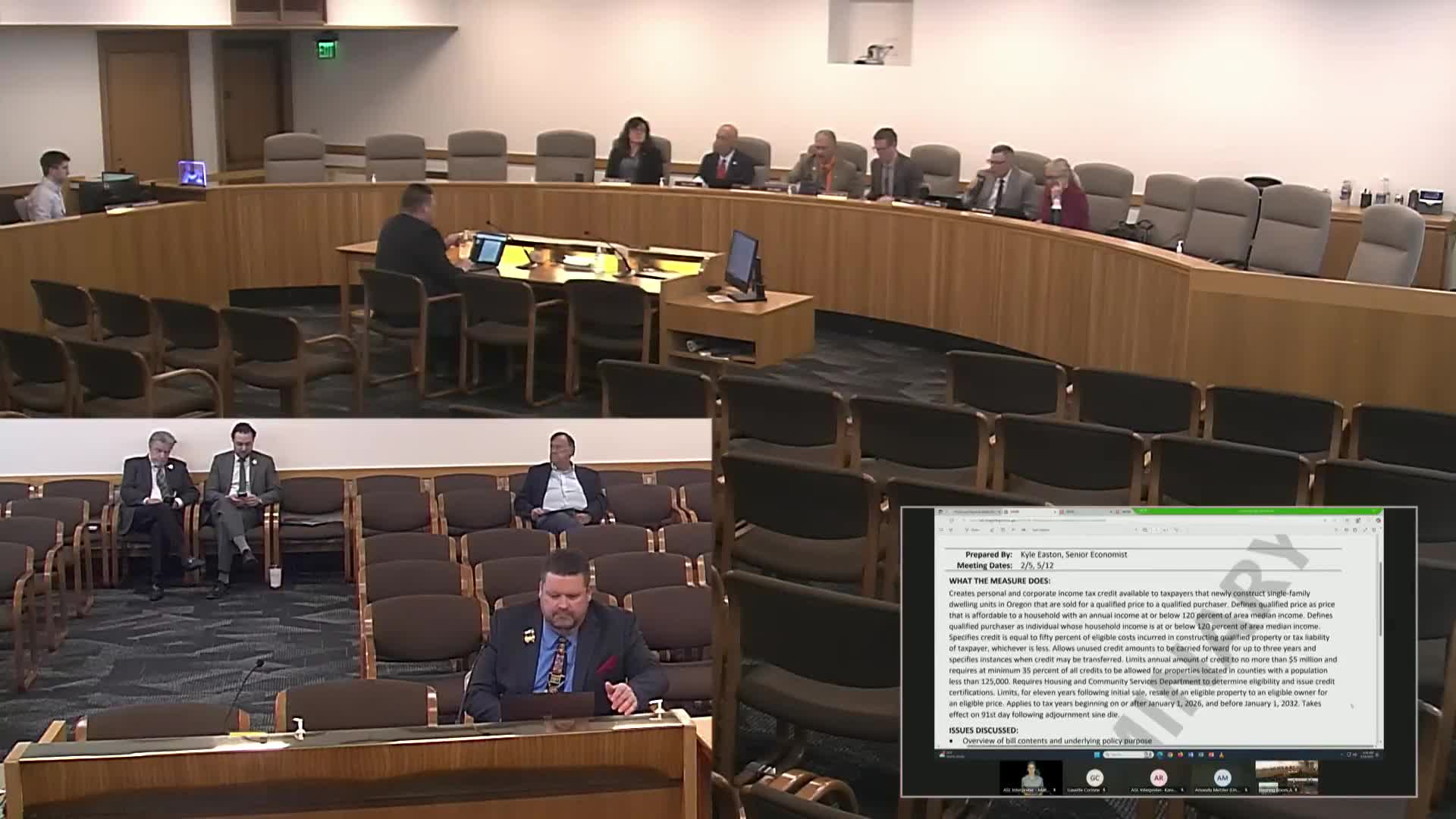
Sponsor testimony by State Senator David Brock Smith described the bill’s original concept — a pilot of $5 million per year in tax credits for five years to incentivize construction of qualified single-family or multifamily workforce housing — and said the dash-1 replaces the original contents to focus legislative attention on rigorous evaluation. The dash-1, as described in committee, requires the Office of Economic Analysis to analyze the effectiveness of tax credits as a supplement to rent-control law in preserving and producing affordable housing.
Rick Metzger of the Oregon Housing Providers Coalition and Brock Nation, policy director for Oregon Realtors, spoke in favor of the dash-1. Metzger emphasized that Oregon has not had an independent, statewide economic analysis of the 2019 rent-control law’s effects on production and preservation, and said the dash-1 would provide “an independent view” and empirical data to guide future policymaking. Nation told the committee that increasing housing supply is the principal long-term remedy and that the dash-1 would help determine whether tax credits would increase preservation and construction of affordable units.
Why it matters: witnesses said anecdote-driven policymaking has produced uncertainty for private capital and developers and that a robust, impartial economic analysis could inform whether tax-credit supplements to rent-control law would change construction or preservation outcomes. The dash-1 sets a reporting deadline of Dec. 1, 2026, and proponents framed the study as a necessary piece of evidence before making further statutory changes.
No committee vote on the dash-1 was recorded in the hearing; the public hearing for SB 500 concluded after testimony and the witness list was exhausted.