Get Full Government Meeting Transcripts, Videos, & Alerts Forever!
Get email alerts on the Farm Tax Deferral Illegal Cannabis topic
No spam. Unsubscribe anytime.
Senate hearing: bill would strip farm tax deferral for land knowingly used for illegal cannabis grows
Summary
Senate Bill 347A would deny or revoke farmland special assessment (farm-use tax deferral) for landowners who knowingly allow illegal cannabis cultivation; the bill includes a 10-year penalty period and an affirmative defense for landowners who lacked knowledge or took immediate action.
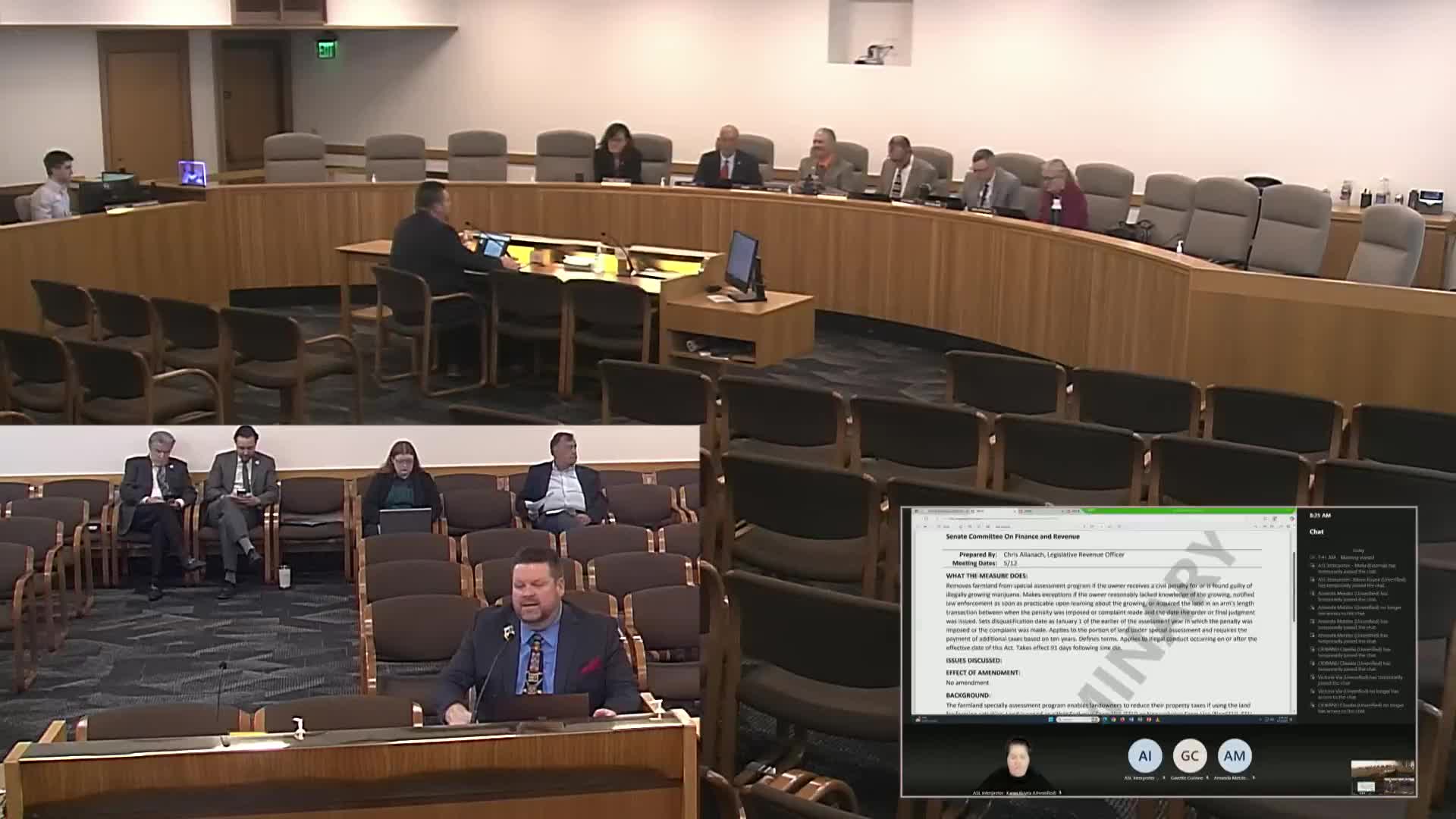
Senate Bill 347A, which the committee scheduled for public hearing Monday, would bar farmland special assessment (the farm-use tax deferral) for properties used for illegal cannabis cultivation and impose a 10-year tax penalty in qualifying cases.
Senator David Brock Smith, the bill sponsor, told the committee that illegal grows in parts of Southern Oregon have proliferated and are often tied to organized criminal activity. He described living conditions and labor abuses at some illegal sites and said the bill is intended to take away a financial incentive for landowners who knowingly allow such activity.
Representatives of the Oregon Farm Bureau Federation and local officials supported the bill. Jenny Dressler of the Oregon Farm Bureau told the committee the bill provides a disincentive for landowners “for taking these bags of cash and allowing this to happen,” and described the bill’s affirmative defense for landowners who lacked knowledge or who contacted law enforcement as a fair safeguard. Amanda Metzler, former chair of the Josephine County Cannabis Advisory Panel, said the bill fixes a “loophole” by holding landowners accountable in many situations while enumerating exceptions where a landowner would not be held responsible.
Committee members asked about threats and coercion associated with cartel activity. Senator Brock Smith said threats to workers and victims are a known element of criminal grows and described the harms to individuals trafficked into illegal cultivation. Vice Chair McLean explained, referencing prior judicial committee review, that the bill’s affirmative-defense structure is consistent with Oregon law on exemptions and that the proposed mechanism is a tax-based civil sanction rather than a criminal penalty.
Why it matters: supporters said the measure adds a civil, tax-based enforcement tool that counties and state agencies can use to discourage illegal cannabis operations on farmland while preserving an affirmative defense for landowners who did not know about the activity. The committee heard no formal opposition during the public hearing and closed the witness list after testimony.