Get Full Government Meeting Transcripts, Videos, & Alerts Forever!
Get email alerts on the School Safety Uvalde Strong Act topic
No spam. Unsubscribe anytime.
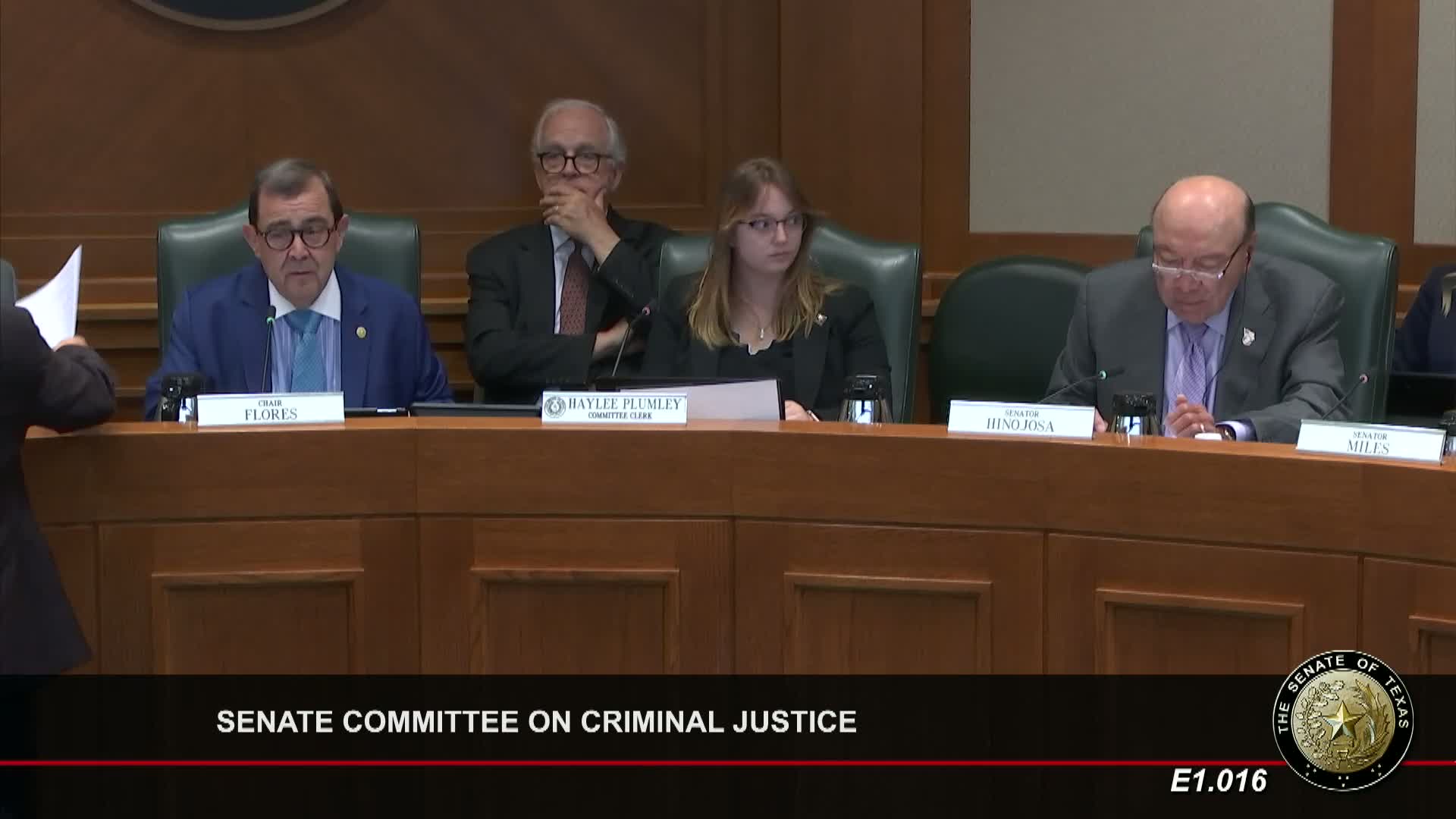
Senate committee advances Uvalde Strong Act to tighten school active‑shooter preparedness
Summary
The Senate Committee on Criminal Justice voted to report the committee substitute for House Bill 33, the Uvalde Strong Act, after extended testimony and discussion about training, security reviews and mutual‑aid agreements to better prepare responders and schools for active‑shooter incidents.
The Senate Committee on Criminal Justice voted to send the committee substitute for House Bill 33, the Uvalde Strong Act, to the full Senate with a favorable recommendation, backing measures that would require security reviews of school facilities, establish standardized active‑shooter training and expand incident reporting and mutual‑aid planning among responders.
The bill follows the May 2022 shooting at Robb Elementary in Uvalde, where committee members and witnesses said failures in coordination and preparedness exposed critical gaps. “This bill will require a public school district that constructs, acquires, and renovates the district facility to conduct a security review of the facility,” the chair told the committee, outlining the measure’s core requirements.
Supporters told the committee the legislation focuses on coordination, training and practical tools rather than creating a large ongoing state cost. Chair Flores and others described removing an original accreditation grant from the fiscal note and relying on existing resources and grant programs administered by the Criminal Justice Division of the governor’s office. Senator Huffman, who presented portions of the measure, said the bill “implements new safety and security requirements for certain law enforcement agencies, educational institutions, governmental entities, emergency medical service providers, and political subdivisions in instances of active shootings and other emergencies.”
Colonel Freeman Martin of the Texas Department of Public Safety testified as a resource witness, urging emphasis on meaningful tabletop exercises and noting the operational differences among more than 2,700 Texas law enforcement agencies. He told the committee that after the Uvalde shooting DPS issued policy guidance directing officers that “if there's an active shooter at a school and there's rounds going off inside that school, you can assume no matter who's there or what they tell you, you can't assume that that's not an active shooter” and that officers should continue to press on until the shooter is stopped, language he said reflected a change in practice.
The bill would require annual meetings among schools, law enforcement and first responders; standardize active‑shooter response policies for municipal, county and campus police; require a public information officer with continuing education at certain entities; and direct the Texas Division of Emergency Management to prepare a preparedness guide. The Advanced Law Enforcement Rapid Response Training (ALERRT) Center at Texas State University, San Marcos, would develop a training program and a template for after‑action evaluations.
Committee members pressed on the bill’s costs and sustainability. Senator Huffman noted the original fiscal estimate had been high because it included a $25,000 accreditation grant per agency for thousands of agencies; committee sponsors removed that ongoing cost from the substitute and emphasized use of existing state programs and the governor’s grant program.
The committee approved the substitute and voted 6–0 to report it favorably to the Senate; the clerk recorded six ayes and no nays. The committee recommended the substitute for the local, uncontested calendar and directed it to the floor for further action.