Get Full Government Meeting Transcripts, Videos, & Alerts Forever!
Get email alerts on the Childcare Background Checks topic
No spam. Unsubscribe anytime.
Audit finds gaps in Oregon childcare background checks; state agencies say laws and systems have narrowed risks but gaps remain
Summary
A 2020 audit by the Oregon Secretary of State found gaps in how the state ran background checks for childcare providers, and agency officials told the Joint Committee on Legislative Audits they have enacted statutory and technical changes but that several risks and implementation tasks remain.
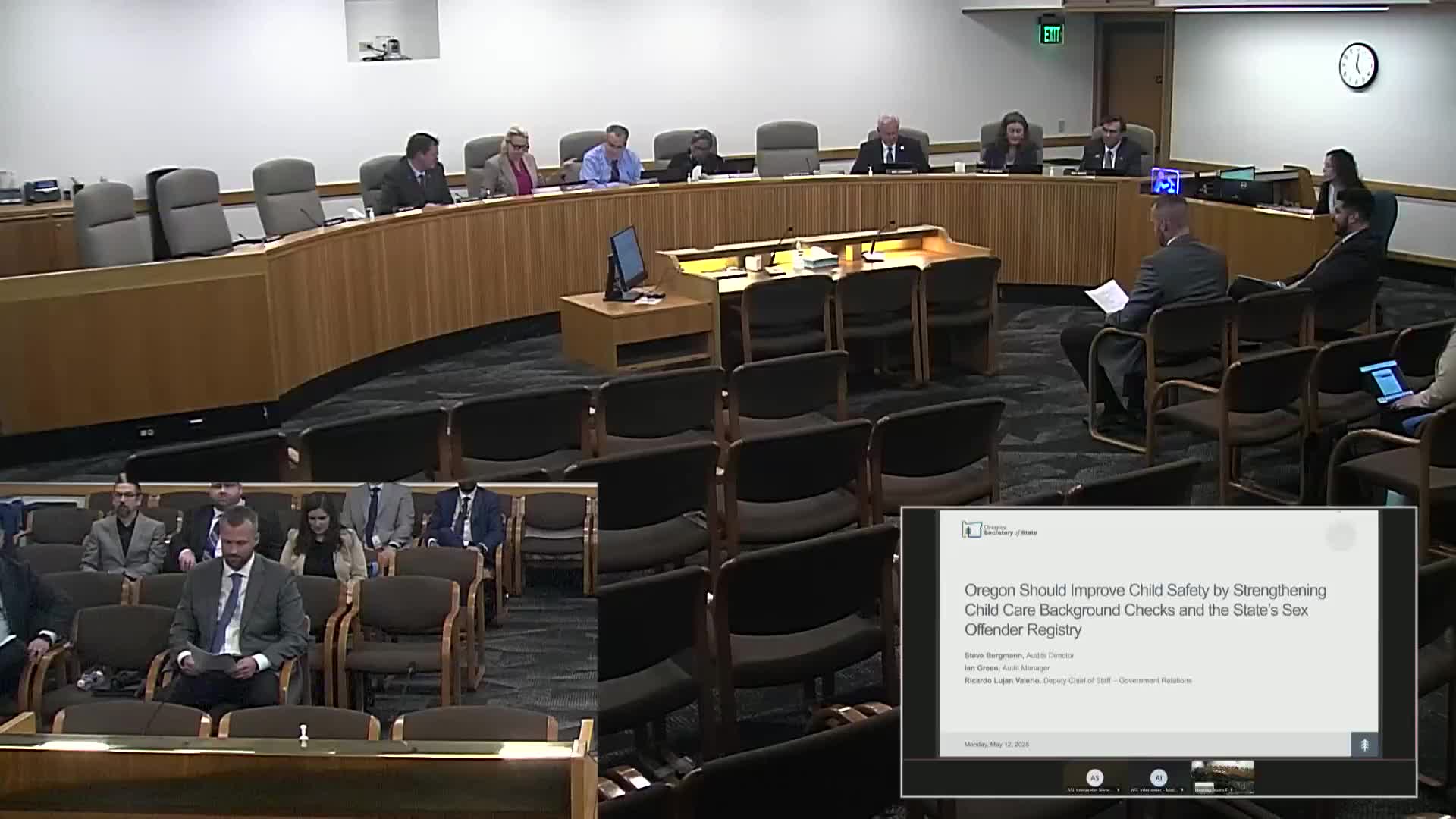
Salem, Ore. — A 2020 audit by the Oregon Secretary of State found that Oregon’s background‑check system for childcare providers had gaps that left some children at increased risk, and agency officials told the Joint Committee on Legislative Audits on May 12 that legislation and system changes have reduced those gaps but not eliminated them.
“For parents, background checks serve as one critical safety control,” said Ian Green, an audit manager with the Oregon Secretary of State Audits Division, summarizing the audit’s purpose and findings. The audit reviewed how Oregon met federal and state background‑check requirements after federal rules expanded in 2017.
The audit identified a number of shortfalls: inconsistent standards across agencies about which crimes disqualify a provider; multiple, poorly connected data systems that hamper sharing of founded abuse or neglect findings; and weaknesses in the offender registry, which relied on self‑reporting and did not meet several federal standards. Auditors said they identified 70 providers the state was attempting to disqualify, 21 providers that should have been disqualified but were not acted on, 11 providers with criminal histories the agency lacked awareness of, and 125 instances where providers had at least one founded case of abuse or neglect.
The findings led to eight recommendations. Several changes have since been enacted or partly implemented, agency officials told the committee. “House Bill 4,005 helped clear the way for the Office of Child Care now to conduct background checks for all providers,” said Alyssa Chatterjee, director of the Department of Early Learning and Care. Chatterjee said the agency’s central background registry had enrolled more than 86,000 individuals by the end of 2024 and that temporary and permanent rules to standardize disqualifying crimes and background‑check standards were adopted in 2022.
Chatterjee described technical and interagency steps taken since the audit: an interagency agreement with the Oregon Department of Human Services (ODHS) to share adult protective services data, monthly automated address comparisons with the Oregon State Police (OSP) sex‑offender registry, and enrollment of personnel in recorded (nonlicensed) programs into the central registry after passage of Senate Bill 1547.
“We maintain an interagency agreement with the Oregon Department of Human Services … and there are regular check‑ins,” Chatterjee said. She also explained that OSP provides monthly updates on the registered‑offender registry and that DELC receives those updates to identify potential matches.
Jeff Akin, interim deputy chief operating officer at ODHS and administrator of ODHS’s background‑check unit, told the committee that ODHS has implemented two of its three assigned recommendations and partially implemented the third. ODHS performs hundreds of thousands of background checks across programs: “Last year, we did about 232,000 background checks,” Akin said, and he estimated ODHS’s active caseload in ORCHARDS at roughly 350,000 to 375,000 individuals. Akin said some monitoring remains complaint‑driven and manual; he urged funding for an automated continuous‑monitoring tool known as Rapback (sometimes spoken as “wrap back”) to scale active monitoring.
“Rapback provides an active monitoring system where … the agency is gonna receive notification of that exact arrest … as soon as I’m fingerprinted and that’s entered into the system,” Akin told the committee, describing how Rapback would notify agencies in near real time of new criminal history rather than relying on biennial rechecks or complaints.
OSP officials described steps they have taken on the audit’s recommendations related to the offender registry and information sharing. “In 2021 OSP began receiving a monthly address report of facilities and licensed childcare locations from DHS and DELC,” said Sean Joyce, director of Criminal Justice Information Services at the Oregon State Police. OSP runs a comparison of registered‑offender addresses against those locations and provides matches back to the licensing agencies; agencies then must request any additional offender information OSP holds.
OSP deputy CJIS director Mitchell Stevens explained how Oregon’s public offender website differs from federal SORNA guidance (the Sex Offender Registration and Notification Act, part of the Adam Walsh Act of 2006). “Where Oregon deviates from SORNA is by using the risk‑based leveling system instead of an offense‑based tiering system, and only includes on the public website the level 3 offenders who present the highest risk,” Stevens said. He said the registry’s public site includes identifying details for level 3 offenders and that the agency added FAQs to explain the site’s limits.
Committee members pressed agencies about remaining limits. Representative Maxine Boyce asked whether the 56,000 background‑check figure earlier cited referred to State Police; Ian Green clarified that the 56,000 figure concerned background checks for childcare providers performed by ODHS and the Office of Child Care at the time of the audit. A senator asked about a backlog of unclassified offenders; OSP confirmed all registrants must report but said unleveled offenders make it harder to know who should appear on the public site.
Agencies and auditors emphasized statutory limits on information sharing. Green noted that “statutory limitations … prevent some sharing of information,” and that in some cases OSP is barred from proactively sharing registry information even when it knows an offender has disclosed an occupation involving childcare. OSP and ODHS said they have pursued legislative changes in past sessions to expand proactive sharing; several bills were introduced in recent sessions but did not advance.
No formal committee votes or policy decisions were taken at the informational meeting. Agency officials told the committee which audit recommendations they consider implemented, partially implemented or still needing work, and they identified remaining dependencies: federal cooperation on interstate exchange of background information, legislative funding to expand automated monitoring (Rapback), and continued work to classify offenders and enhance the public registry.
The audit and agency testimony leave several outstanding issues the committee flagged for follow‑up: the practical limits of interstate responses to background queries (some states provide little or inconsistent data), the backlog of offender classifications that affects which individuals appear on the public registry, and the degree to which continuous monitoring tools can be funded and deployed across ODHS’s large caseload.
The meeting was informational; members said they will hear additional Secretary of State reports at a future meeting and can summon agencies back for updates if the committee requests further follow‑up.