Get Full Government Meeting Transcripts, Videos, & Alerts Forever!
Get email alerts on the Campaign Finance topic
No spam. Unsubscribe anytime.
Speakers at Cleveland Democracy Day urge constitutional amendment, criticize local campaign finance practices
Summary
At a May 12, 2025 Democracy Day public hearing, Cleveland residents and activists urged a constitutional amendment to limit corporate political spending, criticized the influence of large donors on elections, and raised concerns about recent local council fundraising and contribution-limit changes.
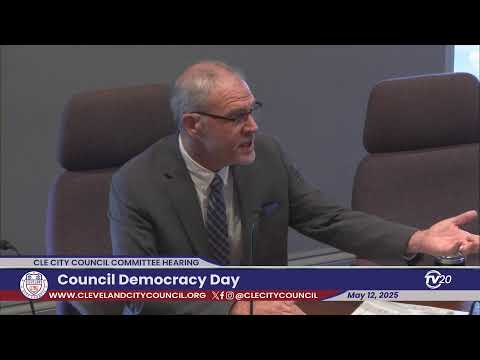
Cleveland City Council convened a Democracy Day public hearing on May 12, 2025, where residents and activists called for a constitutional amendment to prevent corporations from exercising political speech rights and criticized the influence of large campaign donors at both the state and local level.
The hearing, required by Section 106 of the Cleveland City Charter, began with a letter from Mayor Justin M. Bibb read into the record by Councilman Chris Harsh. "Your voice matters," the mayor wrote, urging civic participation and calling attention to the 2010 U.S. Supreme Court decision in Citizens United v. Federal Election Commission as a catalyst for increased corporate political spending.
The event gave each speaker up to five minutes to address the "corrosive influence of money in politics." Steve Norris, organizer of the Cleveland Democracy Day hearing, reviewed the 2016 citizen initiative that collected more than 9,000 signatures and prompted the city ordinance establishing the biennial hearing. "Democracy Day is about shining a light on the impact of unlimited political spending on Cleveland," Norris said.
Several speakers tied national issues to local concerns. James Lam, a Third Ward resident, said he wanted concrete action beyond statements. "When I talk about democracy, I'm looking at something that it was or it has been around for a long time," Lam said, adding he often sees elected officials only around election time. Sean Freeman said campaign success is increasingly measured by dollars raised rather than ideas, and urged leaders to match words with campaign-funding choices.
Greg Coleridge, co-director of the national Move to Amend campaign, connected large private donations to a state-level request for public subsidies for a new football stadium. Coleridge cited reporting and campaign-finance figures he said show the Haslam family has contributed heavily to Ohio candidates, and said those donations increase private influence over public decisions. "Since money is speech, then those who have the most money have the most speech," Coleridge said.
Public commenter Justin Strekel highlighted recent Cleveland City Council actions, saying the council "did just double the contribution limit for donors" and that the council leadership fund had been used to oppose a citizen-initiated participatory-democracy ballot measure. Strekel described the council leadership fund as an "incumbent protection plan" and said the combination of higher contribution limits and concentrated leadership funding discourages challengers.
Speakers also discussed campaign costs and local campaigning: one commenter estimated the cost to mail to households in a ward at roughly $1 per household and said a council campaign can cost $15,000–$40,000 depending on approach and scale. Organizers said testimony and written statements would be forwarded beyond the city: Councilman Chris Harsh said the letters and testimony collected at the hearing would be sent to the Ohio General Assembly delegation and the city's congressional delegation.
The hearing was framed as an opportunity to press elected officials for policy changes ranging from a constitutional amendment to local reforms on campaign finance rules. No formal city vote or new ordinance was enacted at the hearing; the record will be transmitted to state and federal elected officials as stated by Councilman Harsh.
The hearing closed after roughly two hours of testimony and the councilman gavels out the 2025 Democracy Day session.