Get Full Government Meeting Transcripts, Videos, & Alerts Forever!
Get email alerts on the Courthouse Flooding topic
No spam. Unsubscribe anytime.
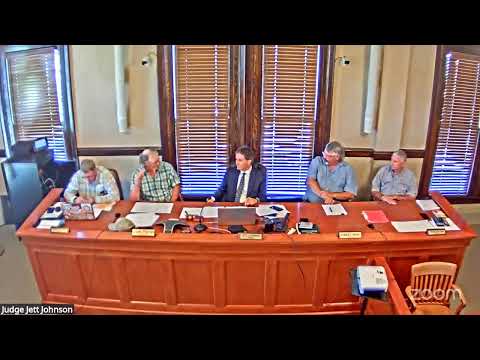
Mills County reviews courthouse flooding, considers excavator work and drainage fixes
Summary
Commissioners heard facility staff describe seepage in the courthouse foundation after heavy rain and reviewed a contractor proposal to excavate, repair a moisture barrier and reroute drains; no contract was approved.
Mills County commissioners on May 12 examined recurring seepage and flooding at the courthouse and discussed repair options including excavation to restore a moisture barrier, extending exterior drain lines, and tying into an existing underground 4‑inch drain.
The issue is significant because water reached the county attorney’s office and probation area on the courthouse’s south side after recent heavy rains; county staff said visible seepage occurred under the foundation and through the elevator shaft during storms.
Facilities manager Mister Burns told the court he contacted a local contractor, Topcut Lawn Service, which proposed using a mini‑excavator and a sod cutter to dig out soil adjacent to the foundation, repair the moisture barrier and resod the area. Burns said the contractor quoted $125 per hour and would bill as a service call; the contractor did not provide a fixed total because the extent of excavation and repairs depends on conditions discovered in the field.
Commissioners and staff discussed two drainage options: extend the exterior concrete drain approximately seven feet past the building edge or convert the runoff to a 4‑inch underground line and tie into an existing drain elsewhere on the property. Staff also reported past repair work on the clerk’s office corner that included moisture‑barrier replacement and that prior excavations reached roughly 5 feet deep to access the foundation.
Staff described problems tracing some existing drain lines; a camera run reportedly shows sections of pipe are broken or filled with gravel and concrete. Burns said the elevator‑shaft sump pump shows water returning into the shaft during heavy rains, and staff recorded water flow at levels higher than expected, which complicates diagnosis.
No formal contract or motion to accept the contractor’s service proposal occurred at the meeting. Commissioners asked staff to obtain a written estimate with scope and hourly projections, to clarify whether the contractor can install or replace the recommended moisture barrier material, and to schedule a tracer/camera run to locate the failing pipes. Commissioners also noted the senior‑citizen building ramp washout as a related storm‑damage item for future work.
The court directed staff to follow up with the contractor for a detailed proposal and to provide estimated hours and total costs before returning to commissioners for approval.