Get Full Government Meeting Transcripts, Videos, & Alerts Forever!
Get email alerts on the Nurse Practitioner Residency topic
No spam. Unsubscribe anytime.
Panel urges state support to expand community health center nurse-practitioner residency program
Summary
Lawmakers heard from community health center leaders and sponsors on a bill to establish a statewide community health center nurse-practitioner residency to improve recruitment and retention of nurse practitioners in underserved areas; Worcester’s long-running pilot was cited as evidence of success.
BOSTON — Lawmakers heard testimony supporting a bill to establish a community health center nurse-practitioner (NP) residency program in Massachusetts, a proposal sponsors said would expand a model that has operated in Worcester since 2009 and improve retention of clinicians in community settings.
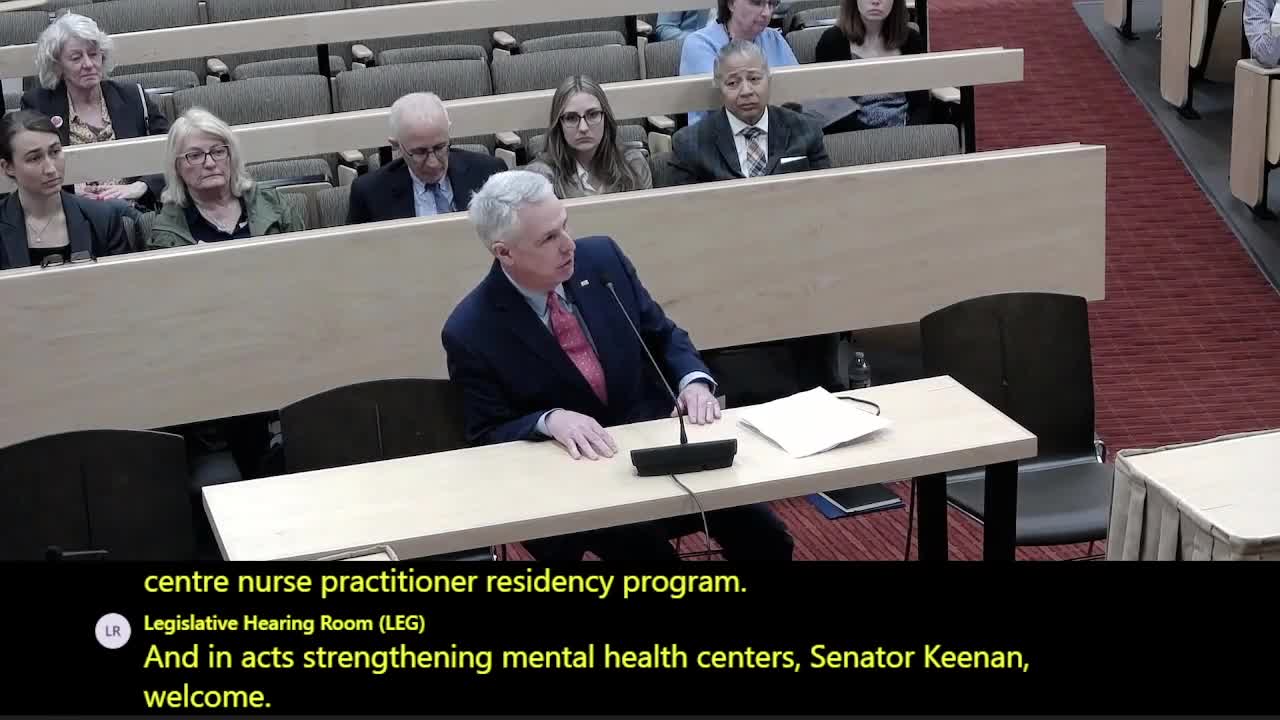
Senator John Keenan and Representative Mary Keefe, both sponsors, framed the bill as a response to workforce shortages at community health centers. Keenan cited a 2023 CHI workforce survey showing vacancy rates above 10% for physicians, nurses, physician assistants and social workers at community health centers.
Representative Keefe introduced clinicians from Worcester and Boston to explain a long-running pilot that provides the evidence base for the measure. Brenda Cechia, a family nurse practitioner and medical director of primary care at Family Health Center of Worcester, described the Worcester residency — established in February 2009 — as the first in the Commonwealth and the second in the nation. Cechia said the program provides full-time supervised clinical training, structured didactic learning and mentorship; she reported that 15 current and former NPs on staff at Family Health Center came through the residency and that 10 NPs remained beyond the formal obligation in Worcester.
Monique Anderson McCurbin, medical director at Codman Square Health Center, described accreditation and success in preparing clinicians to deliver culturally competent, team-based primary care in community settings. Speakers described the model as a retention strategy, not just training: the bill would fund residency slots and require an additional post‑residency service commitment (witnesses described Worcester’s model as 1 year in residency followed by a 1‑year obligation in the health center; the sponsored bill contemplates a 24‑month residency with an additional 18‑month commitment in some drafts; proponents said specifics could be adjusted).
Lawmakers pressed for fiscal detail. Panelists said their center’s budget for three NP residents was about $620,000 for the residency year (that figure included salaries, preceptor time and administrative support). Committee members also asked about other estimates that appeared in the hearing: Senator Keenan referenced an approximate $2.5 million figure as a statewide estimate for program expansion, and proponents clarified that smaller figures (for example, $600,000) referred to a limited number of slots rather than a statewide rollout.
Witnesses emphasized that the residency equips newly graduated NPs to practice at full scope in community health centers — managing chronic and acute problems, integrating behavioral health and addressing social determinants — work that respondents said differs from hospital-based training. The panel asked the committee for favorable action to expand the pipeline of primary care clinicians willing to work in community health centers.