Get Full Government Meeting Transcripts, Videos, & Alerts Forever!
Get email alerts on the Dig Law Damage Prevention topic
No spam. Unsubscribe anytime.
Committee advances updates to dig law; manual-probing definition removed for further work
Summary
The House Commerce Committee reported House Bill 392 as amended to strengthen Louisiana’s damage-prevention law for underground utilities, adding training and transparency requirements and deferring a new definition of "manual probing" for further work.
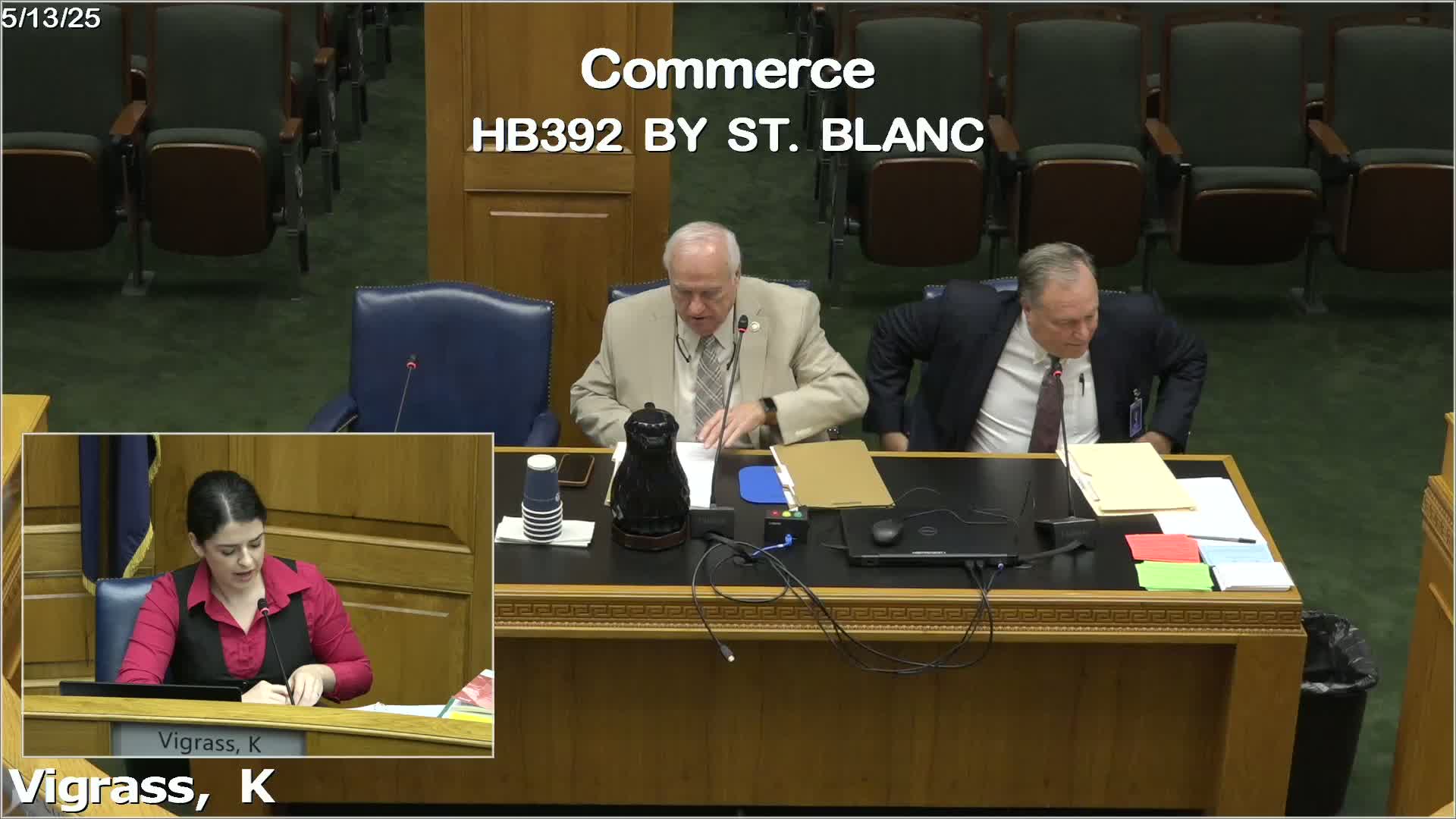
The House Commerce Committee reported House Bill 392, sponsored by Representative Saint Blanc, with amendments to strengthen Louisiana’s underground utilities and facilities damage-prevention law (the “dig law”). The bill updates definitions and procedures for excavation and demolition and adds requirements intended to reduce damage to underground facilities during broadband and other construction projects.
Representative Saint Blanc described the bill as the product of the Dig Law Advisory Committee, a stakeholder group that includes electric and gas utilities, pipeline operators, telecommunication companies, water and sewer providers, contractors, home builders, engineering groups and state partners such as the Department of Natural Resources (DNR) Pipeline Safety, DOTD and others. He said the committee’s work followed about 18 months of vetting and collaboration.
Emery Belton, chairman of the Dig Law Advisory Committee, told the committee the bill makes several technical adjustments and seeks to address damage caused largely by rapid broadband deployment, especially in rural areas. He said the committee removed a proposed definition of "manual probing" from the bill for further work because stakeholders and the Senate raised technical questions about how it would operate in the field. "The issue isn't fully baked," Belton said, and the committee will return with more precise language after additional stakeholder input.
Other amendments adopted in committee clarified that the 120‑hour marking period for certain tickets does not include weekends or holidays and refined the definition of "large excavation or demolition" to require contiguous areas for a large‑project designation. The bill also requires excavators or contractors to have at least one person on a job site who can show evidence of having completed a Louisiana 1 Call online safety/damage-prevention module; that certification would be annual and the names of those certified would be available on 1 Call’s database for inspectors.
Committee members pressed on enforcement and practical questions. Representative Boyd and others expressed concern about removing the manual-probing definition before session’s end, asking whether omitting the definition would allow inconsistent, ad hoc interpretations in the field; Belton and other witnesses said the committee intends to return with clarified language next year after additional stakeholder work. Representative Cox asked about on‑site enforcement options and whether an owner-operator or inspector could shut down a job if a certified person is not present; witnesses said enforcement authority rests with agencies such as DNR Pipeline Safety or state enforcement partners and that emergency intervention typically involves contacting enforcement authorities rather than unilateral shut-downs by private parties.
Representative Saint Blanc moved to report HB 392 with amendments; the committee adopted the technical and substantive amendments and reported the bill favorably by voice vote with no objections recorded on the transcript.