Get Full Government Meeting Transcripts, Videos, & Alerts Forever!
Get email alerts on the Attorney Advertising topic
No spam. Unsubscribe anytime.
Louisiana House debates bill to curb misleading attorney ads; authors say AG would enforce
Summary
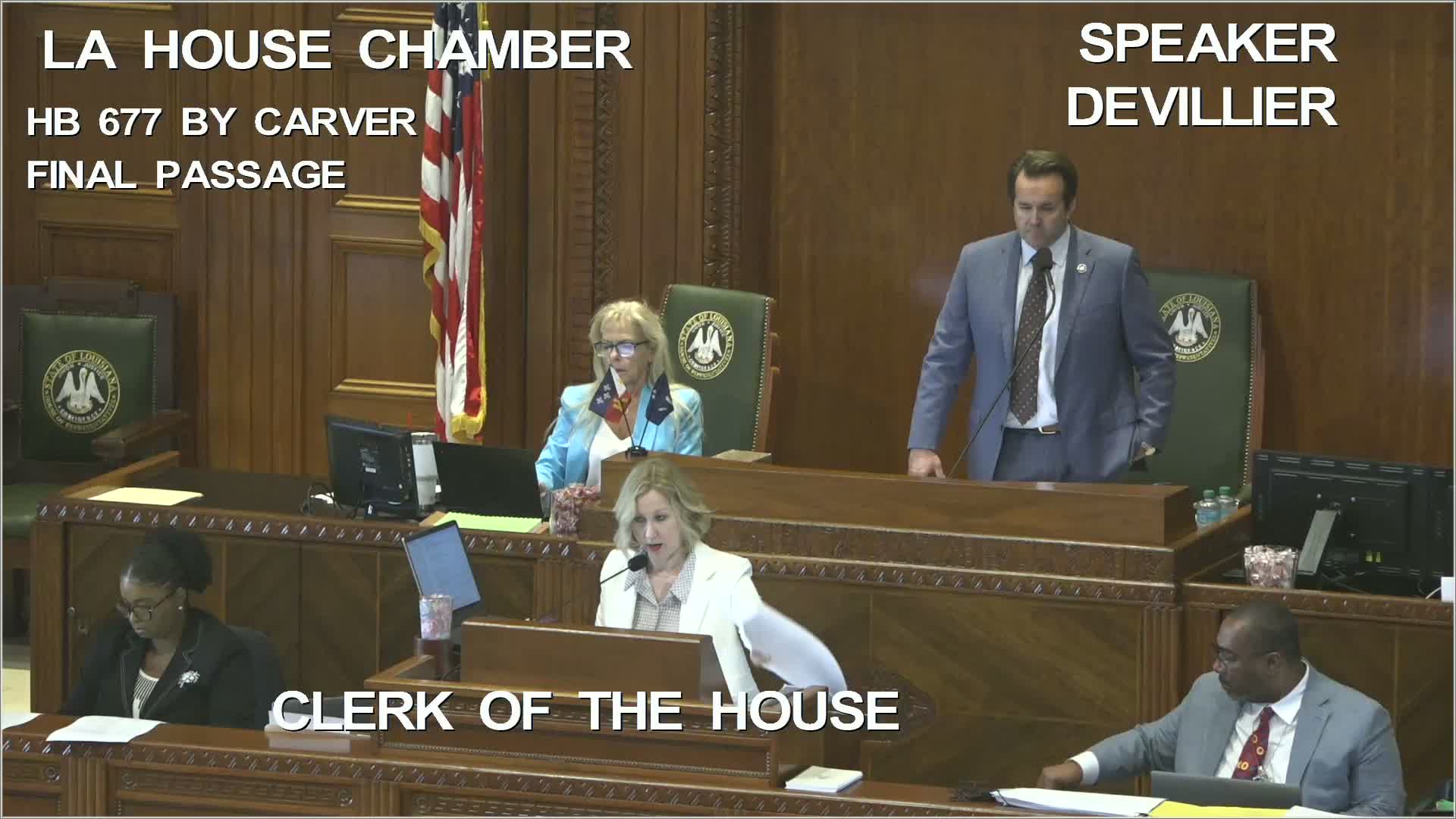
Representative Carver moved final passage of House Bill 6 77 after an extended floor debate over applying Louisiana—s Unfair Trade Practices Act to attorney advertising, a change supporters say will force clearer disclosures of settlement amounts and critics say could conflict with the Supreme Court's disciplinary authority.
Representative Carver moved final passage of House Bill 6 77 after an extended debate over whether attorney advertising should be treated like other business advertising and be enforceable by the state Attorney General.
The bill would revise how Louisiana—s Unfair Trade Practices Act is applied to attorney advertising, requiring ads that state a client—s recovery to either disclose litigation expenses or show the net amount the client received. Representative Carver described the measure as aimed at "truth and holding up truth in our society," saying the goal was to "protect consumers" from misleading ads.
Supporters told colleagues the measure is narrowly tailored to require more transparency in attorney advertisements and to give consumers a clear sense of the financial outcome advertised. Representative Carver said enforcement would follow existing processes under the Unfair Trade Practices Act, with the Attorney General empowered to investigate complaints and seek restitution for injured parties.
Opponents repeatedly raised constitutional and practical concerns. Several members asked whether the bill would interfere with the Supreme Court—s authority over attorney discipline and whether the Office of Disciplinary Counsel or the Louisiana State Bar Association already regulated lawyer advertising. Representative Green pressed on what a complainant—s concrete injury would be from a factual, but potentially misleading, advertisement. Representative Marcel and others raised worries that members of the public could file large numbers of complaints that would require Attorney General resources to pursue.
Carver and supporters cited court precedent they said allows state unfair-practices rules to apply to lawyer advertising while leaving the Supreme Court—s disciplinary authority intact. Carver noted the bill had been vetoed in a prior term and said the veto related to concerns about Article V and the court—s disciplinary jurisdiction.
Members pressed staff and the sponsor on several technical features: a provision treating "each iteration" of an advertisement as a complaint for enforcement purposes; whether paid actors or testimonials would be covered; and a "loser-pays" clause in the enforcement section (page 1, lines 13—16) that would allow the state to recover investigative expenses and attorney fees if it prevailed. Carver said the statute treats attorney ads like other businesses under the Unfair Trade Practices Act and said district attorneys could also enforce the law under the AG—s supervision.
After amendments negotiated in committee, members voted on procedural motions during floor debate (including a failed motion to extend debate) and on the bill itself. The final recorded co-author vote was taken; the transcript does not record a complete final tally for final passage in the floor transcript provided.
Why it matters: Backers say the bill increases transparency for consumers evaluating legal services and closes a perceived gap between commercial advertising and attorney marketing. Critics say it risks overlapping with judicial disciplinary authority, could increase burdens on the Attorney General—s enforcement resources, and may invite frivolous complaints.
What comes next: The transcript shows the sponsor moved for final passage on the floor; the record in this transcript does not include a definitive, block-anchored final roll-call tally for final passage. Implementation questions raised on the floor—including how "iterations" and claims of injury would be handled, and how the AG—s office would resource enforcement—remain outstanding and were discussed at length by members.