Get Full Government Meeting Transcripts, Videos, & Alerts Forever!
Get email alerts on the Campus Plan Wesley Theological Seminary topic
No spam. Unsubscribe anytime.
Wesley Theological Seminary seeks campus‑plan approval for new student housing; commission limits some discussion to further processing
Summary
Wesley Theological Seminary asked the Zoning Commission to approve a revised campus plan that would demolish two residence halls and build a 659‑bed student residence while preserving open space and adding landscaping, a playground and street improvements; the commission limited discussion of off‑site inclusionary zoning and related financial contributions to a later further‑processing filing.
Wesley Theological Seminary asked the Zoning Commission to approve a revised campus plan that would demolish two existing residence halls and the president’s house, construct a new student residence building sited on the current surface parking lot, and add landscaping, a community playground and streetscape improvements along University Avenue.
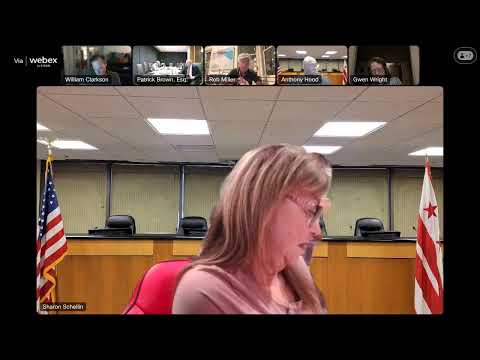
Chairman Anthony Hood opened the virtual hearing and repeatedly instructed parties and the applicant to limit their remarks to the campus plan itself, saying, “We are not hearing any further processing this evening,” and directing that detailed proposals for off‑site inclusionary zoning or an alternate financial contribution be reserved for a further‑processing case for the proposed student housing building.
The seminary’s president, Robert McAllister Wilson, told the commission the campus plan—titled “thrive in place”—is intended to secure the institution’s long‑term presence in the city and to support its educational and outreach activities. Wilson and Reverend Dr. Anthony Sinkfield described a rise in enrollment and student demand for affordable, modern housing and said the plan would allow Wesley to continue its programs and community services.
Landmark Properties, the proposed developer, and the project team presented details of the revised proposal. The new building is described as 659 beds (various unit sizes) with a five‑ to seven‑story stepped massing, a tallest point of roughly 74 feet 8 inches, and two levels of below‑grade parking (approximately 264 spaces) with 77 spaces designated as Wesley replacement parking. The project team said the design eliminated a previously proposed administrative building, increased landscaped area and roof‑mounted sustainability features, and raised the site’s green area ratio (GAR) commitment from the GAR requirement of 0.4 to a proposed 0.6.
Office of Planning (OP) recommended approval of the campus plan with conditions in its report (Exhibit 85) and supported an area‑variance request for a small setback relief of the campus building (subtitle F 203.3). OP’s planner, Maxine Brown Roberts, summarized that the campus plan would be consistent with the Future Land Use Map’s institutional designation and would add on‑campus housing while preserving significant open space on the hilltop campus.
Opposition parties — Neighbors for a Livable Community and the Spring Valley Wesley Heights Citizens Association — and several individual neighbors said they remain opposed. Their written and oral testimony focused on three core concerns: (1) the proposal’s commercial orientation because most beds are expected to be leased to students from neighboring American University (AU); (2) whether that commercial scale is consistent with campus‑plan and Comprehensive Plan standards (including arguments based on recent case law cited by neighbors); and (3) potential objectionable impacts on neighbors and AU (stormwater, parking and traffic, campus security, and long‑term nonconforming risk if the commercial model fails).
Commissioners and parties also questioned enrollment accounting and campus impact: the applicant said Wesley’s historical student cap used a full‑time‑equivalent methodology (715 FTE) but proposed replacing that with a 1,000 headcount cap under current methodology; Landmark asserted the new building would add 659 beds (a net new campus bed count the team described as 569). Several commissioners asked applicants to clarify how those counts translate into daily campus presence, operational impacts and parking demand.
Sustainability and site design drew detailed technical testimony. Architect Jack Borman and civil engineer Sarah Link described the stepped massing to reduce visibility from University Avenue, increased landscape buffering, bioretention and a green roof, solar panels, and a GAR commitment of 0.6. Grove/Slade transportation witness Erwin Andress described a travel‑demand management (TDM) and monitoring commitment and said the team will implement DDOT‑recommended measures (bike racks, revised scooter corral) and a TDM performance monitoring plan.
ANC representatives (ANC 3D and ANC 3E) and a pro‑Wesley neighborhood association testified that the CLC process and ANC engagement produced many refinements; several ANC‑backed conditions require sidewalk installation along University Avenue, added playground access, monitoring of traffic mitigation measures, and the continuation of the community‑liaison committee during implementation.
Legal and plan consistency issues were raised repeatedly. Opponents argued the proposed building’s scale and the applicant’s characterization of the use conflict with the Future Land Use Map and Comprehensive Plan policies for moderate‑density residential areas and cited the D.C. Court of Appeals (Durant) precedent as a caution. The applicant and OP countered that the institutional designation and a narrowly tailored text amendment (Z.C. No. 24‑09) permit the campus plan approach and that site‑specific conditions and further processing will resolve details such as off‑site inclusionary zoning compliance.
Procedurally, the commission accepted many expert witnesses for this continued hearing with some reserves and asked the applicant to supplement missing expert resumes and materials in the record. Chairman Hood emphasized that final conditions related to any alternate inclusionary‑zoning or off‑site contribution must be considered in a separate further‑processing filing for the student housing building and asked parties to avoid mixing that discussion into the campus‑plan hearing to preserve a clear administrative record.
The commission set a schedule for written post‑hearing submissions. The applicant was asked to file a written rebuttal and to clarify which proposed campus‑plan conditions it accepts or wishes to defer to further processing; parties will have the opportunity to respond in writing; the commission anticipates addressing the case at a later public meeting and finalizing the record before deliberation.
Ending: The hearing closed with the commission instructing all parties to exchange the requested written materials on a schedule to be posted in the public record and with the chair reiterating that off‑site inclusionary‑zoning details and many implementation specifics will be resolved at further processing if the campus plan advances.