Get Full Government Meeting Transcripts, Videos, & Alerts Forever!
Get email alerts on the Signage topic
No spam. Unsubscribe anytime.
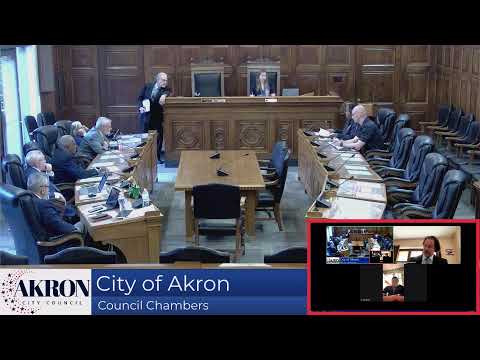
Council committee hears two conditional-use requests for billboards at 800 Flora Avenue
Summary
Kenjo Outdoor requested conditional-use permits for one digital and one static double-sided billboard at 800 Flora Avenue; planning staff and commission recommended approval subject to conditions while council members pressed planners on lighting, spacing and proximity to nearby houses and the interstate.
Kenjo Outdoor asked an Akron City Council planning committee on conditional-use permits to place two double-sided, V-shaped outdoor advertising displays at 800 Flora Avenue, one with digital panels and one externally illuminated, and both reaching an overall height of 65 feet above ground.
The requests were introduced by planning staff. Planning consultant/agent Antonucci said the digital faces would measure 48 feet by 14 feet (672 square feet per face), sit on a 48-inch-diameter steel monopole with a base elevation roughly 10–12 feet above the interstate surface, and would be oriented toward the highway. Antonucci said a lighting study had been submitted and “it is expected that the digital display would comply with national lighting requirements.” He added that the proposal meets most zoning development standards and that both planning staff and the planning commission recommended approval subject to conditions.
At the public hearing, Dan Nielsen, identified as Kenjo Outdoor’s representative, testified in favor. “We bought this property. It was vacant currently. We bought it. We paid the back taxes,” Nielsen said, describing the site as long and parallel to the highway and noting the company already operates several signs in the city and advertises local businesses. Nielsen said the petitioner is working with the state to adjust exact placement of the two displays to satisfy Ohio Department of Transportation spacing rules.
Council members asked specific questions about impacts on nearby houses. Councilwoman Tina Boyse asked whether trees or other measures would help reduce light for residences on Eleventh Street. Antonucci pointed committee members to the lighting study and said at a distance of about 500 feet measured from the sign the predicted illumination was roughly 0.02 foot-candles, which he compared to a typical household 100-watt garage light. He also said the static panel had been moved to increase separation from a nearby house and that state spacing rules constrain where digital signs may be located.
Antonucci and Nielsen both cited state spacing rules in their answers: they noted a minimum 500-foot separation from ramps per Ohio Department of Transportation standards and a separate 1,000-foot spacing requirement for digital structures under state law; Antonucci said the city’s code sets a 660-foot separation from the edge of the primary highway for advertising displays but that conditional-use approvals have established precedents for locating billboards closer in some cases. Planning staff emphasized that final placement would need state approval when permits are finalized.
The committee opened and closed the public hearing for both requests after Mr. Nielsen’s testimony. Planning staff and the planning commission recommended approval of both conditional uses subject to conditions; no formal council decision was taken at this meeting, and the committee will make a recommendation to full council at the 5:00 p.m. session.
Questions from residents or additional testimony were not offered during the committee’s hearing, and committee members requested copies of the lighting study for public review.
Details captured in the planning report and committee discussion include the panels’ dimensions (48 ft × 14 ft; 672 sq ft face), monopole diameter (48 in), overall height (65 ft), predicted illumination at ~500 ft (0.02 foot-candles per the lighting study excerpt), and the petitioner’s reliance on Ohio Department of Transportation spacing rules.