Get Full Government Meeting Transcripts, Videos, & Alerts Forever!
Get email alerts on the Septic To Sewer Vote topic
No spam. Unsubscribe anytime.
Residents press Lake Clarke Shores for vote on septic-to-sewer conversion; council declines immediate straw-ballot motion
Summary
Residents presented a petition and asked the council to permit a resident vote on converting septic systems to sewer. Council members heard multiple requests but a motion to prepare a straw ballot for the 702 affected homes failed for lack of a second.
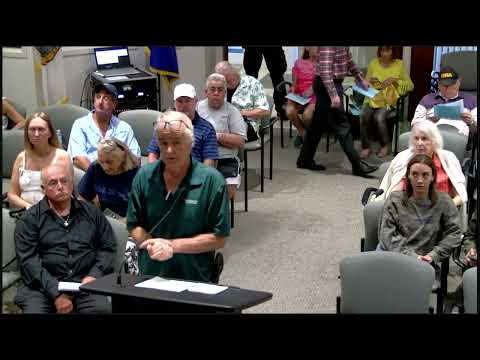
At the Sept. 24 council meeting multiple residents urged the Town Council of Lake Clarke Shores to allow residents to vote on a proposed conversion from septic systems to a centralized sewer system. Speakers cited a petition they said included more than 950 signatures and requested a formal resident vote particularly for the subset of about 702 homes that would bear most of the cost of hookup.
Resident Jen Chanowski told the council, "Please give the 702 homes that will be required to fund the septic to sewer conversion project a vote." Several other residents — including Tim Daughtry and Howard Goldfarb — spoke in favor of a resident vote and asked for more public meetings with specific cost estimates and timelines.
Council and staff response: the town manager said the town held an informational "charrette" with outside experts that is available on the town website; he urged residents to review that material. Town Attorney Charlie explained legal and procedural constraints: "The process is that you would agree to place it on a ballot. And we would have it then on election ballot. I do not recommend you do it as a special election because that will be expensive." He also explained options such as a nonbinding "straw" ballot and that arranging a legally binding, geographically limited ballot raises legal questions about who would be qualified to vote.
Motion and outcome: Council Member Brigitte Keating moved to have a straw ballot prepared for the approximately 702 affected homes; the motion did not receive a second and therefore failed. Council members said they wanted more time to gather legal options and analysis before placing any ballot question before residents.
What was asked for: residents requested both (a) a binding referendum or ballot question limited to affected homes and (b) more public meetings presenting exact cost breakdowns, anticipated duration of construction and likely disruptions. Speakers asked the town to provide specific per-household cost estimates and to explain financing options.
Next steps: councilors and staff agreed to explore the legal pathways and to return with options. The town attorney advised that staff and council can prepare a straw ballot or pursue a binding referendum but that the legal and logistical approach must be carefully designed so it complies with state and local law; staff said they would need more time to present structured options for council consideration.