Get Full Government Meeting Transcripts, Videos, & Alerts Forever!
Get email alerts on the Budget topic
No spam. Unsubscribe anytime.
Methuen school leaders post revised FY26 proposal after weeks of debate as residents, staff urge preserving reading and arts roles
Summary
Superintendent presented a revised FY26 staffing plan that restores several classroom and specialist positions and asks the city for one‑time funds; parents, teachers and students urged the school committee to avoid layoffs of reading specialists, counselors and fine‑arts staff.
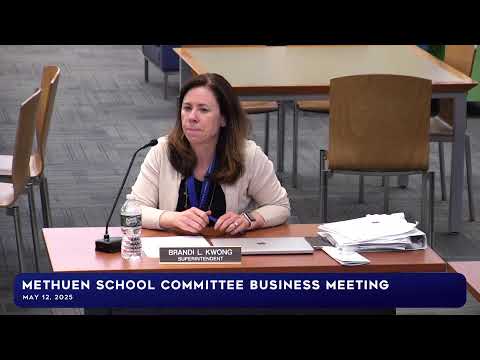
The Methuen School Committee received a revised fiscal year 2026 budget recommendation May 12 and was told the administration will post that plan for the required public hearings while work continues to narrow remaining gaps.
The revised recommendation from Superintendent Dr. Quang restores several positions the district had earlier proposed cutting, but officials said the plan still leaves a shortfall and that further changes will depend on city action and potential state support. The administration asked the city to consider roughly $1.5 million in one‑time funds to reduce layoffs.
Why it matters: Committee members, staff and dozens of speakers at the meeting said proposed cuts to reading specialists, counselors and fine‑arts positions would directly affect student supports and the district’s recovery from pandemic learning loss. Public testimony, teacher feedback and procedural deadlines converged this month as the district prepared to post a budget for the statutorily required public hearing period.
Most important facts first: Superintendent Dr. Quang told the committee the district had reworked the staffing plan after conversations with city leaders and committee members and was prepared to post the revised package to satisfy hearing deadlines. The document restored classroom teachers to keep class sizes for grades 3–8 at 25 or fewer and K–2 generally between 18 and 22. It also restored a reading specialist at each grammar school, an LPN at the Comprehensive Grammar School, an additional custodian at the Tenney and Timoney schools, district behavioral support specialists and two additional core teachers at Methuen High School. The administration described the posted plan as a “living, breathing document” that may change as the city and state decisions are clarified.
Public testimony was emphatic. Shantel Lucas, a reading specialist at the Comprehensive Grammar School, told the committee: “Reading is not a privilege. It's a right,” and urged members to “protect and prioritize all the reading specialist positions.” Bryce Henderson, a lower‑school counselor at the Comprehensive Grammar School, warned that reducing counseling and preventive social‑emotional supports would shift schools from proactive interventions into crisis response: “Do the hard work now so that success can come later.” Student and alumni speakers, including Olivia Wells, president of the Methuen High School theater club Stage Door 22, argued that cutting theater and fine arts staff would remove vital social‑emotional outlets and career pathways for students.
Committee discussion and process: Several committee members said they want to send a full, unfunded budget to the City Council so the council can vote and the community can see the tradeoffs; others said submitting a clearly out‑of‑balance budget would create unrealistic expectations. Member Donovan urged the committee to use the statutory budget process and to let the council decide tradeoffs. Member Willett and others noted that state budget changes — including potential Chapter 70 and circuit‑breaker adjustments — were still in flux and could alter local revenues.
Numbers and scope: The administration said the revised plan cut the previously cited high layoff estimate substantially. The staffing chart presented during the meeting estimated roughly 19 Unit A layoffs (an estimate that could change with retirements, resignations and bid processes), two full Unit B layoffs, and a set of Unit C vacancies; the administration noted that 16 Unit B bargaining employees (BBEs) would be offered program‑assistant positions in the district. The administration estimated the additional annual cost to adopt the newly recommended K–4 literacy package (see separate story) would be about $181,000; current combined costs for the district’s reading/phonics/software stack are roughly $177,000. The administration requested about $1.5 million in one‑time city funding to reduce the gap between the posted school budget and the city’s proposed contribution.
Actions and next steps: The superintendent recommended posting the revised FY26 staffing and budget materials to meet public‑hearing deadlines; the committee did not take a final vote on the budget that night. The committee did vote on other agenda items: it approved the 2025–26 calendar (the committee adopted the version labeled Draft 1 after a separate vote), created a Budget Finance subcommittee and a Redistricting subcommittee, and later adjourned into executive session on collective‑bargaining matters.
What advocates said they want next: Teachers, reading specialists, counselors, parents and students urged the committee to pursue all available sources — city one‑time funding, state supplemental dollars, and grants — to avoid layoffs. Many speakers also asked the committee and mayor to hold joint hearings with city councilors and to pursue longer‑term budget reforms to prevent recurring crisis cycles.
Community context and constraints: Committee members repeatedly said the ultimate outcome depends on a combination of municipal appropriations, state budget actions (including Chapter 70 and circuit‑breaker adjustments) and contractual obligations under multiple bargaining units. The superintendent noted legal timelines for notifications (including the June 15 deadline for some notices) and said posting a budget satisfies public‑hearing requirements but does not lock the district into a final layoff list.
Taper: The administration and committee left the posted proposal open to change and signaled they will use the scheduled public hearings and follow‑up discussions with the mayor and city council to try to close the remaining gap. Residents and staff asked the committee to prioritize restoring specialist roles, keep class sizes lower where possible, and explore one‑time funding and grants before cutting positions.