Get Full Government Meeting Transcripts, Videos, & Alerts Forever!
Get email alerts on the Climate Vmt Ghg topic
No spam. Unsubscribe anytime.
Sumner study session previews VMT and greenhouse gas reduction plan; council to consider resolution June 16
Summary
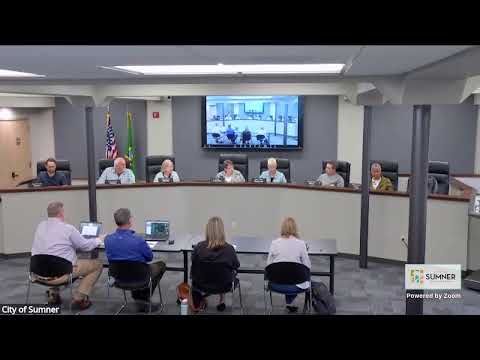
Sumner's Community Economic Development Director Ryan Windisch and consultants presented a vehicle miles traveled (VMT) and greenhouse gas (GHG) reduction plan at the May 12 study session and said the plan will return for council action June 16 with a resolution.
Sumner's Community Economic Development Director Ryan Windisch and consultants from Parametrics and Transpo presented a vehicle miles traveled (VMT) and greenhouse gas (GHG) reduction plan at the May 12 study session, and told the council the plan will return for formal action June 16 with a resolution.
"You have to. It's a legal requirement. You're mandated by state law to make these updates and to include this in your comprehensive plan," said Maddie Bueno, project manager with Parametrics, referring to House Bill 1181 and the state requirement to include a climate element in the city's comprehensive plan.
Consultants described the technical findings: Sumner's travel demand model shows a driving mode share of 92%; about 20% of residents commute 45 minutes or longer; and roughly 30% of vehicle miles on city streets are cut-through trips not originating or ending in Sumner. The team calculated a 2023 per-capita VMT baseline of 6.51 and recommended targets of a 10% reduction by 2035 and a 13% reduction by 2045 compared with that baseline. Consultants grouped recommended measures into tier 1 strategies—largely already in the city's comprehensive plan, such as increased density, transit-oriented development near the Sounder station, integration of affordable housing, commute trip reduction, limiting parking supply, and pedestrian/bicycle network improvements—and tier 2 strategies that would require new policy decisions, such as parking pricing.
Beth Miller of Transpo presented the GHG inventory and scale: "So for the city of Sumner, you produced about 87,000 metric tons of c o 2 e and greenhouse gas emissions, in 2022," she said. She summarized the inventory breakdown (downscaled from Pierce County): building energy accounts for about half of emissions; transportation roughly 40% (passenger vehicles the majority, freight about 6%, off-road and rail about 10%); and the remainder from solid waste, wastewater and refrigerants.
The consultants noted several constraints and clarifications that shaped the plan: trucks and freight are not the focus of state VMT targets (truck VMT is tied to economic activity), cut-through traffic is largely outside city control and must be handled through regional coordination, and reductions in per-capita VMT assume implementation of the adopted comprehensive plan land-use strategies. Consultants also flagged that many statewide policies and market forces (for example, the Clean Energy Transformation Act and zero-emission vehicle rules) will reduce emissions over time, leaving remaining emissions where city-level strategies are most relevant (notably natural gas in buildings and diesel for heavy equipment and freight).
City levers identified in the plan include permitting incentives (fee reductions for energy- or GHG-reducing actions), municipal fleet electrification and procurement plans, education and outreach, targeted infrastructure investments to improve walkability and transit access, and monitoring metrics such as per-capita VMT, transit ridership, miles of pedestrian and bicycle infrastructure, utility energy sales (kWh and therms), and annual GHG inventories.
Councilmembers asked technical and policy questions during the discussion: about how VMT is estimated (census data, a travel demand model derived from the Puget Sound Regional Council model and local traffic counts), the role of traffic calming for cut-through traffic, implications for parking policy at the Sounder station, cost considerations for electrification and building upgrades, battery life and disposal concerns, and the limited GHG impact of tree-planting compared with other strategies.
What happens next: Windisch said the VMT and GHG reduction plan will return to the council June 16 with a resolution for formal approval and implementation planning.